
What Is Coffee Badging – Meaning, Trends And Workplace Impact
Coffee badging means swiping your badge just to mark presence, often during quick coffee breaks, rather than for genuine work engagement. This trend, rising sharply in 2024, exposes tensions in hybrid workplaces where presence is monitored but meaningful collaboration suffers.
Managers badging more than employees highlight role-based disparities. The practice erodes trust, lowers morale, and shifts focus from productivity to appearances.
Exploring its roots and consequences can reveal how companies are tackling this challenge and fostering authentic engagement.
What Is Coffee Badging and Why It Matters

What drives employees to practice coffee badging, and why should you care? Coffee badging is when employees briefly enter the office to swipe their badge, grab coffee, and leave. This behavior has become a notable response to return-to-office mandates amid hybrid work challenges.
You’ll find that 44% of US employees admitted to this behavior in 2024, showing it’s pretty common. It’s often motivated by a feeling that being physically present is more about appearances than actual productivity.
This trend can hurt workplace culture by reducing genuine interaction and collaboration. Those things are really important for keeping employees engaged.
If you want a thriving hybrid work environment, it’s important to address coffee badging. It reflects deeper issues with how presence and performance are valued and can erode trust and meaningful connection within your team.
Coffee Badging and 2024 Hybrid Work Trends
Although hybrid work models aim to balance flexibility and collaboration, coffee badging remains a widespread practice in 2024. About 44% of US employees admit to it, and similar rates are seen internationally. This behavior highlights ongoing tensions in hybrid work trends, where just showing up at the workplace still holds symbolic importance.
In 2024, nearly half of employees use coffee badging, revealing persistent office presence pressures in hybrid work models.
You’ll notice many people use brief office visits to signal their presence. They’re basically maneuvering around office policies that often tolerate coffee badging. This definitely impacts how remote work is perceived and managed.
Think about these emotional drivers behind coffee badging: first, the fear of being overlooked or undervalued by supervisors. Then, there’s the pressure to conform to traditional office norms, even though hybrid work offers flexibility. And finally, the desire to maintain team connections and keep professional visibility.
Understanding these factors helps you see why coffee badging sticks around, even as hybrid workplace dynamics continue to evolve.
Who Coffee Badges Most and Why
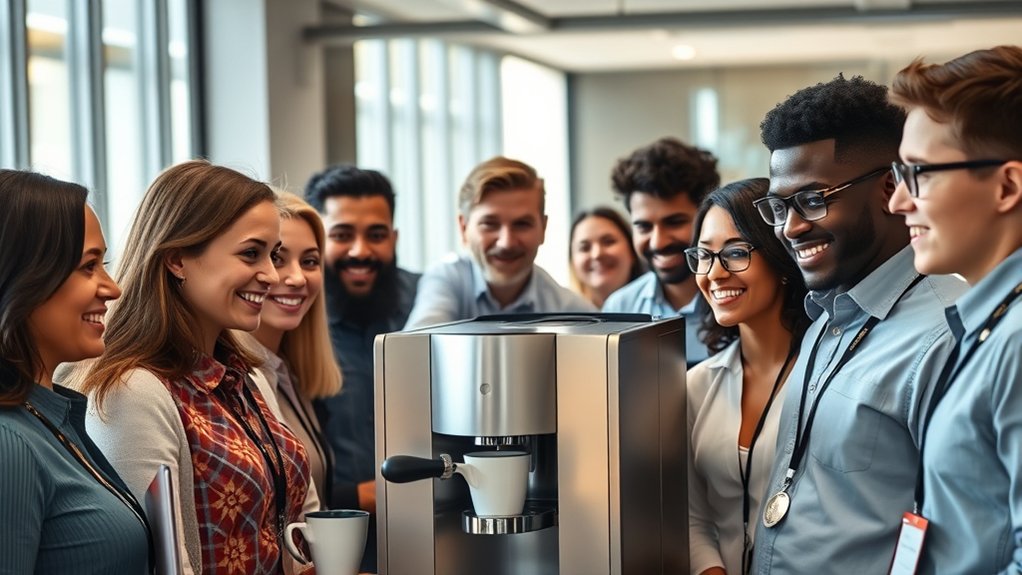
The persistence of coffee badging in hybrid work environments raises questions about who engages in this behavior most frequently and why. Data shows that managerial roles participate in coffee badging at a markedly higher rate, nearly 47% compared to 34% for non-managers.
This difference highlights key role-based differences in workplace autonomy and office attendance flexibility.
Managers generally enjoy greater autonomy and can navigate hybrid work schedules with more freedom, enabling brief, purposeful office visits. In contrast, individual contributors often face stricter oversight and less flexible arrangements. This reduces their opportunity to coffee badge.
These patterns suggest that coffee badging reflects not just individual choice but structural variations in how organizations balance remote work and in-person presence across different roles.
Understanding this dynamic helps clarify why leadership more commonly adopts coffee badging practices.
Psychological Reasons for Coffee Badging
Since coffee badging often arises in response to perceived constraints, it reflects a psychological pushback known as reactance. This is where employees try to reclaim autonomy by making brief office visits. It’s a way to resist workplace policies that feel restrictive or like a violation of the psychological contract.
You might find yourself engaging in coffee badging to subtly oppose mandates without causing a big scene. There are three core psychological reasons behind this behavior:
- Protecting your sense of autonomy against imposed schedules.
- Expressing dissatisfaction through low-risk symbolic resistance.
- Maintaining preferred routines due to status quo bias.
Rooted in evolutionary psychology, this behavior echoes ancient survival-driven resistance to control. Understanding these psychological drivers helps reveal how coffee badging acts as a nuanced response to workplace constraints.
It’s all about balancing compliance with personal freedom.
Consequences of Coffee Badging

You’ll notice that coffee badging can really chip away at workplace trust. It tends to make people suspicious about whether employees are actually present or just going through the motions.
On top of that, it makes enforcing policies a bit tricky because it’s harder to tell who’s genuinely attending and who’s just doing a quick check-in.
In the end, this kind of behavior hurts collaboration and can weaken team dynamics and overall productivity.
Workplace Trust Erosion
When employees spot coffee badging as a way to navigate rigid attendance policies, they often start questioning the fairness and trustworthiness of management. This perception triggers workplace trust erosion, undermining the psychological contract and organizational norms.
You’ll notice trust dwindling as coffee badging becomes common, signaling skepticism about enforcement and fairness.
This erosion impacts employee perception deeply, leading to disengagement and fractured culture.
You might experience:
- Reduced loyalty as employees feel their commitment isn’t reciprocated.
- Lower morale stemming from perceived mistrust and superficial office interactions.
- Increased turnover risks due to damaged relationships and weakened collaboration.
Understanding this dynamic helps you appreciate how coffee badging subtly erodes trust.
Ultimately, it harms organizational cohesion and long-term success.
Policy Enforcement Challenges
Although organizations implement attendance policies to guarantee productivity and accountability, coffee badging poses significant enforcement challenges by creating loopholes that employees exploit. You’ll find that badging can distort attendance data, making it difficult to assess true office presence, especially in hybrid work models.
Even though access control systems catch about 70% of these attempts, employees often adjust their behavior to bypass detection.
Strict policy enforcement without considering employee autonomy risks breeding resentment, encouraging covert badging and non-compliance.
Furthermore, heavy-handed measures can erode trust and morale. This might increase turnover and reduce engagement.
To manage these challenges effectively, you must balance rigorous attendance monitoring with flexibility and trust.
Make sure your policies reflect the realities of hybrid work while maintaining accountability. It’s all about finding that sweet spot where rules make sense and people feel respected.
Impact on Collaboration
Balancing attendance policies while respecting employee autonomy addresses some enforcement challenges, but coffee badging still undermines workplace dynamics in other ways. It reduces your office presence to superficial visits, limiting spontaneous interactions that boost collaboration and team cohesion.
When you spend nearly half your in-office time on non-essential activities, meaningful workplace engagement suffers. This shift diminishes opportunities for creative brainstorming and knowledge sharing, which are critical for effective teamwork.
Consider these impacts:
- You lose chances for authentic relationship-building essential to team cohesion.
- Collaboration turns transactional, lacking depth and innovation.
- Workplace engagement declines, weakening overall productivity and morale.
Ultimately, coffee badging promotes attendance over authentic collaboration and erodes the rich, interactive environment your team needs to thrive.
How Companies Are Addressing Coffee Badging
How do companies effectively tackle coffee badging to maintain workplace integrity? They leverage badge logs and access control systems to monitor office occupancy and detect suspicious patterns. With 70% of coffee badging cases caught through access analytics, workplace monitoring proves essential.
Organizations also enhance attendance policies, clearly communicating expectations to reduce ambiguity. The rise of hybrid work challenges traditional oversight, prompting a 46% increase in employee tracking software adoption to guarantee genuine presence without infringing privacy.
By analyzing access data and attendance inconsistencies, companies identify and address loopholes systematically.
Furthermore, fostering flexible schedules and engaging work environments indirectly diminish coffee badging by encouraging authentic office engagement rather than performative attendance.
Through these strategies, you can maintain fairness and transparency in your workplace while adapting to evolving work models.
Practical Ways to Reduce Coffee Badging at Work
When you implement flexible scheduling and leverage access control data, you create a foundation to reduce coffee badging effectively.
In hybrid work environments, thoughtful workplace policies can enhance in-office attendance and employee engagement authentically.
Consider these practical steps:
- Allow employees to select in-office days, minimizing performative presence and fostering trust.
- Analyze access control data to identify coffee badging patterns, enabling targeted interventions.
- Offer engaging activities and perks that motivate genuine participation, reinforcing meaningful in-person interactions.
Impact of Coffee Badging on Culture and Productivity
You might notice that coffee badging actually creates barriers to genuine collaboration. Instead of having meaningful interactions, people just make brief appearances in the office.
This kind of behavior can really skew how we see productivity, making it all about being present rather than the actual work getting done.
When you think about it, understanding these dynamics helps shed light on the subtle ways coffee badging reshapes workplace culture and efficiency.
Collaboration Challenges
Although coffee badging might seem like a harmless way to maintain a presence in the office, it often disrupts genuine collaboration by reducing spontaneous interactions. When employees focus on brief, superficial office visits to appear engaged, the depth of team bonding and employee engagement suffers.
This habit weakens your workplace culture, especially in hybrid work environments where meaningful connection is already challenging. You might notice:
- Collaboration declines as spontaneous idea-sharing diminishes.
- Relationships become transactional, eroding trust and cohesion.
- The office feels fragmented, undermining collective motivation.
These collaboration challenges mean your organization risks lower overall performance because coffee badging prioritizes appearance over authentic engagement. To build a resilient workplace culture, you need to foster genuine interactions rather than encourage insincere office presence.
Productivity Perceptions
The collaboration challenges posed by coffee badging extend into how productivity is perceived and measured within organizations. Coffee badging often cultivates a work culture centered on appearances rather than meaningful output, leading to reduced employee engagement and productivity.
You might notice employees spending nearly half their time on non-essential tasks, which skews productivity metrics and undermines workplace trends aimed at efficiency. This superficial presence diminishes organic collaboration, *vital* for innovation and morale.
| Aspect | Impact of Coffee Badging | Resulting Workplace Effect |
|---|---|---|
| Productivity | Decreased due to inefficiency | Lowered work output |
| Employee Engagement | Reduced by disengagement | Weakened team cohesion |
| Work Culture | Focus on presence over work | Superficial collaboration |
Understanding these dynamics helps you address productivity perceptions accurately. It’s important to look beyond surface-level metrics and focus on meaningful measures of success.
Manager vs. Employee Coffee Badging Habits
When managers enjoy greater autonomy and flexibility, they’re more likely to engage in coffee badging, with nearly 47% participating compared to 34% of non-managers. This trend highlights how role-based flexibility shapes coffee badging habits and underscores disparities in workplace attendance policies.
Managers’ greater flexibility leads to higher coffee badging rates, revealing role-based attendance disparities.
As a manager, your coffee badging behavior can inadvertently influence employee habits, setting unspoken norms about in-office presence. Understanding these dynamics helps you navigate evolving workplace trends effectively.
Consider these implications:
- Managers’ frequent coffee badging may create perceptions of leniency in attendance, impacting team morale.
- Employees might feel pressured to match managerial flexibility, causing inconsistencies in adherence to attendance policies.
- Recognizing these differences allows you to address potential fairness issues and align expectations across roles.
Building Engagement to Reduce Coffee Badging
You can cut down on coffee badging by creating a workplace where trust is at the core. When people feel truly valued and connected, they’re more likely to be genuinely engaged instead of just clocking in.
Building that kind of trust helps everyone focus less on showing up for appearances and more on being meaningfully involved.
Enhancing Workplace Trust
Although coffee badging can seem like a minor issue, it often signals deeper trust and engagement problems within the workplace. To enhance trust and improve office attendance in a hybrid work setting, you need transparent communication and flexible workplace policies.
When employees feel valued and experience meaningful in-office benefits, their motivation for performative presence decreases. You can foster employee engagement by addressing dissatisfaction and modeling authentic behavior as a leader.
Consider these key actions:
- Promote open dialogue about expectations and concerns to build trust.
- Design in-office experiences that offer real value beyond mere presence.
- Implement flexible policies that respect employees’ work-life balance.
Promoting Genuine Presence
Building genuine presence in the workplace requires more than flexible policies and open communication. It demands creating an environment where employees find clear value in coming to the office.
In hybrid work, fostering authentic workplace culture and employee engagement directly reduces coffee badging by making office attendance purposeful. You can encourage genuine presence by offering amenities, social activities, flexible scheduling, and leadership that models real engagement.
Data-driven workspace optimization also enhances in-person collaboration and professional growth opportunities, increasing meaningful office time.
| Strategy | Impact on Engagement | Effect on Office Attendance |
|---|---|---|
| Flexible Scheduling | Increases autonomy | Reduces performative visits |
| Amenities & Social Events | Enhances social connection | Encourages genuine presence |
| Leadership Modeling | Sets cultural expectations | Promotes consistent presence |
| Workspace Optimization | Improves collaboration | Fosters purposeful visits |
| Professional Development | Boosts motivation | Increases meaningful time |
Frequently Asked Questions
How Does Coffee Badging Affect Employee Health and Well-Being?
Coffee badging negatively affects your health and well-being by increasing stress and anxiety. You feel pressured to be physically present without meaningful interaction. It really takes a toll on you.
It also disrupts your work-life balance, which can lead to burnout and fatigue. This kind of behavior reduces your social support and sense of belonging. That’s a big deal because those connections are important.
Plus, coffee badging limits physical activity and genuine connection, both of which are essential for mental health. Overall, it can leave you feeling disengaged and less satisfied at work. It’s definitely not good for you.
Are Certain Industries More Prone to Coffee Badging?
You’ll notice that creative industries, like marketing and media, are more prone to coffee badging, with up to 50% of employees engaging in brief in-office visits. This trend reflects flexible work schedules and the need for occasional in-person collaboration.
In contrast, sectors such as finance and law show lower rates due to their demand for consistent physical presence. It really highlights how industry demands shape coffee badging behavior.
What Role Does Office Design Play in Coffee Badging?
Office design heavily influences coffee badging by shaping your experience and motivation to stay. If your workplace feels cramped, noisy, or unwelcoming, you’re more likely to make brief, performative visits just to appear present.
But when your office offers comfortable, functional spaces with private workstations and social zones, it encourages genuine engagement. Thoughtful design aligns with your hybrid work needs, reducing the urge for superficial attendance and fostering authentic in-person collaboration.
Can Technology Help Detect or Prevent Coffee Badging?
Think of technology as a lighthouse guiding you through the fog of workplace attendance. Yes, it can detect and prevent coffee badging by using access control systems and real-time analytics to monitor who’s truly present.
Features like zone-based access and occupancy data help you identify unauthorized visits swiftly.
How Do Labor Laws Impact Coffee Badging Policies?
Labor laws shape how you enforce coffee badging policies by setting boundaries on employee monitoring and data use. You must comply with privacy regulations like GDPR or the FLSA, which require transparency and often explicit consent before tracking badge data.
These laws protect workers from covert surveillance and unfair penalties. So, you have to balance productivity goals with respecting legal limits and employee rights when designing or updating your attendance monitoring systems.
Conclusion
You might notice coffee badging blending into your daily routine like steam swirling from a morning cup—subtle but telling. This habit reflects deeper workplace dynamics shaped by hybrid trends and psychological needs. Recognizing its patterns lets you address disengagement before it seeps into culture and productivity.
By fostering genuine connection and clear communication, you can transform those fleeting coffee breaks from mere badges into meaningful engagement. This can reshape your work environment for the better.