How Many Tablespoons In A Coffee Scoop – Measurement Guide
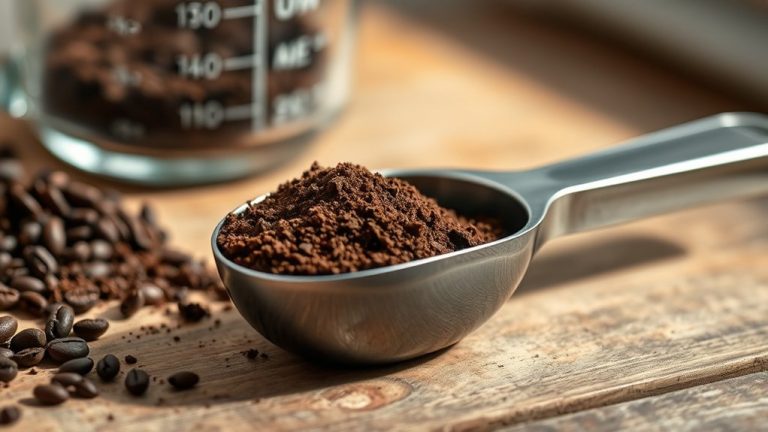
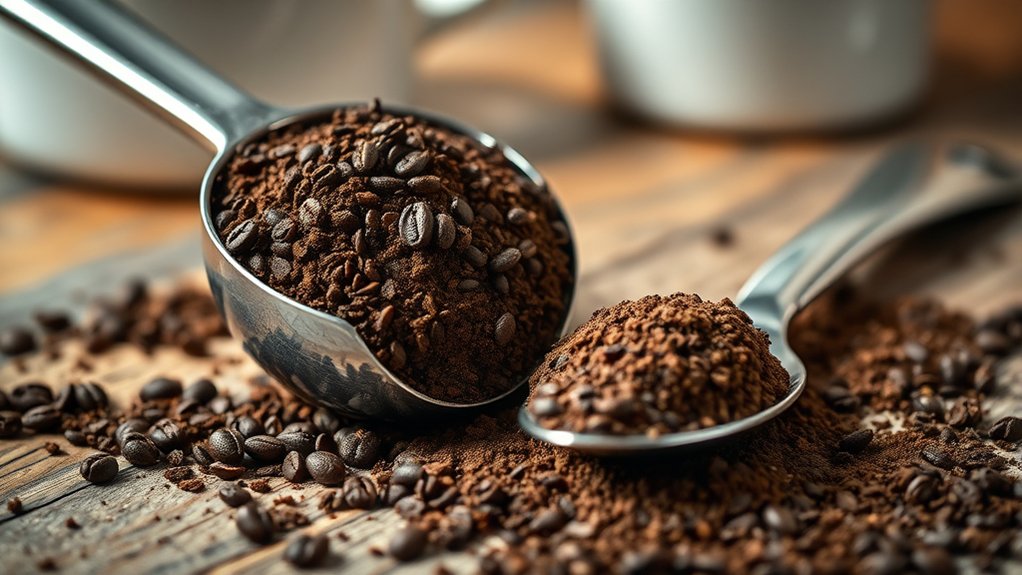
A standard coffee scoop typically holds about 2 tablespoons of ground coffee, roughly 10 grams depending on grind size and density. However, scoop sizes can vary between brands, so verifying with a measuring spoon or scale improves accuracy.
Since grind coarseness affects volume, relying on weight ensures consistency and better flavor control. Adjusting scoop amounts based on brewing method also fine-tunes strength.
Understanding these details helps you optimize your coffee extraction and taste balance throughout your brewing process. It’s a simple step that can make a big difference in your cup.
What Is a Coffee Scoop and How Much Does It Hold?
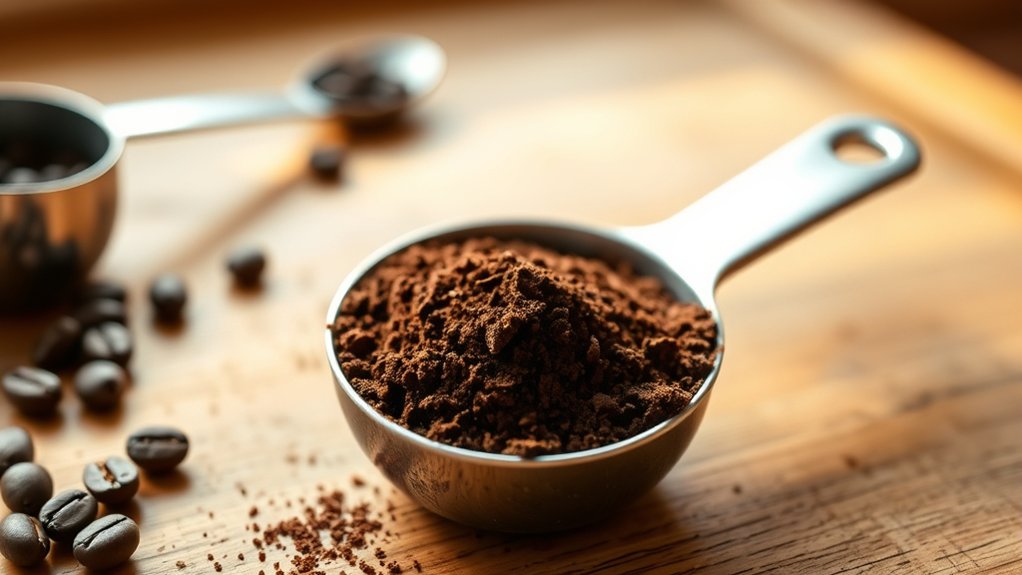
How much coffee does a standard scoop actually hold? Typically, it contains about 2 tablespoons of ground coffee, which translates to roughly 10 grams depending on grind size and density. Since coffee scoop sizes vary, you should verify your scoop’s exact capacity for precise measurement.
Using a consistent scoop size guarantees brewing consistency. This helps you control flavor extraction alongside factors like brewing temperature.
Proper coffee storage also plays a crucial role. Freshly ground coffee stored correctly maintains its flavor profile, which your scoop measurement complements.
How Many Tablespoons Are in a Standard Coffee Scoop?
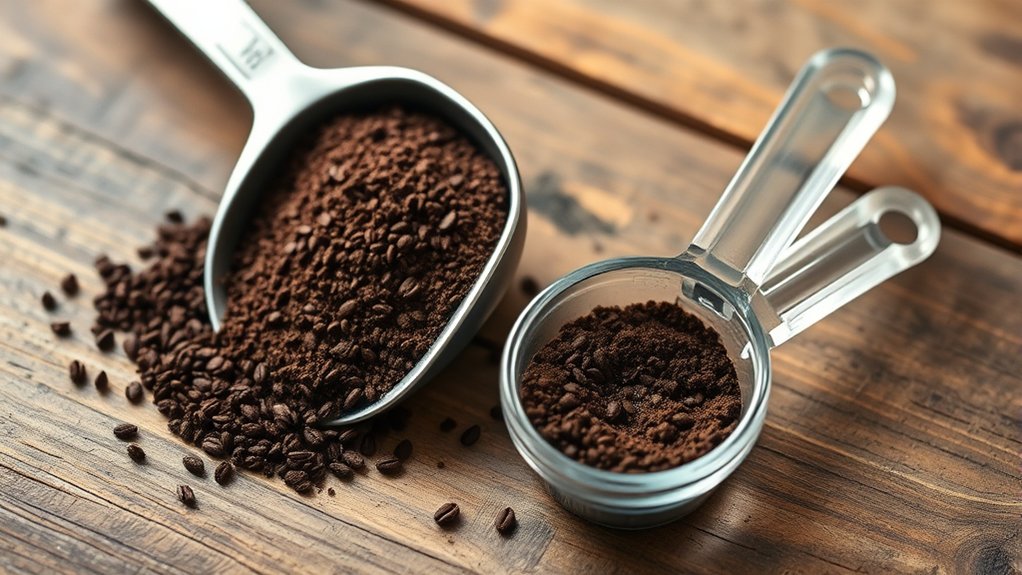
Although coffee scoop sizes can vary slightly, you’ll find that a standard coffee scoop holds about 2 tablespoons of ground coffee. This measurement equates to roughly 10 grams, ensuring precision when you’re aiming for consistent coffee-to-water ratios.
By using a standard scoop, you maintain control over variables like brewing temperature, which greatly impacts extraction quality.
Proper coffee storage preserves the grounds’ freshness, but consistent scooping guarantees the amount you use remains steady, optimizing flavor regardless of storage conditions.
If you don’t have a scoop, measuring 2 tablespoons with a kitchen spoon replicates the volume accurately.
This consistency is essential for achieving balanced brews, as variations in scoop size could lead to under- or over-extraction, especially when brewing temperature and coffee storage conditions are carefully managed.
How Scoop Size Variations Affect Your Coffee Brew
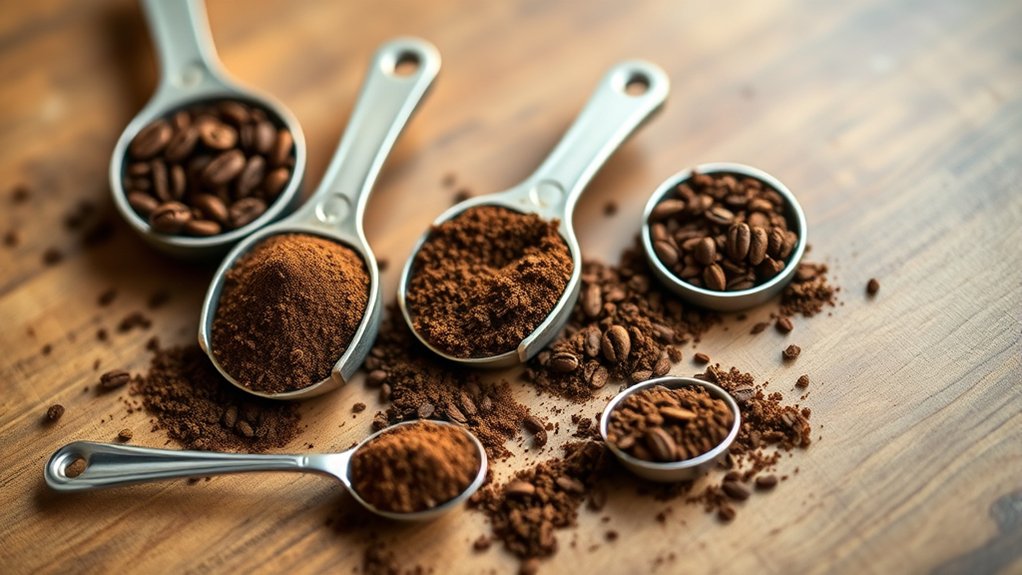
Since coffee scoop sizes vary widely, from as little as 1 tablespoon to as much as 3 tablespoons, using the wrong scoop can really change your brew’s strength and flavor. Different scoop sizes affect extraction rates. These rates then interact with coffee bean origins and brewing temperature to influence taste.
For example, a larger scoop can lead to over-extraction, which often makes the coffee bitter. This is especially true with delicate beans from high-altitude regions. On the other hand, a smaller scoop might cause under-extraction, resulting in a weak cup.
| Scoop Size (tbsp) | Brew Strength | Recommended Action |
|---|---|---|
| 1 | Weak, under-extracted | Increase scoop size or adjust temperature |
| 2 (standard) | Balanced flavor | Maintain standard brewing |
| 3 | Strong, over-extracted | Reduce scoop size or lower temperature |
Comparing Coffee Scoops and Tablespoons: What’s the Difference?
You’ll find that a standard coffee scoop holds about 2 tablespoons of ground coffee, so it’s bigger than just one tablespoon. Scoop sizes can vary a bit, but many are made to give you a consistent measure every time. That way, your brew stays accurate.
And if you don’t have a scoop on hand, using tablespoons is a handy and practical alternative to measure your coffee just right.
Scoop Versus Tablespoon
When measuring ground coffee, knowing the difference between a coffee scoop and a tablespoon can really impact how consistent your brew turns out.
A coffee scoop usually holds about 2 tablespoons of coffee. This gives you a fixed and reliable measure that helps keep your coffee fresh by avoiding overuse or waste.
On the other hand, a tablespoon is a general kitchen measurement, roughly 5 grams, but its volume can vary a bit depending on what you’re measuring.
Using a coffee scoop ensures precision, which directly affects the balance of brewing temperature and extraction quality.
If you use a tablespoon instead, slight variations may change the coffee-to-water ratio. That could lead to inconsistent strength and flavor.
Standard Scoop Volume
Although coffee scoops vary slightly by brand, a standard scoop typically holds about two tablespoons of ground coffee, equating to roughly 10 grams. This volume is critical because the amount of coffee directly influences the coffee flavor and extraction quality.
When measuring grounds, you’ll notice that one tablespoon usually weighs around 5 grams, so two tablespoons align closely with the scoop’s capacity.
However, since scoop sizes aren’t universally standardized, it’s wise to verify your specific scoop’s volume for precision. Accurate measurement affects not only flavor but also brewing temperature stability.
Using the right amount of coffee grounds guarantees the water temperature remains ideal during brewing, preserving the desired taste profile.
Measuring Without Scoops
Measuring coffee grounds accurately can be challenging without a dedicated scoop, especially since scoop sizes vary across brands. A standard coffee scoop holds about 2 tablespoons or roughly 10 grams, but this isn’t universal.
When you don’t have a scoop, using tablespoons becomes an effective alternative; one tablespoon equals about half a scoop or 5 grams. Because coffee scoops are designed specifically for coffee grounds, they often provide more consistency, which directly impacts coffee flavor and brewing time.
Using tablespoons may introduce slight variations, but with a precise measuring spoon, you can maintain repeatable results. This precision guarantees your coffee flavor stays balanced and brewing time remains consistent, avoiding under- or over-extraction that can spoil your cup.
Converting Coffee Scoops to Tablespoons Made Easy
A standard coffee scoop holds about 2 tablespoons, so you can easily convert scoops to tablespoons by just multiplying by two.
When measuring, make sure to fill the scoop and level it off—that way, you get a consistent amount every time.
Just remember, scoop sizes can vary, so it’s a good idea to double-check how much your scoop actually holds to keep your coffee measurements precise.
Standard Scoop Volume
When you want to convert coffee scoops to tablespoons, understanding the standard scoop volume is essential. A typical coffee scoop holds about 2 tablespoons of ground coffee. Despite minor variations among manufacturers, this volume remains consistent enough for practical use.
Knowing this helps you control your coffee storage amounts and adjust your brewing temperature accurately for ideal extraction.
Since 1 scoop equals roughly 2 tablespoons, simply multiply your scoops by 2 to get the equivalent tablespoon measure.
To guarantee precision, use a measuring spoon or scale to verify your scoop’s exact volume.
This attention to detail supports consistent coffee strength and flavor, making your brewing process more reliable and tailored to your taste preferences.
Tablespoons To Scoops
Although coffee scoop sizes can vary, converting tablespoons to scoops is pretty straightforward once you know the standard volumes. One scoop usually equals 2 tablespoons of ground coffee. Since coffee flavor depends on precise measurements and brewing temperature, using tablespoons for accuracy helps keep things consistent.
To convert tablespoons to scoops, just divide the tablespoon amount by 2.
| Tablespoons | Scoops |
|---|---|
| 2 | 1 |
| 4 | 2 |
| 6 | 3 |
This simple conversion makes sure you maintain the right coffee-to-water ratio. That ratio influences extraction quality and how well you control brewing temperature. Measuring in tablespoons helps you get the best flavor and consistency every time.
Accurate Coffee Measurement
Since one coffee scoop generally holds about two tablespoons of ground coffee, converting scoops to tablespoons becomes a straightforward calculation. You simply multiply the number of scoops by two to get the equivalent tablespoons.
For instance, if a recipe calls for 1 tablespoon, use half a scoop; for 2 tablespoons, use a full scoop.
However, scoop sizes can vary, so measuring your scoop’s capacity with a tablespoon or scale guarantees accuracy.
Consistency in measurement is vital for maintaining uniform coffee strength and flavor.
Remember, precise coffee storage preserves freshness, which impacts taste.
Controlling brewing temperature optimizes extraction.
Combining accurate measurements with proper storage and brewing conditions guarantees a balanced and satisfying cup every time.
How Brewing Method Affects Tablespoons Per Scoop
Because brewing methods demand different coffee-to-water ratios, you’ll need to adjust the tablespoons per scoop accordingly to achieve ideal flavor and strength.
Adjust tablespoons per scoop to match brewing methods for optimal coffee flavor and strength.
For instance, drip coffee commonly requires 1-2 tablespoons per 6 oz, while French press leans toward 2 tablespoons per 6 oz to optimize extraction at a controlled brewing temperature.
Espresso uses weight measurements, about 18-20 grams, which is roughly 3-4 tablespoons, ensuring concentrated flavor.
Cold brew, with its lower brewing temperature, demands a higher coffee-to-water ratio—approximately 16 tablespoons per batch—to extract rich coffee flavor over an extended steeping period.
Tailoring tablespoons per scoop by brewing method lets you precisely control strength and extraction.
This ultimately enhances your coffee’s flavor profile and makes sure it’s consistent with your preferred brewing temperature.
How Grind Size Changes Coffee Measurement by Tablespoons
When you change grind size, you directly affect how much coffee fits into a tablespoon, which alters the brew’s strength and flavor balance. Grind consistency impacts coffee density. Finer grounds pack more densely while coarser grounds are less dense and take up more space. This difference affects volume measurements by tablespoons.
Here’s the deal: finer grinds increase coffee density, so a tablespoon holds more mass. That can risk over-extraction if you don’t adjust.
On the flip side, coarser grinds reduce density, meaning you need more volume for the same strength or risk under-extraction.
Using a scoop without thinking about grind consistency can lead to inconsistent flavor because of these volume differences.
Adjusting Tablespoons for Your Preferred Coffee Strength
Understanding how grind size affects coffee measurement by volume sets the stage for fine-tuning your brew strength through precise tablespoon adjustments.
To enhance coffee flavor, increase tablespoons. Using 1.5 to 2 per 6-ounce cup yields bolder coffee. Decrease to 1 to 1.5 for a milder taste.
Brewing temperature remains critical, but adjusting grounds quantity directly influences intensity. Since 1 coffee scoop equals about 2 tablespoons, small changes markedly impact strength.
| Coffee Strength | Tablespoons per 6 oz | Expected Flavor Intensity |
|---|---|---|
| Light | 1 – 1.5 | Mild, subtle |
| Medium | 1.5 | Balanced, smooth |
| Strong | 1.5 – 2 | Bold, robust |
Experiment incrementally to find your ideal balance.
When Should You Use a Scale Instead of Scoops or Tablespoons?
Although scoops and tablespoons offer convenience, you’ll get greater accuracy and consistency by using a scale, especially in professional brewing or when following specific recipes. A scale removes variability caused by scoop size or changes in coffee density due to storage conditions. This way, you can maintain the ideal coffee-to-water ratio, which is super important when adjusting for different roast levels or grind sizes.
Use a scale instead of scoops or tablespoons when:
- You need precise measurements to replicate specific flavor profiles.
- Brewing temperature and extraction depend on exact coffee dosing, like with espresso shots.
- Consistency over time matters, and volume-based methods just don’t cut it.
Weighing grounds gives you repeatable control, helping you get the best brewing results beyond just measuring by volume.
Common Coffee Measuring Mistakes to Avoid
You’ll want to avoid over-scooping because that often leads to a bitter brew by adding too much coffee. It’s a common mistake, but easy to fix once you’re aware of it.
Also, inconsistent water measurements can really throw off the balance, making your cup either weak or way too strong.
And don’t forget about grind size! Using the wrong one disrupts extraction, which affects both flavor and strength more than you might expect.
Over-Scooping Bitter Coffee
When you scoop more than the recommended 1-2 tablespoons of coffee per 6 ounces of water, you risk over-extracting the grounds. This leads to a bitter and overly strong brew. Over-scooping increases extraction time, which makes the bitterness worse even if your brewing temperature is spot on or your coffee is stored perfectly.
To avoid this, focus on measuring precisely with a scoop or scale to keep things consistent. If you notice bitterness, try using less coffee to balance the flavor. Also, make sure you’re storing your coffee properly to keep it fresh, as freshness really affects extraction quality.
Using too much coffee often messes up the delicate balance between the amount of coffee and water. This causes an unpleasant harshness in your cup.
Inconsistent Water Measurements
Since water volume directly influences extraction, inconsistent water measurements can drastically alter your coffee’s strength and flavor. When you rely on eye estimation or coffee pot markings, especially for larger batches, you risk varying the water-to-coffee ratio. This compromises coffee freshness and overall taste.
Using a kitchen cup or mug instead of a precise measuring jug introduces further discrepancies. You might under- or over-extract your coffee without realizing it, even if your brewing temperature is perfect.
These inconsistencies make it difficult to reproduce a balanced cup consistently.
To maintain consistent flavor and fully leverage your coffee’s freshness, measure water accurately with standardized tools. This precision ensures the right extraction and ideal interaction with your chosen brewing temperature every time.
Incorrect Grind Size
Although grind size might seem like a minor detail, it critically affects how much coffee your scoop actually holds. Grind consistency directly impacts the volume and weight of coffee in your scoop, altering dosing accuracy. Ignoring this leads to brewing inconsistencies regardless of coffee freshness.
Think about it this way: finer grinds pack tightly, so a scoop holds more weight but less volume. This can cause over-extraction and bitterness.
On the other hand, coarser grinds take up more space per scoop, which might mean under-dosing and weak brews.
Tips for Consistent Coffee Measurement Using Scoops and Tablespoons
Ensuring consistent coffee measurement requires using the same scoop or tablespoon every time, as variations in size can considerably impact the brew’s strength and flavor. Since a standard coffee scoop holds about 2 tablespoons, switching tools can alter the coffee flavor unpredictably.
Use the same scoop consistently, as size differences significantly affect coffee strength and flavor.
Always fill your scoop or tablespoon level to avoid under- or over-dosing, which affects extraction and ultimately the brewing temperature’s effectiveness.
Regularly calibrate your measuring tools to catch wear or design inconsistencies that skew portions. For even greater precision, consider weighing grounds with a digital kitchen scale.
This method eliminates volume variability, ensuring repeatable coffee flavor and ideal interaction with your brewing temperature.
How to Experiment With Scoops and Tablespoons for Your Perfect Brew
When you want to tailor your coffee’s strength and flavor precisely, experimenting with scoops and tablespoons becomes essential. Start by understanding that a standard coffee scoop usually holds about 2 tablespoons, but variations exist. Use measuring spoons to compare and adjust your scoop’s capacity accurately.
Here’s how to refine your process:
- Weigh your coffee grounds in grams to find the exact equivalent of your scoop and tablespoon measurements.
- Record each variation’s results, noting how changes affect flavor and strength.
- Store coffee properly to maintain freshness, as stale grounds can skew your brewing techniques and taste.
Trying out these steps will help you find the perfect balance for your brew. It’s all about tweaking little things until you get that ideal cup you love.
Frequently Asked Questions
Can I Use a Coffee Scoop for Measuring Tea Leaves?
You can use a coffee scoop for tea leaf measurement, but scoop conversion accuracy varies due to leaf density and shape.
For precise brewing, weigh tea leaves instead. Relying on scoops often leads to inconsistent flavor strength.
It’s a handy shortcut, but if you want your tea just right, a scale is your best bet.
Are Coffee Scoops Dishwasher Safe?
If you own a stainless steel coffee scoop, you can safely wash it in the dishwasher. Just remember, coffee scoop materials like plastic might warp.
It’s a good idea to store your scoop dry and clean. This helps prevent residue buildup and keeps things hygienic. Simple habits like these go a long way!
Do Metal and Plastic Scoops Affect Coffee Taste?
You won’t notice flavor changes from coffee scoop material itself, as both metal and plastic are inert. However, metal guarantees better flavor preservation by resisting odors, while plastic may retain residues if not cleaned thoroughly.
How Do I Clean and Maintain a Coffee Scoop?
Think of your coffee scoop as a delicate instrument. Use warm, soapy water and vinegar soaks to keep the scoop material durable. This helps it last longer and stay in great shape.
When cleaning, be sure to brush out any crevices carefully. Dry the scoop thoroughly after washing to prevent any moisture buildup. These simple steps keep your scoop working perfectly and preserve the flavor consistency of your coffee.
Can Coffee Scoops Be Used for Espresso Grounds?
You can use a coffee scoop for espresso grounds, but coffee scoop accuracy varies. Since espresso grind compatibility demands precision, weighing grounds is better. Scoops often hold too much, leading to inconsistent dosing and flavor imbalance in espresso shots.
Conclusion
Mastering coffee measurement is like tuning a delicate instrument. Precision really matters. Knowing your coffee scoop holds about 2 tablespoons helps you dial in flavor consistently.
While scoops offer convenience, using a scale can fine-tune your brew for perfection. Avoid common pitfalls by understanding scoop size variations and converting accurately. It’s all about getting it right.
By blending careful measurement with a bit of experimentation, you’ll discover the ideal balance. That way, you brew coffee that hits all the right notes every time.