How Many Beans Per Cup Of Coffee – Coffee Measurement Guide
You’ll need about 40 medium roast coffee beans, roughly 10–11 grams, for a standard 6-ounce cup of drip coffee. Different methods vary: a French press calls for up to 50 beans, espresso needs 120–140, and cold brew uses 60–80.
Roast level affects bean count, with dark roasts requiring fewer beans due to lower density. Measuring by weight guarantees consistency, and grind size impacts strength, so precise ratios matter.
Keep going to fine-tune your perfect brew.
How Many Coffee Beans Make One Cup of Coffee
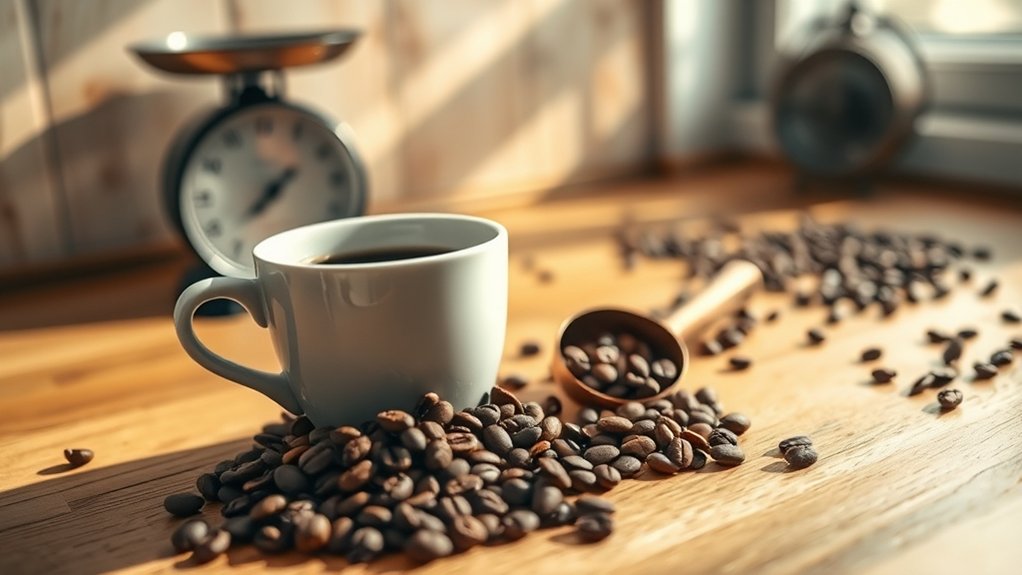
Wondering how many coffee beans you need for a perfect cup? For a standard 6-ounce cup, you’ll want about 40 medium roast coffee beans, which equals roughly 10-11 grams of coffee. This aligns with the ideal coffee-to-water ratio to guarantee balanced extraction.
Since individual beans weigh between 0.12 to 0.15 grams, the total count varies with roast and desired strength. Medium roast beans typically require 38-42 beans per cup, while dark roasts need fewer due to lower density.
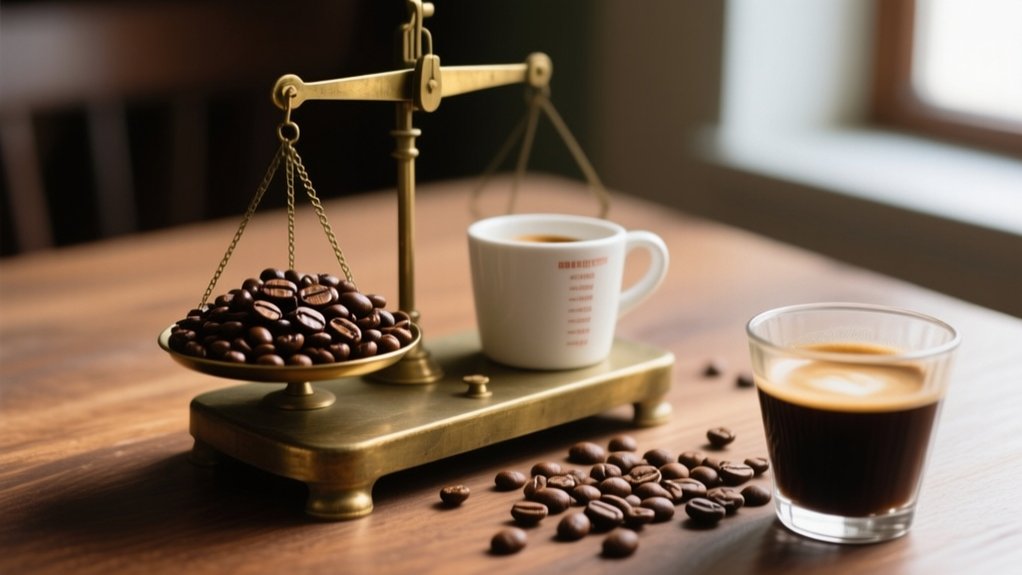
To achieve consistency in brewing coffee, it’s essential to measure coffee by weight rather than volume. Using accurate measurements, like a digital kitchen scale, allows you to precisely measure coffee beans per cup, optimizing flavor and strength every time.
Why Measuring Coffee Beans by Weight Matters
You can’t really trust volume measurements because grind size and bean density can cause the weight to vary a lot.
So, weighing your coffee beans is the way to go if you want to get the exact amount every single time. This precision makes a big difference in how your coffee tastes and how strong it turns out.
Plus, using a scale helps you keep things consistent and gives you better control over the extraction process, which means you end up with the best cup possible.
Accuracy Over Volume
Because coffee beans vary in density and size depending on factors like roast level and grind, measuring by weight rather than volume guarantees you get an accurate dose every time.
Volume measurements can mislead; for example, one tablespoon of coffee fluctuates in weight due to grind size.
Using a digital scale lets you precisely measure grams, ensuring consistent brewing. Typically, 10-11 grams of beans produce a 6-ounce cup, but dark roasts weigh less due to moisture loss, requiring fewer beans by weight.
The Specialty Coffee Association recommends 15 to 30 grams per cup, emphasizing weight’s role in accuracy.
A scale helps maintain the ideal coffee-to-water ratio, roughly 1:15 to 1:18, essential for extracting the best flavor.
Relying on weight, not volume, guarantees precision in your coffee measurements.
Consistent Flavor Results
Measuring coffee beans by weight doesn’t just improve accuracy; it directly impacts the flavor and strength of your brew. Using precise measurements guarantees you maintain the golden coffee-to-water ratio, typically between 1:15 and 1:18. This ratio is critical for ideal extraction and consistent flavor.
Since grind size and bean density vary, relying on volume leads to inconsistency. A digital scale lets you measure coffee beans accurately, translating to about 10 to 12 grams of ground coffee or roughly 70 roasted beans per cup.
This consistency means you can replicate your preferred strength and flavor every time. It also allows you to fine-tune your ratio based on taste.
Ultimately, weighing your coffee beans assures a balanced cup with ideal extraction, avoiding the guesswork inherent in volume-based methods.
Grind Size Impact
Although grind size varies widely, it plays an essential role in determining how much coffee you need for ideal extraction and flavor. When you adjust the grind size, you change the surface area exposed during brewing, which affects the flavor extraction.
Finer grinds increase surface area and require more coffee beans to achieve your desired strength, while coarser grinds extract efficiently with less. Because a tablespoon’s weight varies by grind size, relying on weight measurements guarantees consistent results.
Using a digital scale, you can precisely measure the amount of coffee needed, typically around 15 grams for a 6-ounce brew.
How Grind Size Affects Coffee Strength and Bean Quantity
You’ll notice that grind size directly affects both how strong your coffee tastes and how many beans you need to use. When you go for a finer grind, it extracts flavor more efficiently. That means you might end up using more beans to get a stronger cup.
On the other hand, coarser grinds don’t extract as much, so you’ll need fewer beans and your coffee will be milder.
The key is matching your grind size to your brewing method. Doing this helps you adjust the amount of beans just right, so your coffee comes out with the ideal flavor and extraction every time.
Grind Size Impact
Since grind size directly influences extraction, understanding its impact helps you tailor coffee strength and bean quantity to your taste. A coarse grind slows extraction time and requires fewer coffee beans, about 10-12 grams (roughly 40 beans) for a 6-ounce cup. This yields milder flavors ideal for French Press.
Conversely, a finer grind accelerates extraction and demands more beans, around 15 grams (60 beans), to produce a stronger brew suited for drip methods. Matching grind size to your brew method guarantees peak coffee strength and balance.
Furthermore, roast type affects bean count. Dark roasts are lighter and smaller, needing fewer beans than medium or light roasts.
Bean Quantity Adjustment
Three key factors influence how you adjust bean quantity: grind size, roast type, and desired coffee strength.
When you use coarser grinds, such as in French Press coffee brewing, the coffee beans you need decrease since extraction is slower, resulting in a milder cup. Coarser grinds typically call for a bean-to-water ratio between 1:12 and 1:16.
Conversely, finer grind sizes increase extraction, so you need fewer coffee beans to avoid over-extraction and bitterness.
Roast type also matters: dark roast beans are smaller and denser, requiring fewer beans, about 35-38 per standard cup, compared to 42-45 for light roasts.
Adjusting the amount of coffee grounds based on these factors guarantees you hit your preferred strength every time.
Bean quantity adjustment is essential for consistent, balanced coffee.
Mastering Coffee-to-Water Ratios for Better Brews
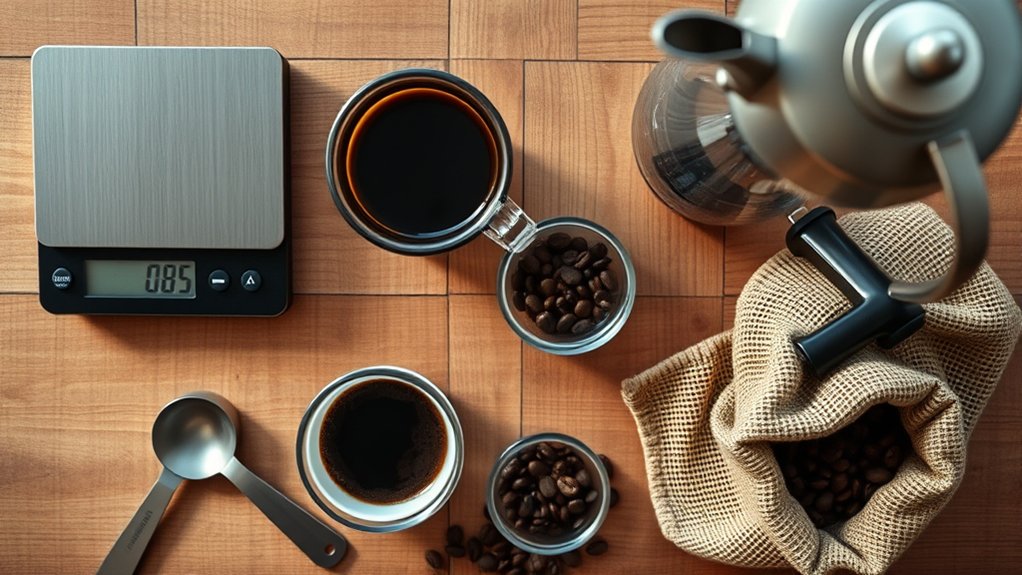
Mastering the coffee-to-water ratio is essential for consistently brewing coffee that matches your taste preferences and extraction goals. The ideal coffee-to-water ratio typically ranges from 1:15 to 1:18. This means for every gram of coffee, you use 15 to 18 grams of water.
For drip coffee, a common guideline is 20 grams of coffee to 320 grams of water, aligning with the golden ratio for a perfect brew. Different brewing methods demand adjustments. For example, French press often requires a tighter ratio for bolder flavors.
Using consistent measurements with a scale instead of volume guarantees reliability and precision. By controlling grams of coffee and water precisely, you can tailor your brew strength and flavor, elevating your daily coffee experience.
How Many Beans You Need for Different Brewing Methods
You’ll want to tweak the number of beans depending on how you’re brewing your coffee. Each method calls for a certain coffee-to-water ratio to get the best flavor.
Plus, knowing how grind size impacts extraction can really help you dial in the right amount of beans.
Bean Quantity By Method
Different brewing methods call for varying amounts of coffee beans to achieve the ideal flavor and strength. When you brew coffee, the quantity of coffee beans directly influences the coffee per cup and its final taste.
For example, using medium-roast Arabica coffee beans, a 6-ounce drip coffee needs about 40 beans (10-11 grams) to balance flavor and strength. Ground coffee beans from other methods require adjustments based on the coffee-to-water ratio.
Consider these guidelines for bean quantity by method:
- Drip coffee: 40 beans for 6 ounces, ensuring a smooth flavor.
- French press: Up to 50 beans for a richer, bolder brew.
- Espresso: 120-140 beans for a concentrated double shot.
- Cold brew: 60-80 beans for robust extraction over time.
Brewing Ratios Explained
Understanding the right brewing ratio is essential for crafting coffee that matches your taste preferences and brewing method. The coffee-to-water ratio directly influences coffee flavors and strength. For drip coffee, use about 15 grams of medium-roast Arabica beans per 250 mL of water (1:16 ratio).
French press brewing calls for a stronger ratio, typically between 1:12 and 1:16, to deliver bolder flavors. A standard coffee scoop holds roughly 10 grams, ideal for a 6-ounce cup. Dark roast beans weigh less, needing fewer beans, around 35-38 per cup.
| Brewing Method | Grams of Coffee per Cup | Notes |
|---|---|---|
| Drip Coffee | 15 | 1:16 coffee-to-water ratio |
| French Press Brewing | 18-21 | Stronger, bolder coffee flavors |
Grind Size Impact
Although grind size might seem like a small detail, it greatly affects how many coffee beans you need for each brewing method. Your choice of grind size directly influences flavor extraction and dictates the coffee-to-water ratio, ensuring you achieve ideal flavor.
Coarser grinds require fewer coffee beans, while finer grinds demand more to maintain strength.
Consider these guidelines for different brewing methods:
- French Press: Coarse grind, 1:12 to 1:16 coffee-to-water ratio, about 38-42 medium-roast beans per cup
- Espresso: Fine grind, around 120-140 beans for a double shot
- Drip Coffee: Medium grind, roughly 40 medium-roast beans per 6-ounce cup
Adjust grind size to match your brewing method for consistent, balanced flavor extraction.
Understanding grind size helps you measure coffee beans accurately for the perfect cup every time.
How to Adjust Coffee Bean Amounts for Your Taste
When you adjust the amount of coffee beans, you directly control the strength and flavor intensity of your brew. Start with the golden cup standard, about 20 grams of coffee beans per 320 grams of water, and tweak from there to craft a personalized flavor profile.
For milder flavor, use closer to 10 grams for a 6-ounce cup. For stronger flavor, increase up to 30 grams.
Keep in mind grind size affects extraction: coarser grinds need fewer beans, finer grinds more.
Also, consider roast level. Dark roasts are less dense, so you might use fewer beans than with light roasts to maintain flavor balance.
How Roast Level Affects Bean Weight and Brew Strength
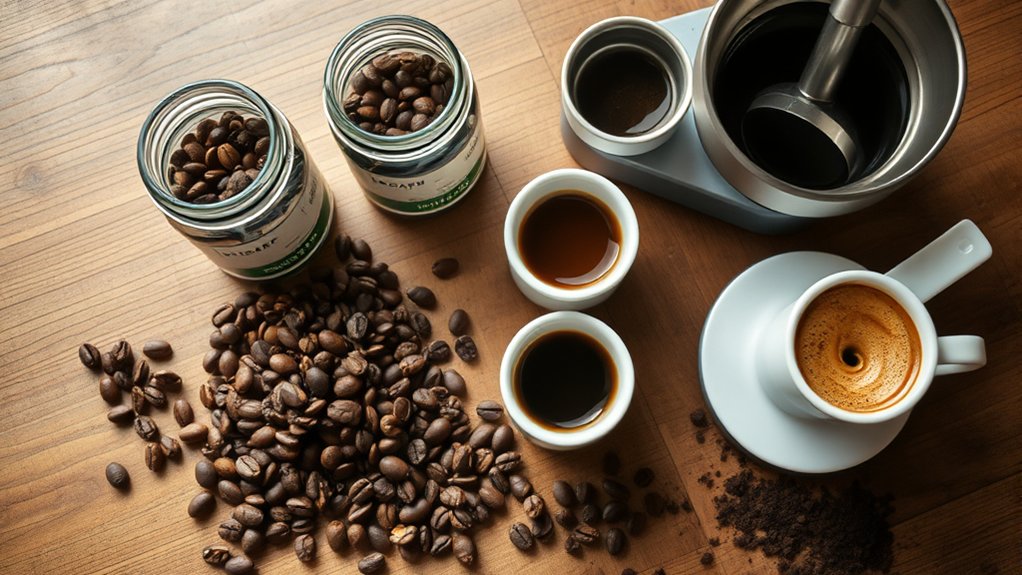
Adjusting your coffee bean amount isn’t just about personal taste. It also depends on the roast level you choose. Different bean types vary in density and weight with roast level, influencing your brew strength.
Dark roasted coffee loses moisture, making the beans lighter. So you need fewer beans, around 35-38 for a 6-ounce cup.
Light roasts retain more moisture, increasing density and weight. That means about 42-45 beans are needed for the same volume. This affects extraction and flavor balance.
Dark roasted coffee offers bolder flavors but fewer beans per cup due to lower density. Light roasts are denser, producing brighter, more acidic notes with more beans needed.
Roast level also impacts caffeine content. Dark roasts have less caffeine per bean.
Proper adjustment by roast level guarantees consistent brew strength and taste.
How to Use Scoops and Scales to Measure Coffee Beans
A reliable measurement method is essential for brewing consistent coffee, and using scoops and scales offers two practical approaches. One standard coffee scoop holds about 10 grams of ground coffee, roughly equal to 2 tablespoons of ground coffee. This matches the amount needed for a standard coffee 6-ounce cup, which requires around 10 to 11 grams or about 40 medium-roast Arabica coffee beans.
While scoops provide convenience, using a kitchen scale guarantees precision, letting you measure the exact number of coffee beans by weight.
Since grind size affects the amount needed, a scale helps you adjust accurately for a balanced flavor. Experiment with both scoops and scales to dial in the perfect cup tailored to your taste preferences.
How to Store Coffee Beans for Maximum Freshness
Measuring your coffee beans accurately is just the beginning of brewing a great cup. Preserving their freshness afterward plays a big role in keeping the flavor quality high.
To store coffee beans effectively, use airtight containers to protect them from air exposure, which reduces freshness. Keep these containers in a cool, dark place away from sunlight and heat sources that speed up deterioration.
Store coffee beans in airtight containers away from light and heat to preserve their freshness and flavor.
Avoid refrigeration or freezing because moisture can harm the quality. It’s best to buy small batches so you can enjoy the beans within a month of roasting for the ideal flavor.
Also, make sure to clean your storage containers regularly to prevent oil buildup that might ruin the taste.
- Store coffee beans in airtight containers
- Keep them in a cool dark place
- Buy small batches to maintain peak freshness
- Regularly clean storage containers to avoid residue buildup
Equipment Maintenance Tips for Consistent Coffee Flavor
Since even the freshest coffee beans can lose their potential without proper upkeep, you should prioritize regular cleaning of your grinder and brewer. Residual oils and coffee grounds build up, altering flavor and clogging your coffee equipment.
Descale your machine periodically to remove mineral deposits that impair performance and consistency.
Always use a digital kitchen scale for accurate measurements of beans, ensuring precision in your brew.
Adjust grind size and brewing time carefully, as these factors directly impact extraction and taste.
Maintaining airtight storage for your beans preserves freshness, but clean, well-maintained equipment is equally essential for delivering consistent coffee flavor every time.
Frequently Asked Questions
Can I Reuse Coffee Grounds for a Second Cup?
You can reuse coffee grounds for a second cup, but expect a weaker coffee flavor and reduced caffeine content. Adjust your brewing methods by shortening steeping time to prevent bitterness.
Grind size and freshness matter less on reuse since most solubles are already extracted. Reused grounds yield lower coffee strength, so they’re best for cold brews or recipes that enhance flavor.
For ideal taste, fresh grounds always deliver better results.
How Does Water Temperature Affect Coffee Extraction?
Water temperature directly impacts your coffee’s extraction process by influencing how flavors dissolve during brew timing.
Too hot, and you risk over-extraction, causing bitterness. Too cool, and under-extraction leads to weak coffee strength and sour notes.
Adjust temperature based on your brewing method and grind size to balance the flavor profile.
Also, remember that water quality affects extraction efficiency, so use fresh, clean water for the best results every time you brew.
What Is the Best Type of Water for Brewing Coffee?
You’d think any water works, but filtered water is your best bet for brewing coffee. It balances water mineralization, filters out chlorine, and supports ideal acidity levels, enhancing taste profiles.
Depending on your brewing techniques and filter types, you’ll want water with neutral pH and moderate minerals to prevent bitterness or flatness.
Pair that with precise water ratios and a proper coffee grind, and you’ll reveal a perfect cup every time.
How Long Should I Let Coffee Bloom Before Brewing?
You should let coffee bloom for about 30 seconds to one minute, which is the ideal time to release trapped carbon dioxide. This bloom enhances flavor and aroma, especially with fresh coffee and finer grind sizes.
Adjust the timing slightly depending on your brewing method. For example, longer blooms work well with pour-over.
Proper blooming guarantees even saturation and prevents channeling. This ultimately improves your coffee’s overall taste and aroma release.
Does Altitude Affect Coffee Bean Measurement or Brewing?
Imagine brewing Ethiopian high-altitude beans; their altitude impact is clear in their vibrant aroma intensity and complex bean flavor.
You’ll notice brewing altitude affects water density, altering extraction time and how the roast profile develops.
To balance these factors, you might adjust your coffee-to-water ratio slightly, ensuring ideal extraction.
Conclusion
Now that you know how many beans make a perfect cup, you’re ready to brew like a pro.
Remember, precision in measuring and grinding shapes your coffee’s character. Think of it as tuning an instrument for the perfect note.
Keep your beans fresh, your equipment clean, and adjust ratios to match your taste. With these tips, every cup you pour will sing with rich, balanced flavor.
Enjoy crafting your ideal brew!