How Many Coffee Beans Per Cup – Brewing Ratios Explained
You’ll need about 70 to 80 whole coffee beans, or roughly 10 to 12 grams, to brew a balanced 6-ounce cup. Measuring by weight guarantees consistency. The standard brewing ratio of 1:16 (coffee to water) helps control strength and flavor.
Adjust the amount of beans based on your grind size, roast, and cup size for the best results. Mastering these details opens up a richer, more nuanced coffee experience. Plus, there are plenty of tips to help you perfect your brew.
How Many Coffee Beans (By Weight) Make One Cup of Coffee
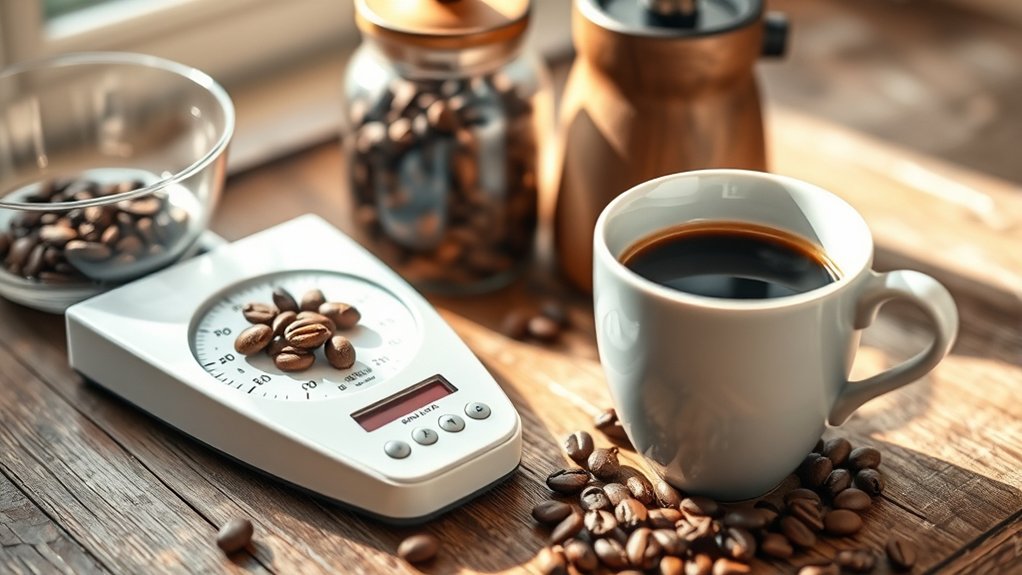
How many coffee beans do you need to brew a single cup? Typically, you’ll use about 10 to 12 grams of coffee beans per 6-ounce cup. This translates roughly to 70 to 80 whole beans, depending on their size and roast level.
About 70 to 80 coffee beans, or 10 to 12 grams, make a perfect 6-ounce cup.
Measuring by weight, rather than volume, ensures brewing consistency. And that’s super important for achieving a balanced coffee flavor every time.
When you weigh your beans accurately, you control extraction. This helps prevent under- or over-extraction that can dull or distort flavor notes.
Using a precise coffee-to-water ratio lets you replicate your preferred taste, whether it’s bright and acidic or rich and bold.
Why Do Brewing Ratios Matter for Coffee Flavor?
You control how strong your coffee tastes by adjusting your brewing ratio. This directly affects whether your cup is bold or mild.
Finding the right balance between bitter and sweet flavors depends on getting your measurements just right. That way, your coffee won’t be too harsh or too weak.
If you stick to consistent ratios, you’ll enjoy the same great flavor every time you brew.
Impact On Coffee Strength
Because brewing ratios control the balance between coffee grounds and water, they directly shape the strength and flavor profile of your cup. Adjusting this ratio influences how concentrated and intense your coffee tastes. When you tweak the amount of coffee relative to water, you control extraction efficiency, affecting aroma and mouthfeel.
Think about it like this: a higher coffee-to-water ratio makes your coffee’s aroma and body more intense. Brewing temperature also plays a role here, interacting with the ratio to change extraction speed and flavor clarity.
If you use too little coffee, you’ll end up with a weak, under-extracted brew that lacks complexity. On the other hand, adding too many grounds can cause over-extraction, resulting in a harsh, bitter taste.
Getting the hang of how brewing ratios impact strength lets you create a cup tailored just for your taste. It’s all about maximizing aroma and enjoyment every time you brew.
Balance Between Bitter And Sweet
Why does your coffee sometimes taste too bitter or overly sweet? The answer lies in the delicate balance between coffee flavor compounds, which brewing ratios directly influence. When you adjust the amount of coffee beans per cup, you control the extraction process. This is the key to achieving an ideal taste balance.
Too many grounds can over-extract bitter compounds, while too few may under-extract, leaving your brew overly sweet or sour. By mastering the right brewing ratio, you guarantee the harmonious interplay of sweetness, bitterness, and acidity in every cup.
Understanding how these ratios affect coffee flavor empowers you to tailor your brew to your preferences. This way, you create a consistently enjoyable cup that highlights the full spectrum of flavor nuances without overpowering your palate.
Consistency In Brewing Results
When brewing ratios remain consistent, your coffee’s flavor profile stays reliably balanced from cup to cup. This consistency guarantees you capture the ideal coffee aroma and maintain the perfect brewing temperature every time.
By sticking to precise ratios, you avoid under- or over-extraction, which can skew flavor.
Pay attention to these key factors:
- Accurate coffee-to-water ratio for balanced extraction
- Stable brewing temperature to preserve aroma and flavor
- Consistent grind size for uniform water flow
- Measured brew time to control strength and bitterness
Mastering these elements helps you replicate your favorite cup with ease.
Consistent ratios transform brewing from guesswork into a reliable art, delivering the taste you love and expect, cup after cup.
Common Coffee Beans-to-Water Ratios Used by Baristas
Although personal taste varies, baristas typically follow specific coffee beans-to-water ratios to achieve the perfect cup. A common standard is the 1:16 ratio, which means 1 gram of coffee for every 16 grams of water. This ratio balances extraction and highlights the coffee aroma.
Adjusting this ratio slightly can enhance bean freshness and flavor clarity, depending on the roast or grind size. For instance, a stronger brew might use a 1:15 ratio, while a lighter cup might stretch to 1:17.
These precise ratios help you extract the ideal oils and compounds without over or under-extracting. By understanding and applying these ratios, you’ll consistently reveal your coffee’s full potential.
You’ll savor every nuance of aroma and freshness in each cup you brew.
How to Weigh Coffee Beans for Consistent Brewing
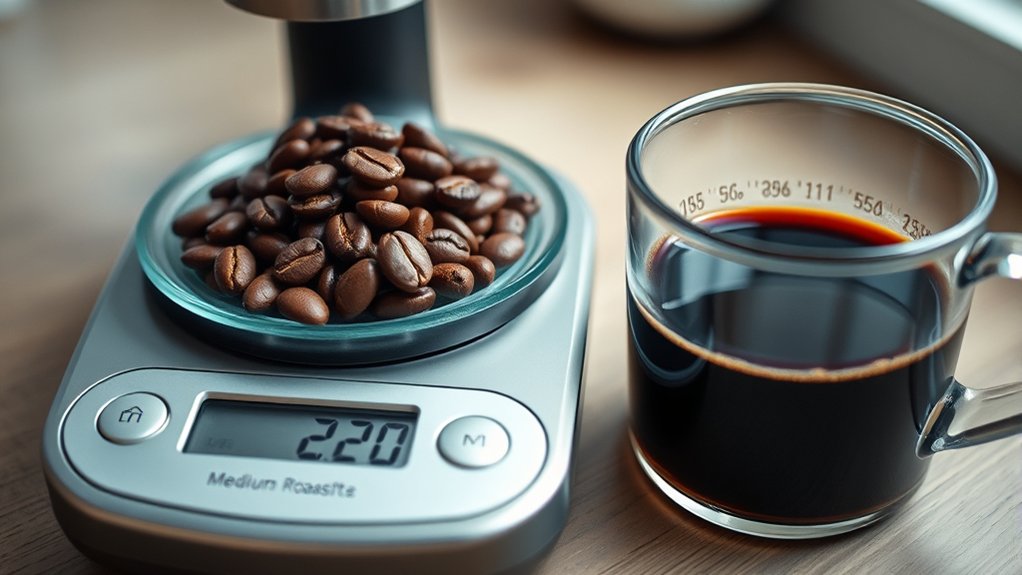
Mastering the right coffee-to-water ratio only works if you measure your coffee beans accurately every time. Using a reliable digital scale guarantees precision, allowing you to replicate your favorite brew consistently. Proper coffee storage maintains bean freshness, which directly affects weight and extraction.
Remember, brewing temperature interacts with your measured dose to influence flavor balance.
To weigh coffee beans effectively:
- Calibrate your scale regularly for accuracy.
- Tare your container before adding beans to avoid extra weight.
- Measure immediately before brewing to prevent moisture loss.
- Store beans in airtight containers away from light and heat.
Measuring Coffee Beans Without a Scale: Tips and Tricks
You don’t actually need a scale to measure your coffee beans accurately. Simple tools like spoons can help you portion your beans consistently. It’s pretty handy once you get the hang of it.
Plus, learning to estimate by eye and using common household items as references makes the whole process quick and reliable. No need to fuss with extra gadgets.
Using Spoon Measurements
When a scale isn’t available, spoon measurements offer a reliable alternative for portioning coffee beans. You can maintain consistency by using a standard tablespoon or teaspoon to measure your beans accurately.
This method complements good coffee storage practices, ensuring your beans stay fresh and your brew balanced.
Remember, proper brewing temperature also influences extraction, so precise bean amounts are critical.
Keep these tips in mind when using spoon measurements:
Use a level spoon to avoid overestimating bean quantity.
Adjust spoon size depending on your desired coffee strength.
Grind immediately after measuring to preserve freshness.
Store beans in airtight containers away from light and heat.
It’s pretty straightforward once you get the hang of it! Just a little attention goes a long way in making your coffee taste great every time.
Visual Bean Estimation
Spoon measurements can be handy, but sometimes you won’t have one nearby. Or maybe you prefer a quicker method. Visual bean estimation relies on recognizing the size and volume of beans to gauge the right amount.
Fresh beans emit a strong coffee aroma, guiding you to use just enough for a rich brew without waste.
Here’s a quick visual guide to help you estimate:
| Coffee Beans | Approximate Volume | Notes |
|---|---|---|
| 10 beans | 1 tablespoon | Light roast, fresh aroma |
| 20 beans | 2 tablespoons | Medium roast, vibrant scent |
| 30 beans | 3 tablespoons | Dark roast, intense aroma |
| Handful (~40 beans) | 4 tablespoons | Use sparingly, check freshness |
Trust your senses and visual cues to maintain bean freshness and aroma in every cup.
Standard Household Items
Several common household items can help you measure coffee beans accurately without a scale. Since the coffee plant produces beans of varying sizes, relying on visual estimation alone can be tricky.
Instead, use these tools to approximate the right amount for your brewing equipment:
- Tablespoon: Typically holds about 5 grams of coffee beans.
- Measuring cup: A quarter cup equals roughly 36 grams of beans.
- Spoons: A heaping teaspoon approximates 2 grams of beans.
- Small containers: Use consistent volume containers to replicate measurements each time.
These simple tools can make your coffee measuring easier and more consistent. Give them a try next time you brew!
How Grind Size Changes How Much Coffee You Need
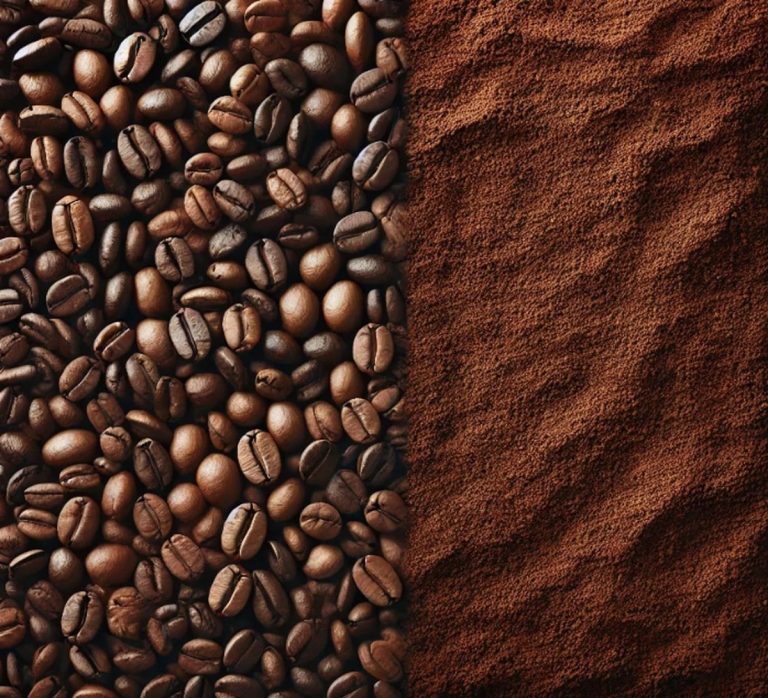
Because grind size directly affects extraction, it also influences how much coffee you need for each cup. A finer grind increases surface area, speeding extraction and requiring less coffee. Conversely, a coarser grind slows extraction, so you’ll need more grounds or longer brewing time to reach the desired strength.
Adjusting your coffee amount based on grind size helps balance flavor and avoid over- or under-extraction.
| Grind Size | Brewing Time |
|---|---|
| Extra Fine | 20-30 seconds |
| Fine | 2-3 minutes |
| Medium | 3-4 minutes |
| Coarse | 4-5 minutes |
| Extra Coarse | 5+ minutes |
Use this guide to tweak your coffee dose as grind size changes and get perfect cups every time.
How Bean Type and Roast Level Affect Coffee Bean Amounts
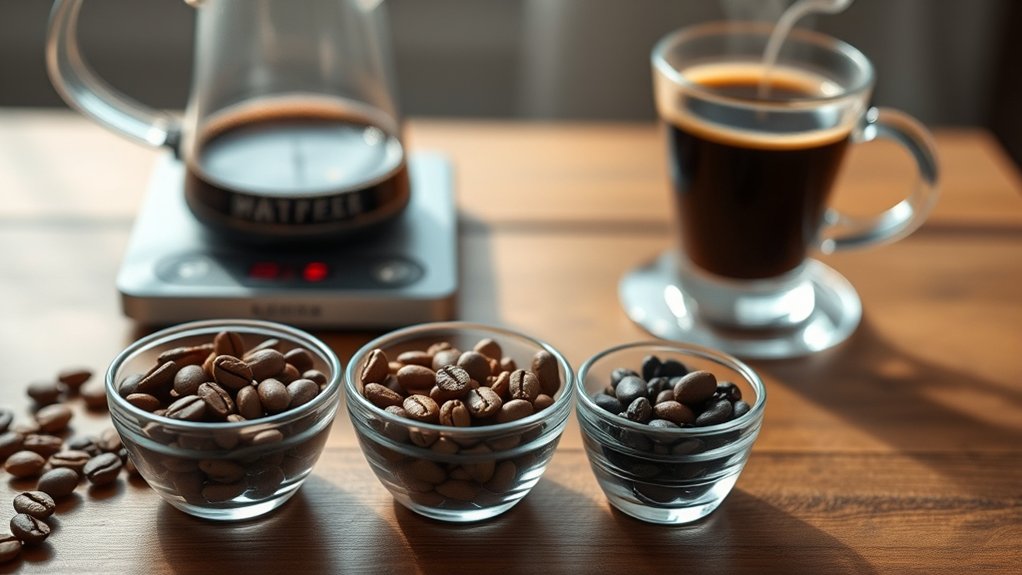
While grind size plays a crucial role in determining how much coffee you use, the type of bean and its roast level also considerably impact the amount needed per cup. Different bean origins vary in density and moisture content, which influences weight and volume per scoop.
Your roast profile affects bean expansion and weight loss. Darker roasts weigh less but take up more space. So, it’s something to keep in mind when measuring.
Consider these factors: beans from high-altitude origins tend to be denser, so you might need slightly less volume. Lighter roast profiles retain more moisture, meaning you’ll use more weight per cup.
Dark roasts expand and become more porous, so you might need more beans by volume. Specialty beans with unique origins might require adjustments based on flavor intensity and density.
Adjusting for these variables really sharpens your brewing precision. It’s all about getting that perfect cup every time.
How to Adjust Coffee Bean Amounts for Different Cup Sizes
You’ll want to start with standard coffee measurements as your baseline. That’s typically around 10 grams per 6-ounce cup.
When you’re brewing larger cups, just scale the amount of beans proportionally so you can keep that perfect flavor balance.
And if you’re making smaller cups, go ahead and reduce the beans accordingly.
This helps you avoid over-extraction and bitterness.
Standard Coffee Measurements
A standard cup of coffee typically requires about 10 grams of coffee beans, but adjusting this amount based on your cup size guarantees the perfect brew every time. To maintain ideal coffee aroma and flavor, always consider bean freshness before measuring.
Here’s how you can fine-tune your measurements: use a kitchen scale for accuracy because even slight deviations can affect taste. For smaller cups (6 oz), reduce beans to about 7 grams to avoid over-extraction. For larger cups (12 oz), increase beans to around 14 grams for balanced strength.
Scaling For Larger Cups
How much coffee should you use when brewing larger cups? Simply multiply your standard ratio by the desired cup size. If you usually use 10 grams of coffee for an 8-ounce cup, scale up proportionally for a 12 or 16-ounce mug.
Keep in mind, adjusting the coffee amount alone isn’t enough. Proper coffee storage maintains bean freshness, which is key to getting full flavor extraction even when you’re brewing larger quantities.
Also, watch your brewing temperature closely. Larger volumes can cool faster, and that can mess with extraction consistency.
Aim for a steady 195–205°F to balance flavor and strength. By scaling your coffee dose precisely and controlling brewing temperature, you’ll enjoy rich, well-balanced coffee in every oversized cup.
Adjusting For Smaller Cups
Wondering how to dial down your coffee bean amount for smaller cups? Adjusting your grind and bean quantity guarantees you don’t lose the coffee aroma or compromise bean freshness.
Here’s how to fine-tune your brew:
Use a scale to measure beans precisely, reducing quantity proportionally. Maintain the recommended brewing ratio (typically 1:15 to 1:18) to preserve flavor balance.
Grind beans just before brewing to maximize coffee aroma and retain freshness.
Adjust water volume accordingly, making sure the smaller cup isn’t diluted or over-extracted. This way, you keep all the rich flavors without wasting any coffee.
How to Customize Coffee-to-Water Ratios for Your Taste
Although standard coffee-to-water ratios provide a solid starting point, you’ll want to adjust them to suit your personal taste and brewing method. The unique characteristics of your coffee plant’s origin influence its flavor profile, so tweaking the ratio lets you highlight preferred notes.
Start by experimenting with small increments. Try slightly more coffee for a bolder cup or more water for a milder brew.
Consider your brewing equipment, too. An espresso machine demands different ratios than a French press.
Precision matters, so weigh your beans and water to maintain consistency.
Keep detailed notes on each adjustment to find your perfect balance. Customizing your coffee-to-water ratio empowers you to craft a cup that’s truly tailored to your palate and brewing style.
Fixing Weak or Bitter Coffee by Adjusting Your Coffee Beans
Adjusting your coffee-to-water ratio is just one piece of the puzzle when it comes to improving your brew. To fix weak or bitter coffee, focus on your coffee beans first. Coffee bean freshness plays a vital role; stale beans often produce flat or bitter flavors.
Also, think about your brewing temperature. Too hot can extract bitterness, and too cold under-extracts, leaving weak coffee.
Here’s what you can do:
- Use freshly roasted beans, ideally within two weeks of roasting
- Store beans in an airtight container away from light and heat
- Adjust grind size for proper extraction: finer for stronger, coarser for milder
- Maintain a brewing temperature between 195°F and 205°F to optimize flavor balance
Frequently Asked Questions
Can I Reuse Coffee Beans for Multiple Brews?
You shouldn’t reuse coffee beans for multiple brews because coffee bean freshness drops considerably after the first extraction. The flavors and oils that make your coffee rich get mostly used up, leaving a weak, bitter taste.
Plus, grind size consistency matters. Reusing grounds messes with that, causing uneven extraction.
To enjoy a great cup, always use fresh beans. Grind just before brewing for the best flavor and aroma.
How Does Water Temperature Affect the Brewing Ratio?
Water temperature drastically impacts your brewing ratio because it influences extraction. If your temperature’s too low, under-extraction happens, and your coffee tastes weak. So, you might need more beans to compensate.
Too hot, and you risk over-extraction, causing bitterness.
Mastering temperature control means balancing water chemistry to optimize flavor without altering your bean-to-water ratio.
Consistent temperature helps you get the perfect brew every time, keeping your coffee balanced and delicious.
What Is the Best Type of Water for Brewing Coffee?
Think of your coffee like a symphony, where water is the conductor. The best type of water for brewing has balanced mineral content, enough to enhance flavor but not overwhelm.
You’ll want filtered water through a quality coffee filtration system to remove impurities without stripping essential minerals.
Too soft, and your brew tastes flat. Too hard, and it becomes bitter. So, choose water that strikes that perfect harmony for a richer, smoother cup.
How Long Should I Let Coffee Steep for Optimal Flavor?
You should let your coffee steep for about 4 to 5 minutes to extract essential flavor. The coffee grind size plays a pivotal role here.
Coarser grinds need longer steeping times, while finer grinds extract faster.
If you steep too long, your coffee might taste bitter. Too short, and it’ll be weak.
Does Altitude Impact Coffee Brewing Ratios?
It’s no coincidence that altitude effects can influence your coffee’s brewing ratios. When you brew at higher elevations, water boils at lower temperatures, which can affect extraction.
You’ll want to adjust your coffee-to-water ratio slightly to maintain brewing consistency, often using a bit more coffee or a finer grind to compensate.
Paying attention to altitude helps you brew a balanced cup, ensuring your coffee tastes just right no matter where you are. It’s a simple tweak that can make a noticeable difference in your daily brew.
Conclusion
If you want coffee that hits every note perfectly, mastering your coffee bean-to-water ratio isn’t just a tip, it’s your secret weapon against bland or bitter brews. Imagine turning your daily cup into a barista-level masterpiece with a simple tweak!
By dialing in the exact weight and adjusting for roast or cup size, you hold the power to transform ordinary coffee into an extraordinary experience every single time. Trust me, your taste buds will thank you!