What Is An Espresso Shot – Definition And Brewing Basics
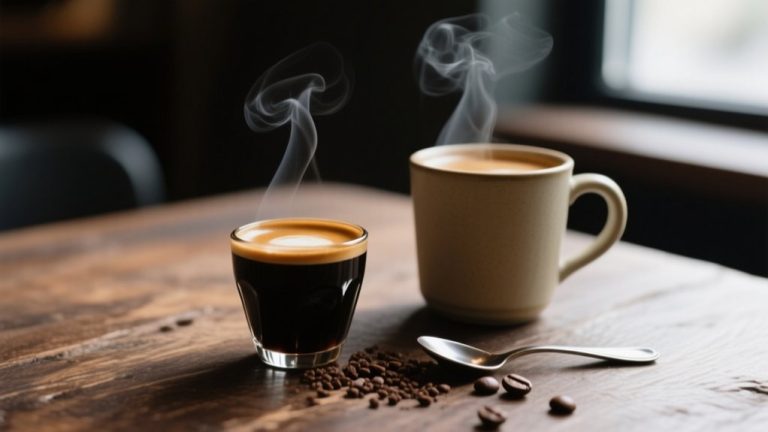
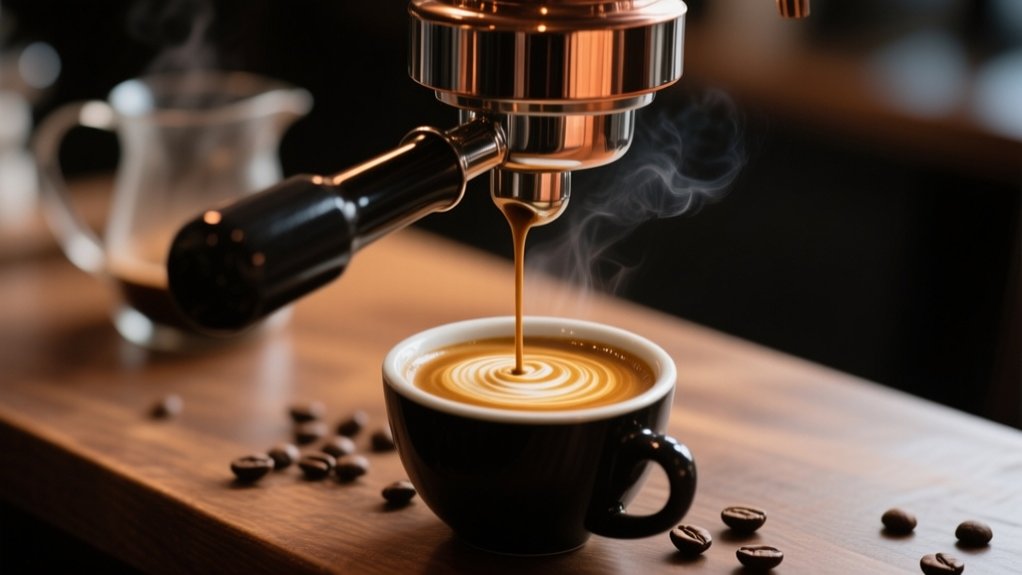
An espresso shot is a concentrated coffee brewed by forcing hot water through finely ground coffee under high pressure for about 25 to 30 seconds. You’ll use around 7–10g of coffee per single shot or 16–18g for a double.
Proper grind size, tamping pressure, water temperature, and extraction time all affect the flavor and crema quality. Mastering these basics helps you pull a rich, balanced shot. There’s plenty more to explore for perfect results.
What Is an Espresso Shot and Why It Matters
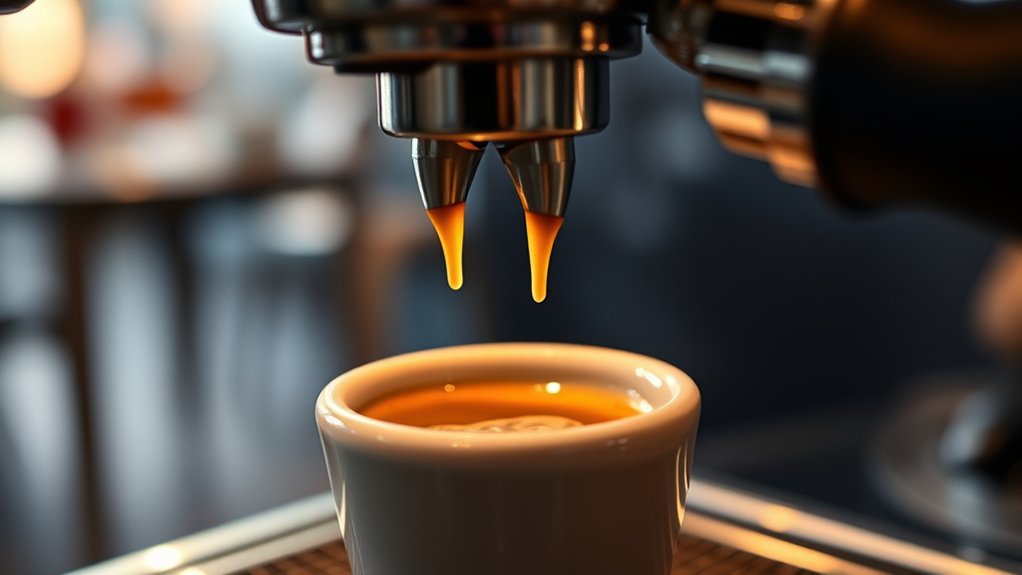
An espresso shot is a small but powerful coffee beverage made by forcing hot water through finely ground coffee under high pressure.
When you brew espresso, shot time is essential; a typical extraction lasts 25 to 30 seconds. This precise timing helps develop the espresso’s complex flavor profile, balancing acidity, bitterness, and sweetness.
Shot time is crucial; a 25 to 30-second extraction unlocks espresso’s balanced and complex flavors.
You’ll notice a rich body and a layer of crema, which signal a quality brew. Brewing your espresso with the right coffee-to-water ratio, about 1:2, ensures a well-balanced shot, usually yielding 25-30 ml of concentrated coffee.
Understanding these basics matters because espresso isn’t just a drink on its own. It’s the foundation for many popular coffee beverages.
Mastering the shot time and brewing process elevates your overall coffee experience.
How Dose Affects Your Espresso
While brewing espresso, the dose, the weight of dry ground coffee you use, plays an essential role in shaping the shot’s flavor and texture. Typically, a dose ranges from 7–10g for a single shot and 16–18g for a double, with 20g often targeted for ideal extraction.
If you underfill your portafilter, extraction becomes uneven, resulting in a weak, underwhelming espresso. Consistently measuring your dose helps you achieve reliable, repeatable results. This is key for dialing in your preferred flavor profile.
Increasing the dose usually produces a fuller-bodied shot with richer flavor. Adjusting it lets you fine-tune the balance between strength and mouthfeel.
How to Measure Espresso Yield Accurately
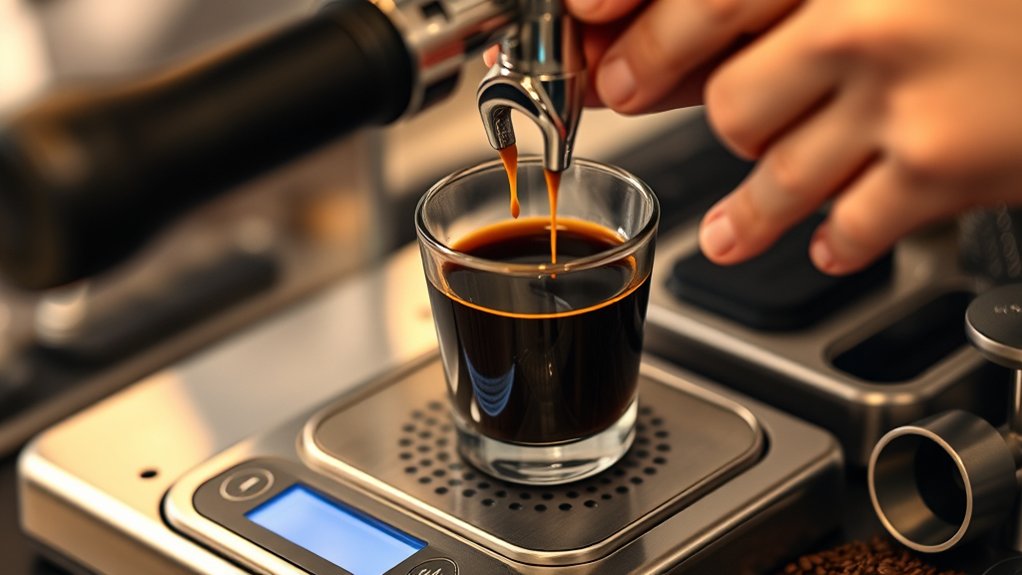
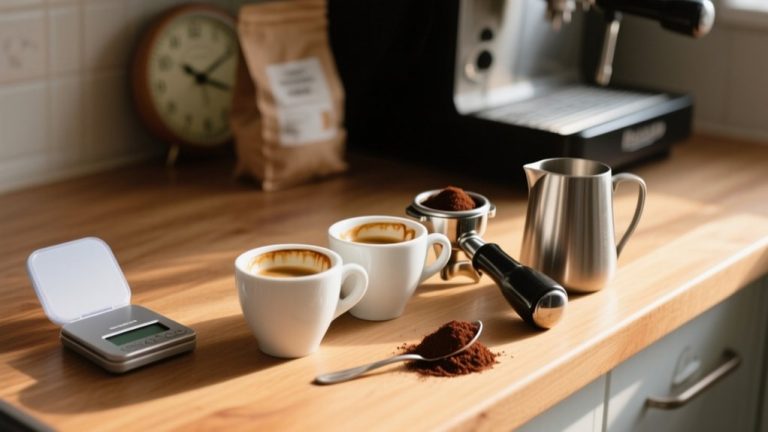
You’ll want to use a coffee scale to measure your espresso yield in grams as it extracts.
This way, you can keep track of the weight precisely, which really helps you control the shot’s strength and flavor.
Without measuring accurately, dialing in your espresso can feel like a total guessing game.
Using A Coffee Scale
Using a coffee scale lets you measure espresso yield with precise weight in grams, ensuring your brew hits the right balance. By weighing the espresso liquid instead of relying on volume, you avoid inaccuracies caused by crema.
For example, with a 20g coffee dose, your target yield is around 30g, maintaining a 1:1.5 ratio for proper extraction. Start your timer when water first contacts the grounds and stop once you reach the desired weight, usually between 25 to 35 seconds.
Consistently using a coffee scale helps you dial in grind size and adjust brew parameters effectively.
This precision leads to better shot consistency and quality, making your espresso experience more controlled and rewarding.
Importance Of Weight Measurement
Precise weight measurement plays a key role in crafting the perfect espresso shot. You need to measure espresso yield by weight, not volume, since crema can distort volume readings.
A coffee scale helps you track yield accurately, guaranteeing you hit common targets like 30g from a 20g dose, maintaining a 1:1.5 ratio. Monitoring this lets you assess extraction quality directly and adjust brewing parameters such as grind size or tamping pressure.
Consistent weight measurement also reveals inconsistencies, so you can fine-tune your process.
Combined with proper shot timing, typically 25 to 35 seconds, precise weight measurement guarantees a balanced flavor profile and a reliable espresso experience every time.
Using Espresso Ratios to Balance Flavor
Although dialing in your espresso shot can feel complex, understanding espresso ratios will give you control over flavor balance. The espresso ratio is the relationship between the weight of your ground coffee (dose) and the weight of the liquid espresso extracted (yield).
For example, a common starting point is a 1:1.5 ratio, using 20 grams of dose and aiming for a 30-gram yield. This ratio promotes ideal flavor extraction, producing a balanced shot.
If you increase the yield relative to the dose, like a 1:2 ratio, your espresso will taste more diluted. Conversely, a lower yield, such as 1:1, creates a concentrated, robust flavor.
How Extraction Time Changes Your Espresso’s Flavor
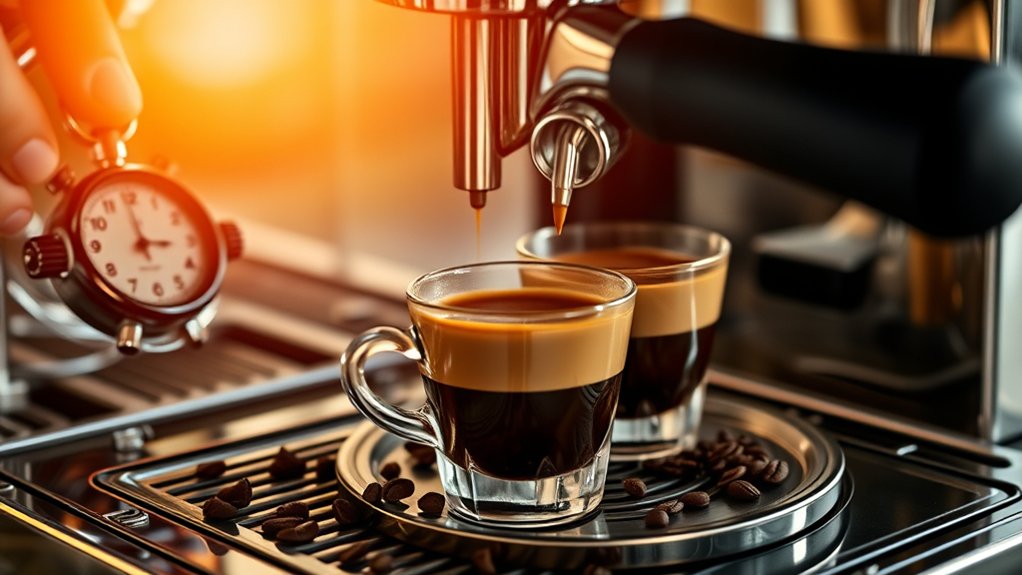
You’ll notice that extraction time directly shapes your espresso’s flavor. Each second brings out different notes—like acidity, sweetness, or bitterness.
Usually, aiming for about 25 to 30 seconds helps you get the best balance in your shot.
Flavor Profiles Over Time
When you pull an espresso shot, the flavors change dramatically depending on how long the extraction lasts. In espresso brewing, extraction time plays a vital role in shaping the flavor profiles you experience.
If the shot is too short, around 20 seconds, it’ll taste sour and under-extracted because essential compounds haven’t fully developed. A balanced shot usually falls between 25 and 30 seconds, blending acidity, sweetness, and bitterness perfectly.
Going beyond 35 seconds leads to over-extraction, introducing bitter and unpleasant notes.
Keep in mind that lighter roasts often benefit from a slightly longer extraction time to reveal their complex flavors, while darker roasts need shorter pulls to avoid excessive bitterness.
Adjusting extraction time lets you control your espresso’s flavor profile precisely.
Optimal Extraction Duration
Understanding how extraction time shapes espresso flavor helps you dial in the perfect shot. The ideal extraction duration typically ranges from 25 to 30 seconds, balancing acidity, sweetness, and bitterness. Start timing when water first hits the coffee grounds to guarantee consistency.
Shorter times produce sour, weak flavors, while longer ones yield bitterness. Your brewing methods and coffee roast influence the exact timing. Darker roasts suit shorter pulls, and lighter roasts benefit from longer ones.
| Extraction Time | Flavor Outcome |
|---|---|
| Under 20 seconds | Sour, weak |
| 25-30 seconds (ideal) | Balanced, complex |
| Over 35 seconds | Bitter, harsh |
| Varies by roast | Adjust accordingly |
Mastering this keeps every shot of espresso delicious and consistent.
How to Choose the Right Grind Size for Your Espresso Shot
Grind size plays an essential role in crafting a perfect espresso shot, as it directly affects extraction and flavor. You want your grind to be finely ground coffee, similar to table salt, to slow water flow and maximize extraction.
Too coarse, and you’ll get weak, under-extracted shots. Keep these tips in mind:
- Aim for a grind size between 200-400 microns to balance resistance and flow rate.
- Adjust grind size based on roast levels. Darker roasts often need a slightly coarser grind than lighter ones.
- Test and dial in your grind regularly to hit the ideal extraction time of 25 to 30 seconds.
How Tamping Pressure Impacts Your Espresso Shot
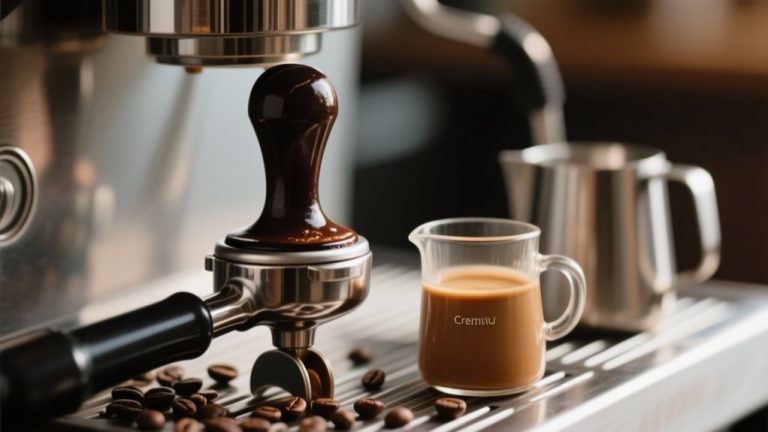
You want to apply consistent tamping pressure—about 40 lbs—to make sure your espresso extracts evenly and to prevent channeling.
If you don’t press hard enough, the water will flow unevenly, which can make your shot taste weak. On the other hand, pressing too hard might cause over-extraction, leading to bitter flavors.
Also, keeping your tamping surface level is key to getting a balanced and flavorful espresso every time.
Consistent Tamping Pressure
Although it might seem like a small step, applying consistent tamping pressure, ideally around 40 pounds, is essential to create a uniform coffee bed that allows water to flow evenly during extraction.
When you use a consistent tamp, you guarantee the coffee puck is compacted evenly, preventing channeling where water finds easy paths and ruins the shot.
To master this:
- Apply firm, steady pressure straight down without tilting.
- Aim for about 40 lbs of pressure for uniform resistance.
- Practice regularly to maintain consistency.
This approach helps water flow through the coffee evenly, resulting in a balanced level of extraction.
Too light or uneven tamping weakens the shot, while too much pressure risks bitterness.
Consistent tamping is key to brewing quality espresso every time.
Effects On Extraction
When tamping pressure falls outside the ideal 30-40 lbs range, it directly affects how water flows through your coffee grounds, altering the extraction process.
If you apply too much tamping pressure, water struggles to pass evenly, increasing extraction time and causing over-extraction, which results in bitter flavors.
On the other hand, too little tamping pressure leads to uneven water distribution, shortening extraction time and producing weak, sour shots.
Consistent tamping pressure guarantees uniform water flow through the coffee bed, promoting balanced flavors and a rich crema.
By mastering the right tamping pressure, you control extraction time effectively, preventing channeling and maintaining the quality of your espresso shot every time.
How Water Pressure and Temperature Affect Espresso
Since water pressure and temperature directly influence how coffee compounds extract, they play an essential role in shaping your espresso’s flavor and texture.
Your espresso machine uses pressurized water, typically between 6-9 BAR, to force hot water through finely ground coffee.
The brewing temperature, ideally 90 to 96°C, affects how well coffee compounds dissolve, impacting taste.
Here’s what you need to know:
- Too low water pressure causes under-extraction, making your espresso sour and weak.
- Excess pressure leads to over-extraction, creating bitterness.
- Maintaining a consistent brewing temperature guarantees balanced flavor and proper oil emulsification.
How Crema Indicates Espresso Quality
If you want to judge the quality of your espresso shot quickly, look at the crema, the thick, foamy layer on top. Crema forms from carbon dioxide and emulsified oils released during extraction, signaling a well-brewed coffee.
Fresh coffee beans, ideally used within two weeks of roasting, produce richer crema that indicates balanced extraction. A golden-brown crema suggests your espresso shot is properly brewed, while a thin or pale layer might mean stale beans or brewing issues.
Using fresh beans within two weeks of roasting yields richer crema and a perfectly balanced espresso shot.
Keep in mind that darker roasts often yield less crema due to their lower acidity and oil content.
Besides its visual cues, crema enhances the espresso’s flavor and mouthfeel, making your brewed coffee experience more enjoyable and satisfying.
Dialing In Your Espresso Shot at Home
The quality of your espresso shot starts with that golden crema, but dialing in your espresso at home guarantees you consistently achieve that rich, balanced flavor.
Follow this Espresso Guide to master your brew:
- Grind Size Adjustment: Begin with a fine grind. If your shot pulls too fast, go finer; if too slow, coarsen it. This controls extraction rate and flavor.
- Dose Consistency: Use 20g of coffee per double shot. Keeping this consistent prevents flavor variation and guarantees balanced extraction.
- Timing the Shot: Start timing when water first hits the grounds. Aim for 25-30 seconds extraction for ideal taste.
Frequently Asked Questions
What Equipment Is Essential for Making Espresso at Home?
You’ll need the right espresso machine types, like semi-automatic or manual, to control pressure and extraction.
Choose grinder options wisely. A burr grinder gives you consistent fine grounds for better brewing techniques.
Don’t forget a tamper and portafilter to secure your coffee grounds evenly.
Selecting fresh, quality coffee beans is essential for rich flavor.
With these essentials, you’ll craft balanced, flavorful espresso shots right at home every time.
Can Espresso Shots Be Made With Decaffeinated Coffee?
Of course, you can make espresso shots with decaf options because who doesn’t want the thrill of espresso without the jittery rollercoaster?
Using the same brewing techniques, you’ll extract a surprisingly rich crema, though the flavor profiles might whisper rather than shout.
Plus, you get the health benefits of less caffeine while still savoring that bold espresso experience.
Just remember, fresh grounds make all the difference in your decaf delight!
How Does Bean Freshness Impact Espresso Flavor?
Bean freshness directly impacts your espresso flavor by preserving the coffee origin’s unique notes and oils.
Fresh beans release more CO2 during extraction, helping you achieve the right grind size and extraction time for a balanced shot.
Stale beans make it harder to control brewing temperature, leading to flat or bitter flavors.
What Maintenance Does an Espresso Machine Require?
Don’t you want your espresso machine running perfectly every time? You need regular machine cleaning, especially backflushing with proper cleaners, to keep oils and residues at bay.
Always use high-quality, filtered water to protect your machine and enhance flavor.
Adjust your grind size carefully and monitor temperature control for consistent extraction.
Plus, descale periodically to remove mineral buildup.
These steps guarantee your espresso tastes great and your machine lasts longer.
How Long Can You Store an Espresso Shot Before Drinking?
You should drink your espresso shot within 10 minutes to avoid significant taste degradation factors like oxidation and crema loss.
For ideal storage conditions, keep it in a pre-warmed cup to maintain temperature and freshness briefly.
Reheating methods aren’t recommended since they can worsen bitterness and flatten the flavor.
Espresso shot timing matters most, so enjoy it immediately for the best aroma and rich taste experience.
Conclusion
Now that you know the essentials of pulling an espresso shot, you’re ready to craft your perfect cup. Like a skilled artist blending colors on a canvas, every variable from dose to temperature shapes your espresso’s flavor.
Keep experimenting with your grind, tamp, and timing until you find that sweet spot. With practice, your espresso shots will sing with rich, balanced flavor every time you brew at home.