How To Make Coffee Stronger – Brewing Tips For Bold Flavor
To make your coffee stronger, start by choosing a brewing method like a French press or espresso that suits bold flavors, especially with dark roasts. Use a slightly finer grind and adjust your coffee-to-water ratio to around 1:15 for richer concentration.
Keep your water between 195°F and 205°F and time your brew carefully to avoid bitterness or weakness. Freshly roasted beans stored well also maximize strength.
Try these tweaks. There’s more to perfecting your bold cup.
How to Choose the Right Brewing Method for Stronger Coffee

When you want to make your coffee stronger, choosing the right brewing method plays a vital role. You’ll want to start by understanding how different coffee bean varieties interact with your brewing equipment selection.
For instance, dark roast beans often yield bolder flavors, especially when paired with methods like the French press or espresso machine, which extract oils and solids more thoroughly.
On the other hand, lighter roasts might require precise control to avoid weak brews. Investing in equipment like a high-quality espresso maker or a sturdy French press can amplify strength by maximizing extraction.
Ultimately, you should match your brewing method to both the bean variety and your flavor preference to craft a cup that’s robust, rich, and satisfying every time.
How Changing Your Grind Size Can Make Coffee Stronger
Although grind size might seem like a minor detail, it dramatically influences how strong your coffee tastes. When you adjust the particle size, you control the extraction rate. The smaller the grind, the more surface area is exposed to water, which intensifies flavor and strength.
However, uniform grind consistency is vital. Uneven particles lead to over-extraction of fine bits and under-extraction of coarse ones. This can cause bitterness or weak spots in your cup.
For stronger coffee, aim for a grind size that matches your brewing method but leans slightly finer to boost extraction without risking clogging or sludge. Investing in a quality burr grinder ensures consistent particle size and gives you better control over strength.
How to Adjust Coffee-to-Water Ratio for Bold Flavor
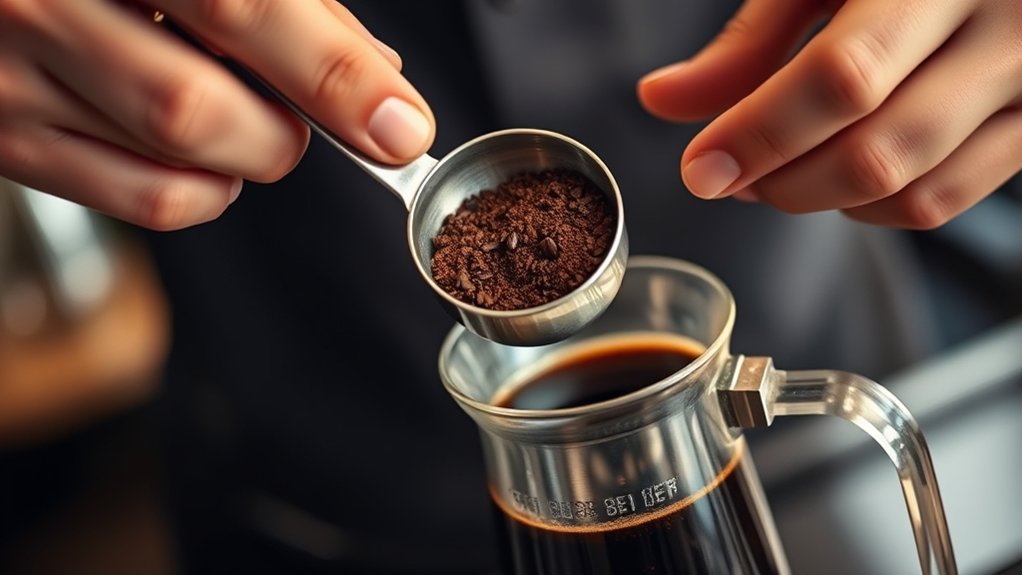
Since the coffee-to-water ratio directly impacts strength and flavor intensity, adjusting it is one of the most effective ways to make your brew bolder. Start by increasing the amount of coffee grounds relative to water. For example, shift from a 1:17 to a 1:15 ratio to extract more concentrated flavors.
Adjust your coffee-to-water ratio, like from 1:17 to 1:15, for a bolder, richer brew.
Keep in mind that different coffee bean varieties absorb water uniquely. So, you might need to experiment to find the perfect balance for your preferred beans.
Your brewing equipment also plays a role. French press and espresso machines often require different ratios than drip coffee makers.
Use a precise scale to measure coffee and water for consistent results. By fine-tuning the coffee-to-water ratio, you can discover richer, more robust flavors tailored to your taste.
Give it a try and see what works best for you!
How Water Temperature Affects Coffee Strength
Because water temperature directly influences how compounds are extracted from coffee grounds, it plays a crucial role in determining your brew’s strength and flavor profile.
When you use water that’s too cool, extraction slows, resulting in a weak, underdeveloped cup.
Conversely, overly hot water can over-extract bitter compounds, overpowering your coffee’s natural nuances.
Ideal brewing temperature typically ranges between 195°F and 205°F, balancing the extraction of oils, acids, and sugars.
Keep in mind, water chemistry also impacts extraction efficiency.
Minerals in your water can enhance or hinder flavor development.
Adjusting brewing temperature in harmony with your local water chemistry lets you maximize strength without sacrificing clarity.
Why Brew Time Matters: Optimizing Extraction for Boldness

When you control brew time carefully, you directly influence how much flavor and strength your coffee develops.
Too short a brew time under-extracts the grounds, resulting in weak coffee lacking depth and coffee aroma.
Too long, and you risk over-extracting, which brings bitterness and muddles the desired boldness.
Finding the sweet spot ensures a balanced, rich cup bursting with aroma and flavor.
Maintaining brewing consistency is key. Use a timer and stick to your preferred brew duration to replicate that perfect strength every time.
Whether you’re using a French press or pour-over, adjusting brew time fine-tunes extraction and unlocks the full potential of your beans.
Prioritize precise timing, and you’ll enjoy a consistently bold, aromatic cup that stands out.
Using Fresh Coffee Beans to Boost Coffee Strength
You’ll notice a stronger, richer flavor when you use fresh coffee beans because their oils and aromas haven’t faded yet. It really makes a difference in how bold your coffee tastes.
To keep your beans potent, just store them in an airtight container and keep them away from heat, light, and moisture. Doing this helps preserve their freshness, so every cup you brew packs maximum strength.
Importance Of Bean Freshness
Although many factors influence coffee strength, the freshness of your beans plays a crucial role in delivering a bold, intense flavor. When you select freshly roasted coffee beans, the unique characteristics tied to the coffee bean origin shine through, enhancing the complexity of your brew.
Fresh beans contain volatile oils that amplify aroma and taste, which stale beans lose over time. Using modern brewing equipment guarantees these fresh flavors extract fully, giving you a stronger cup without bitterness.
| Fresh Beans | Stale Beans |
|---|---|
| Rich aroma | Faded aroma |
| Vibrant flavor | Flat taste |
| Enhanced strength | Weak intensity |
| Optimal extraction | Poor extraction |
Choosing fresh beans transforms your coffee experience, making every sip bold and satisfying. It really makes a difference you can taste!
Proper Bean Storage Methods
Since fresh beans are key to a strong coffee, storing them properly is vital to preserve their quality. To maintain coffee bean freshness, you need to protect the beans from air, moisture, heat, and light. All of these can degrade the flavor.
Choosing the right storage container options can make a huge difference in your brew’s strength and aroma. Here’s what to keep in mind:
- Use airtight containers made of ceramic, glass, or stainless steel to block out air and moisture.
- Store beans in a cool, dark place. Avoid the fridge or freezer because they can cause condensation.
- Buy coffee in small batches so you can use it while it’s still fresh.
How Coffee Strength Is Defined and Measured
When you want to make your coffee stronger, it helps to understand how strength is defined and measured. Coffee strength refers to the concentration of dissolved solids in your brew, which directly impacts flavor intensity and body.
Making coffee stronger starts with understanding that strength means the concentration of dissolved solids affecting flavor and body.
Different coffee bean varieties have varying inherent strengths due to their chemical composition, so selecting the right beans is essential.
Brewing equipment also plays a key role. Devices like espresso machines extract coffee differently compared to drip brewers, which affects how strong your coffee tastes.
You can measure strength using Total Dissolved Solids (TDS) with a refractometer. This gives you an objective reading of your coffee’s concentration.
By grasping these factors, you gain control over your coffee’s boldness. This lets you tailor the brewing process and equipment choices to get the strong, flavorful cup you want.
It’s all about knowing what affects strength so you can brew just the way you like it.
How to Avoid Over-Extraction That Masks Strength
If you want your coffee to taste strong without bitterness, you need to avoid over-extraction. This happens when too many compounds dissolve from the grounds, resulting in harsh, unpleasant flavors. Over-extraction masks the true strength by overwhelming the balanced flavor and dulling aroma enhancement.
To keep your brew bold yet smooth, focus on controlling extraction time and grind size.
Here’s how to avoid over-extraction:
- Use a coarser grind to slow down extraction and preserve flavor balancing.
- Limit brewing time to prevent excessive compound release.
- Maintain water temperature between 195°F and 205°F to optimize extraction.
Adding Coffee Boosters: Effective Ways to Boost Your Brew
You can easily boost your coffee’s strength by tossing in some natural flavor enhancers like cinnamon or vanilla extract. These spices and extracts don’t just make your coffee taste better—they add a whole new layer of complexity to your brew.
And here’s the thing: picking the right creamers and sweeteners can really take your cup to the next level. They add richness and intensity without covering up that bold coffee flavor you love.
Natural Flavor Enhancers
How can you intensify the flavor of your coffee without simply adding more grounds? Natural flavor enhancers offer a clever way to elevate your brew through subtle flavor balancing and aroma enhancement. Instead of overpowering bitterness, these boosters refine your cup’s complexity and richness.
Try these effective natural options:
- Add a pinch of sea salt to reduce bitterness and highlight sweetness.
- Stir in a bit of unsweetened cocoa powder for a deep, chocolatey undertone.
- Use a splash of cold brewed coffee concentrate to amplify strength and aroma without excess grounds.
Each method enhances your coffee’s profile naturally, helping you craft a bolder, more satisfying cup. Give them a try and see which one hits the perfect balance for your palate. It can really enrich your morning ritual.
Spices And Extracts
While natural flavor enhancers subtly refine your coffee’s complexity, spices and extracts take your brew to a new level by injecting bold, distinctive notes that complement its inherent richness. You can experiment with spice blends like cinnamon, cardamom, or nutmeg. Adding them directly to your grounds before brewing releases warm, aromatic flavors that deepen your coffee’s profile.
Alternatively, try a few drops of extract flavors such as vanilla, almond, or hazelnut after brewing to introduce concentrated, nuanced layers without diluting strength. These boosters intensify your cup’s character, making each sip more vibrant and memorable.
Creamers And Sweeteners
Enhancing your coffee with spices and extracts sets a flavorful foundation, but balancing boldness with smoothness often calls for the right creamers and sweeteners. Choosing the perfect addition can elevate your brew without overpowering its strength.
When selecting creamers, consider those that complement your coffee’s intensity and texture.
Mastering milk frothing also plays a vital role, lending a velvety finish and enabling you to experiment with coffee art for a visually appealing cup.
Sweeteners should enhance, not mask, the coffee’s natural flavors.
Try these effective boosters:
- Whole milk or oat milk, for creamy richness and smooth froth
- Natural sweeteners like honey or maple syrup, to add subtle sweetness
- Flavored creamers with hints of vanilla or caramel, to deepen complexity
Use these to achieve a bold yet balanced cup.
Troubleshooting Common Issues When Making Stronger Coffee
Even the most careful coffee makers can run into issues when trying to brew a stronger cup. If your coffee lacks the rich coffee aroma you expect, check your brewing temperature first. Water that’s too hot can scorch the grounds, causing bitterness, while water that’s too cool won’t extract enough flavor.
Perfect brewing temperature is key to unlocking rich coffee aroma without bitterness or weak flavor.
Aim for 195-205°F to unlock bold, balanced notes.
Another common problem is over-extraction, which happens when you brew too long or use too fine a grind. This can make your coffee harsh rather than strong.
If your cup tastes weak despite using more grounds, try adjusting your grind size or brewing time. By fine-tuning these variables, you’ll consistently enjoy a robust, aromatic coffee that satisfies your bold flavor cravings.
Frequently Asked Questions
Can Milk or Cream Affect the Perceived Strength of My Coffee?
Yes, cream addition can affect how strong your coffee tastes. While cream doesn’t change the actual caffeine content, it can lead to flavor masking, softening coffee’s boldness and making it seem milder.
If you want to preserve that strong, intense flavor, try adding less cream or opt for alternatives that won’t dilute the taste.
This way, you keep the robust character without sacrificing richness.
Does the Type of Coffee Bean Origin Influence Strength?
Yes, the type of coffee bean origin definitely influences strength. Different bean varieties bring unique flavor profiles, which affect how bold and intense your coffee tastes.
For example, beans from regions like Sumatra often have richer, earthier notes, making your brew feel stronger. In contrast, Ethiopian beans might offer lighter, fruity flavors that seem less intense.
How Does Altitude Impact Coffee Brewing Strength?
Altitude effects impact your coffee’s strength by altering brewing pressure. At higher altitudes, the atmospheric pressure is lower, which means water boils at a lower temperature.
This can reduce extraction efficiency, making your coffee taste weaker.
To counter this, you can increase brewing pressure or adjust grind size and brew time.
Can Decaf Coffee Be Made Strong and Bold?
You don’t need a time machine to make decaf coffee strong and bold. By focusing on flavor enhancement through careful bean roasting, you can bring out richer, intense notes. Darker roasts work great for boosting decaf’s profile.
Grinding finely and using fresh beans also help concentrate flavor. Just remember, decaf’s caffeine is low. But with the right techniques, you’ll enjoy a robust cup that satisfies your craving for boldness without the jitters.
Are There Health Risks to Drinking Very Strong Coffee?
Yes, drinking very strong coffee can pose health risks, especially if you consume too much caffeine. You might experience caffeine overdose symptoms like jitters, headaches, or a rapid heartbeat.
Over time, excessive caffeine intake can negatively affect your heart health. It could increase the risk of high blood pressure or arrhythmias.
So, it’s important to keep an eye on how much strong coffee you drink.
Listen to your body and watch for any signs that you might be having too much. That way, you can avoid these potential problems and still enjoy your coffee.
Conclusion
Now that you know how grind size, brewing method, and water temperature impact strength, you can confidently tweak your process. While many believe longer brew times always mean stronger coffee, over-extraction can actually dull bold flavors.
Instead, focus on balance. Adjust your coffee-to-water ratio and extraction time carefully. With these tips, you’ll craft a robust cup that highlights your coffee’s true character.
This proves strength isn’t just about intensity but quality too.