How Many Scoops Of Coffee For 6 Cups – Brewing Ratio Guide
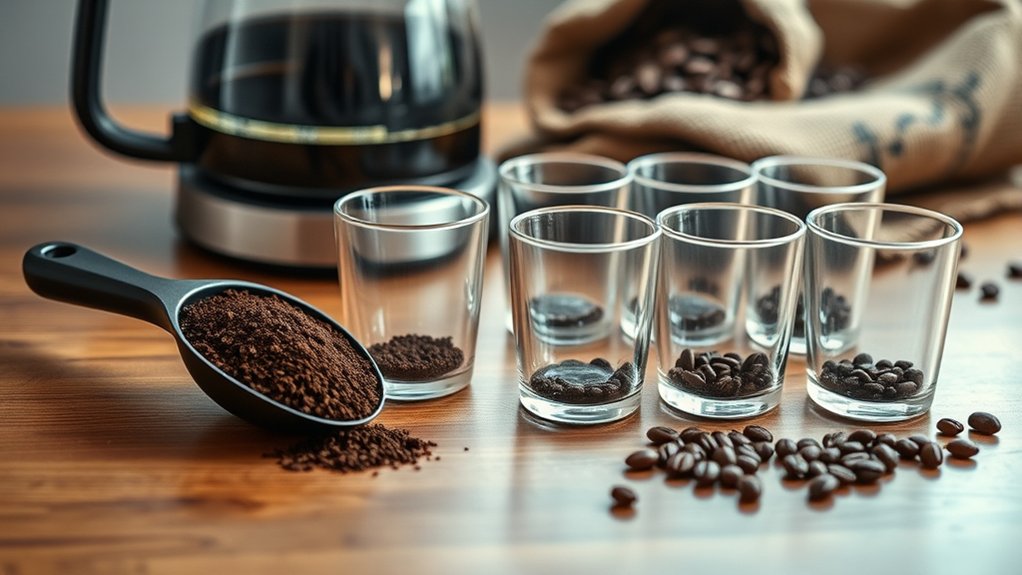
For 6 standard 6-ounce cups, use about 3 to 6 scoops of coffee grounds. Each scoop holds roughly 2 tablespoons or 10 grams. Stick to a coffee-to-water ratio near 1:16 for balanced flavor, and adjust scoops depending on how strong you like it.
Use standard scoops or tablespoons for easy measuring. Remember, cup size matters because larger mugs need more grounds. Proper measurement and storage help keep your brew consistent and flavorful.
Feel free to explore how to fine-tune your coffee to get the perfect cup every time. It’s all about finding what works best for your taste!
How Many Scoops of Coffee Do You Need for 6 Cups?
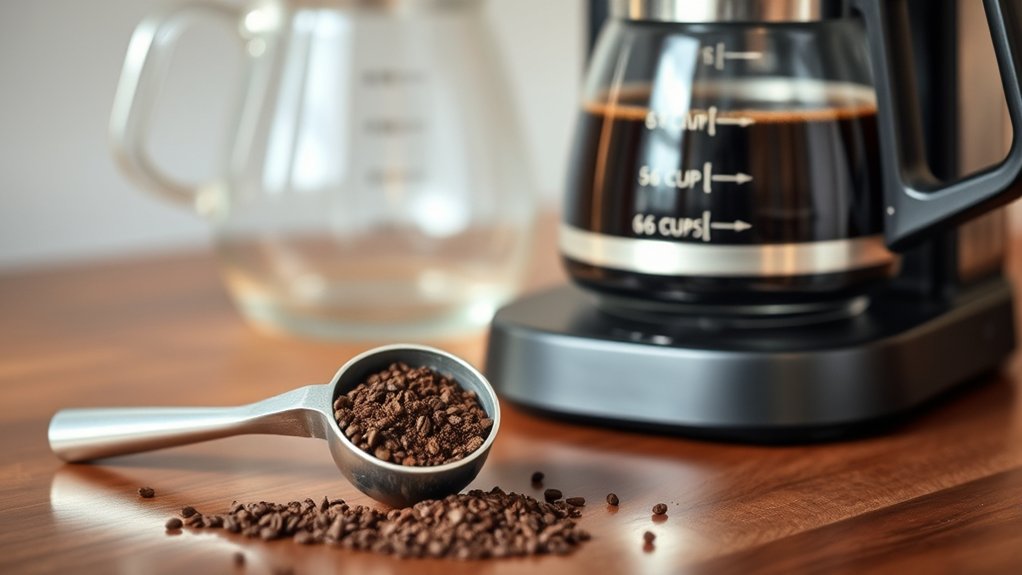
Although the exact amount varies with your taste, you’ll generally need 3 to 6 scoops of coffee grounds to brew 6 cups. Each scoop holds about 2 tablespoons, so using 4 to 6 tablespoons guarantees a balanced flavor for 6 oz cups. Adjust the scoops according to how strong you want your coffee.
Remember, the perfect brewing temperature between 195°F and 205°F helps extract the best flavor from your grounds.
Proper coffee storage is essential too. Keep your beans airtight and away from moisture to maintain freshness and flavor integrity.
What Is the Standard Coffee-to-Water Ratio?
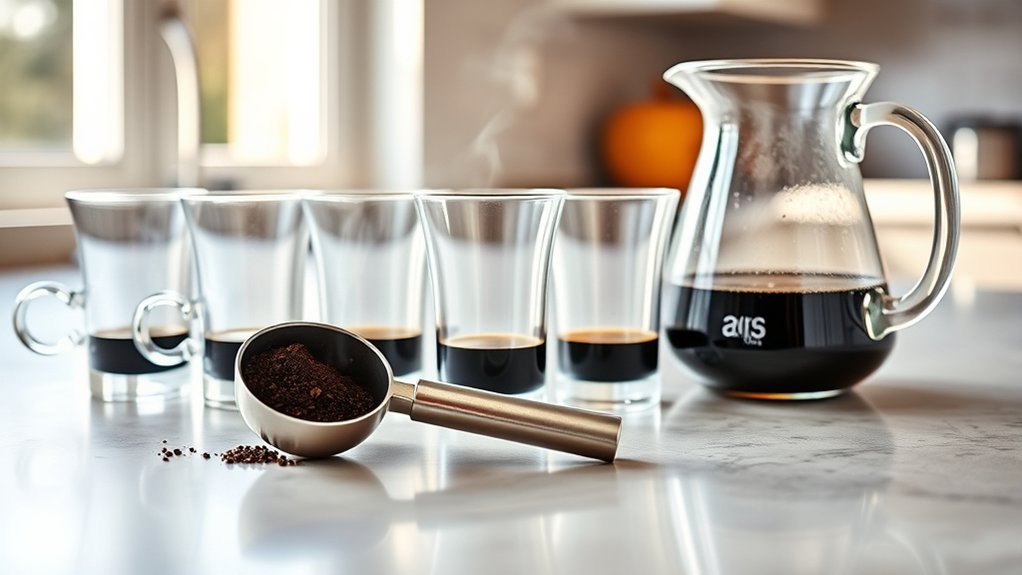
When you brew coffee, understanding the standard coffee-to-water ratio is essential for achieving the right balance of flavor and strength. The typical ratio is about 1:16, which means 1 gram of coffee per 16 ml of water. This range, often called the Golden Ratio (1:15 to 1:18), helps you extract oils and aromas effectively.
Keep in mind, brewing temperature and proper coffee storage also influence the final taste. Here’s a quick reference:
| Coffee (grams) | Water (ml) | Ratio |
|---|---|---|
| 10 | 160 | 1:16 |
| 15 | 240 | 1:16 |
| 20 | 320 | 1:16 |
Feel free to adjust the ratio slightly based on your taste preferences for stronger or milder coffee. It’s all about finding what works best for you.
How Cup Size Affects Coffee Scoop Measurements
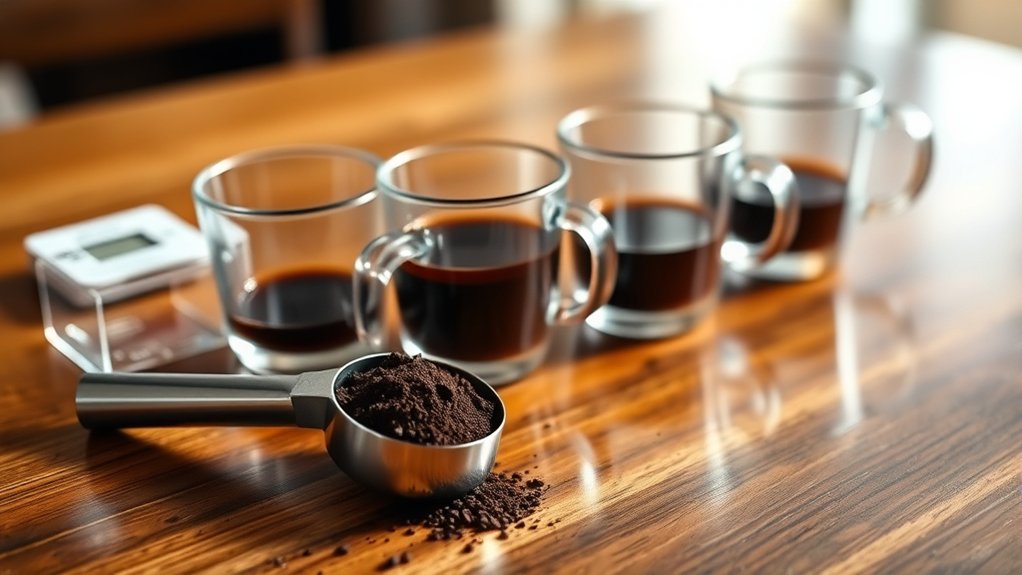
Since the size of your coffee cup directly impacts the amount of coffee grounds you need, understanding cup measurements is vital for consistent flavor. A standard coffee cup holds 6 ounces, and using about 2 tablespoons of coffee per cup typically delivers balanced taste.
However, if your cup capacity is larger, say 8 or 10 ounces, you’ll need to increase coffee grounds accordingly to maintain measurement consistency and avoid weak brews. Recognizing the difference between a 6-ounce standard cup and bigger mugs helps you adjust scoop amounts precisely.
How to Convert Coffee Scoops to Tablespoons and Grams
You can easily convert coffee scoops to tablespoons by multiplying the number of scoops by two, since one scoop holds about two tablespoons. So, if you have three scoops, that’s roughly six tablespoons.
Now, if you want to measure in grams, just multiply the number of scoops by ten. Each scoop typically equals 10 grams of coffee grounds. That way, three scoops would be about 30 grams.
Using these conversions makes it simple to keep your coffee strength and flavor consistent every time you brew. It’s an easy trick that helps you get the perfect cup without any guesswork.
Scoop To Tablespoon Conversion
Although coffee scoops are a convenient way to measure grounds, converting them to tablespoons or grams guarantees accuracy in your brew. One scoop equals 2 tablespoons or about 10 grams of coffee. Knowing this helps you maintain consistency, which is essential for flavor enhancement.
Proper coffee storage also keeps your grounds fresh, preserving taste. To convert scoops to tablespoons, just multiply by 2; for grams, multiply scoops by 10.
| Scoops | Tablespoons |
|---|---|
| 1 | 2 |
| 2 | 4 |
| 3 | 6 |
| 4 | 8 |
Using precise measurements improves your brew’s balance and brings out the best flavor with every cup.
Grams Per Scoop Measurement
When measuring coffee scoops, understanding their weight in grams helps you achieve consistent brewing results. One standard scoop holds about 2 tablespoons, which weighs roughly 10 grams. Since 1 tablespoon equals around 5 grams, converting scoops to grams is pretty straightforward: 1 scoop equals 10 grams.
For precise control, especially when factoring in coffee bean freshness and perfect brewing temperature, use a digital scale rather than relying solely on volume measurements. This way, you guarantee your coffee grounds remain consistent, preserving flavor and extraction quality.
When adjusting recipes for different brewing methods, remember this 10-gram standard per scoop. Accurate gram measurement helps you maintain the ideal coffee-to-water ratio, making your 6-cup brew both balanced and flavorful every time.
Why Consistent Coffee Measurement Matters for Brewing
Because consistent coffee measurement directly affects the strength and flavor of your brew, it’s essential to use the same scoop size each time. Precise measurement guarantees your coffee grounds react predictably with brewing temperature, avoiding bitterness or weak taste.
It also helps you maintain quality despite variations in coffee storage conditions.
Keep these points in mind for consistent results:
- Use a standard scoop or scale for accuracy
- Measure coffee grounds before brewing
- Adjust amounts based on your preferred strength
- Account for brewing temperature in extraction time
- Store coffee properly to preserve freshness and flavor
How Grind Size Affects Coffee Measurement
Consistent measurement sets the foundation, but how you grind your coffee also plays a key role in determining the right amount to use. Grind size directly affects surface area, which influences extraction rate and flavor intensity.
With fine grinds, extraction happens faster, so you might need less coffee or adjust brewing time, especially considering your brew temperature to avoid over-extraction.
Coarse grinds extract slowly, typically requiring a higher coffee-to-water ratio for balanced flavor. Maintaining grind consistency ensures predictable results, allowing you to fine-tune your coffee measurement precisely.
By adapting your scoop amount based on grind size, you can achieve ideal extraction without sacrificing taste.
How Brewing Methods Affect Coffee Scoop Usage
Although coffee measurement principles remain the same, brewing methods demand different scoop amounts and grind sizes to reveal their best flavors. You also need to think about coffee bean freshness and brewing temperature because both impact extraction and taste.
Here’s how scoop usage varies by method:
- Drip brewing: 3-4 scoops for 6 cups, medium grind, standard brewing temperature.
- French press: slightly more coffee per cup with a coarser grind, best around a 1:15 ratio.
- Espresso: fine grind, 1-2 tablespoons per shot, hotter brewing temperature, concentrated flavor.
- Cold brew: considerably more grounds per scoop, coarser grind, lower brewing temperature, higher coffee-to-water ratio.
Remember to adjust scoop amounts based on freshness to keep your coffee strength and flavor just right.
Tailoring scoops to your brewing method helps ensure a balanced cup every time.
Digital Scale vs. Coffee Scoop Accuracy
You’ll get more consistent coffee by weighing your grounds on a digital scale. It measures precise amounts down to 0.1 grams, which really helps keep things consistent.
Scoops are definitely convenient, but they can vary in size. That means small differences can sneak in, affecting the flavor and strength of your coffee.
Precision Measurement Differences
When aiming for the perfect brew, choosing between a digital scale and a coffee scoop really impacts your measurement accuracy. Precision matters because coffee flavor and brew temperature depend on consistent coffee-to-water ratios.
Here’s how they differ:
Digital scales measure weight in grams, which means you get repeatable accuracy every time. Scoops, on the other hand, measure volume. That can vary a lot depending on the density of the grounds and how tightly you pack them. Plus, scoop sizes differ across brands, so you mightn’t get the same amount each time.
Using a scale helps reduce errors, especially when you’re making multiple cups. And when your measurements are precise, you have better control over extraction. That means enhanced flavor and keeping your brew temperature just right.
Convenience Versus Accuracy
Because coffee measurements directly affect flavor and strength, choosing between a digital scale and a coffee scoop comes down to balancing convenience with accuracy. A digital scale offers precise weight-based measurements, eliminating guesswork and ensuring consistent coffee-to-water ratios essential for flavor consistency.
For example, measuring 55 grams per liter of water guarantees you hit the ideal strength every time. This improves brewing efficiency, especially when making larger batches.
On the other hand, scoops measure by volume, which can vary based on grind density and packing, introducing variability in strength and flavor.
While scoops are quicker and more convenient, their lack of precision can compromise consistency. So, if you really care about exact flavor profiles and efficient brewing, a digital scale is the better choice over a coffee scoop.
Coffee Maker Cup Sizes Explained
Although coffee makers often label their measurements as “cups,” these don’t match the standard 8-ounce cups you might expect. Instead, they usually refer to smaller 5 to 6-ounce servings. Understanding this difference helps you maintain the right coffee-to-water ratio and optimize coffee bean freshness and brewing temperature for a balanced cup.
Coffee maker “cups” are smaller than standard 8-ounce cups, usually 5 to 6 ounces, ensuring proper brew balance.
Keep in mind, a standard coffee cup is about 6 ounces, not 8. Coffee maker “cups” typically equal 5 ounces of brewed coffee. A 12-cup coffee maker holds roughly 60 ounces total.
This equates to about 10-12 smaller cups, not 12 standard ones. So, adjust scoops accordingly to preserve brewing temperature and flavor consistency.
Knowing this guarantees you measure accurately and enjoy a perfectly brewed coffee every time.
Tips for Measuring Coffee Grounds Without a Scale
You can use standard coffee scoops or measuring tablespoons to estimate your coffee grounds without a scale. One scoop usually holds about 2 tablespoons, which is roughly 10 grams.
Using Standard Coffee Scoops
When you don’t have a kitchen scale, using a standard coffee scoop is an easy and reliable way to measure your coffee grounds. One scoop holds about 2 tablespoons, which makes it simple to keep the right coffee-to-water ratio.
For 6 cups, aim for 3 to 4 scoops depending on how strong you like your coffee. Proper scooping helps you get a balanced flavor without any guesswork.
Here are some tips to keep in mind when using a scoop:
Store your coffee properly to keep it fresh and flavorful. Use fresh grounds to get the most out of your brewing temperature. Make sure to level off your scoops so your measurements stay consistent. And don’t overpack the grounds—that can lead to uneven extraction.
Feel free to adjust the number of scoops a little to suit your taste and cup size. Using scoops is a simple way to brew strong, tasty coffee without needing a scale.
Measuring Tablespoons Accurately
Standard coffee scoops offer convenience, but measuring tablespoons gives you more control over your coffee-to-water ratio, especially if you don’t have a scale.
Use a standard tablespoon, which holds about 5 grams of coffee grounds, and level it off with a straight edge to avoid over-measuring.
Since 2 tablespoons roughly equal one standard scoop, you can standardize your measurements easily.
Measure in small batches, record the tablespoons used, and adjust as needed for grind size variations that affect volume.
Proper coffee storage preserves freshness, which means your measured grounds deliver ideal flavor at the right brew temperature.
Consistency in measuring tablespoons helps maintain the perfect balance between coffee strength and brew temperature.
This leads to a better cup every time without relying on a scale.
Visual Portion Estimation
Although using a scale offers the most accuracy, visual portion estimation provides a practical alternative when one isn’t available. By training your eye, you can maintain consistent coffee strength and enjoy your coffee art with every brew.
Here are tips for measuring grounds without a scale: use a standard coffee scoop holding about 2 tablespoons (10 grams) as a volume guide. You can also compare coffee grounds to common objects like a ping-pong or golf ball to estimate volume.
Opt for a heaping tablespoon (1.5x a level tablespoon) to adjust strength without scales. Aim for a mound that fills a scoop or tablespoon without overflowing.
Don’t forget to store your beans properly in airtight containers to preserve freshness and ensure reliable portioning.
Mastering visual estimation complements good bean storage and really enhances your coffee brewing ritual.
Adjusting Scoop Amounts for Stronger or Milder Coffee
Because your preferred coffee strength varies, adjusting the number of scoops per 6 ounces of water lets you tailor the brew to your taste. Increasing scoops above one intensifies flavor, while decreasing scoops creates a milder cup.
Proper coffee storage preserves freshness, ensuring accurate strength adjustments. And maintaining the ideal brewing temperature enhances extraction.
| Strength Level | Scoops per 6 oz. Water |
|---|---|
| Milder | 0.75 |
| Standard | 1 |
| Stronger | 1.5 – 2 |
Adjust scoops in small increments to avoid bitterness or weak flavors. Keep in mind that consistent coffee storage and stable brewing temperature help maintain the balance. This way, your adjustments reliably produce the desired strength every time.
How to Customize Your Coffee Strength Using Scoops
When you want to customize your coffee strength, adjusting the number of scoops per 6 cups of water is a simple and effective method. Start with a baseline of 3 scoops (6 tablespoons) for a balanced coffee flavor.
From there, tweak your scoop count to match your preference and brewing temperature for the best extraction.
Use 2 scoops (4 tablespoons) for a lighter, milder taste. Increase to 4 scoops (8 tablespoons) for a stronger, more robust cup.
Adjust scoops proportionally for different cup sizes.
Feel free to experiment between 2 and 4 scoops to find your ideal strength. Just keep your brewing temperature consistent to maintain flavor balance.
This precise control helps you dial in a perfect brew tailored to your taste. It’s all about finding what works best for you!
Frequently Asked Questions
Can I Use Different Coffee Beans With the Same Scoop Measurement?
You can use different coffee bean varieties with the same scoop, but you’ll need grind size adjustments and possibly tweak scoop amounts to keep flavor consistent. Bean density and size affect how much coffee your scoop actually holds.
How Does Water Temperature Influence the Coffee-To-Water Ratio?
You can’t judge a book by its cover. Water temperature directly impacts flavor extraction and water absorption.
If the water is too hot or too cold, you’ll need to adjust the coffee-to-water ratio. This helps balance the strength and avoid bitterness or weakness.
It’s all about finding the sweet spot for the perfect cup. So, pay attention to the temperature and tweak your ratio accordingly.
What Is the Ideal Brewing Time for 6 Cups of Coffee?
You should aim for a brewing duration of 4 to 6 minutes for 6 cups, adjusting your coffee grind accordingly.
A coarser grind suits longer brewing, while finer grinds need shorter times to avoid bitterness or sourness.
It’s all about finding the right balance that works for your taste. Give it a try and tweak as needed!
Should I Rinse the Coffee Filter Before Brewing?
Yes, you should rinse the coffee filter before brewing. The rinsing process removes paper residue and oils, improves aroma, and helps the filter lay flat. This ensures even water flow and a cleaner, more refined cup of coffee.
It’s a simple step that can really make a difference in taste. Plus, it’s quick and easy to do. So, why skip it? Give it a try next time you brew!
How Does Altitude Affect Coffee Brewing Measurements?
Altitude impact lowers water boiling points, so you’ll need measurement adjustments. Using slightly more coffee or extending brew time can help guarantee proper extraction.
Adjust coffee-to-water ratios carefully to maintain flavor despite temperature changes at high elevations. It’s all about finding that sweet spot so your brew tastes just right. Don’t worry, a few tweaks will make a big difference!
Conclusion
If you’ve ever wondered how many scoops of coffee you need for 6 cups, it’s no coincidence that the standard ratio is about one scoop per cup. But since cup sizes vary, adjusting your scoops guarantees the perfect brew every time.
Remember, consistent measurement isn’t just a habit, it’s the key to customizing your coffee strength exactly how you like it. So grab your scoop, measure precisely, and enjoy your ideal cup!