Is Pour Over Coffee Better Than Drip – Comparison And Benefits Explained
If you enjoy hands-on brewing with precise control, pour over coffee offers a brighter, more complex flavor by letting you adjust water temperature, grind size, and pouring technique. It’s perfect for smaller batches and highlights fresh beans’ unique notes.
Drip coffee, meanwhile, suits you if you want convenience, speed, and larger quantities but with a simpler, mellower taste. Want to know which method fits your routine and taste best? Keep exploring to discover more.
Key Differences Between Pour Over and Drip Coffee
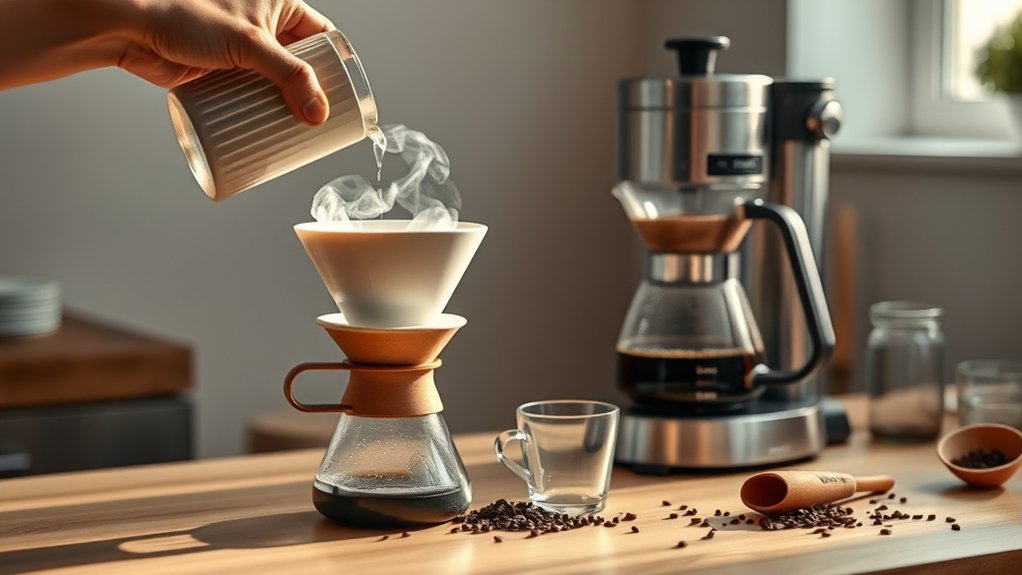
Although both methods brew coffee, pour over and drip coffee differ considerably in control and experience.
With pour over coffee, you get precise control over water temperature, pouring speed, and brew time. This lets you craft a nuanced flavor profile that highlights brighter, more delicate notes.
Pour over coffee offers precise control, creating nuanced flavors with bright, delicate notes.
Drip coffee, on the other hand, offers a less customizable brewing method. It produces a rounded, mellow cup, perfect for convenience and larger batches.
If you’re a coffee enthusiast who enjoys the ritual of the brewing process, pour over coffee appeals with its hands-on approach.
Cleanup is also simpler for pour over equipment since it usually just requires rinsing.
Drip coffee makers demand more maintenance and descaling to keep performing well.
Both brewing methods have unique advantages depending on your preferences and lifestyle.
Brewing Variables That Impact Coffee Flavor
When you control brewing variables like water temperature, grind size, and pouring technique, you reveal the full potential of your coffee’s flavor.
With pour over coffee, you can precisely manage water temperature within the ideal 195-205°F range, optimizing flavor extraction.
Adjusting grind size to medium-fine helps avoid over- or under-extraction, balancing taste perfectly.
Your pouring technique plays an essential role too, allowing even saturation and variable flow rates that highlight complexity.
Also, blooming, the initial wetting of grounds, releases trapped gases, enhancing flavor and reducing bitterness.
Longer brew time in this brewing method further develops nuanced flavors, unlike quicker drip coffee machines.
Comparing Flavor Profiles: Pour Over vs. Drip Coffee
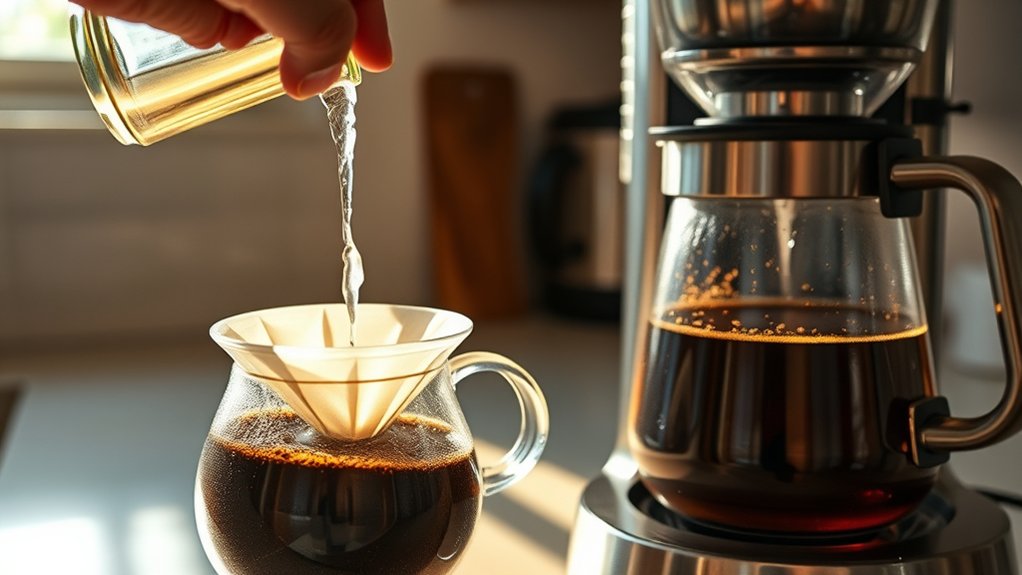
Since you control every step in pour over coffee, you’ll notice a brighter, more complex flavor compared to the mellow, rounded taste typical of drip coffee.
The manual brewing process in pour over coffee allows precise control over water temperature and pouring technique, which influences the extraction process a lot.
Drip coffee’s automated brewing yields a consistent but less nuanced flavor profile. Coffee enthusiasts often prefer pour over because it highlights unique flavor notes and aromas.
- Brighter acidity in pour over coffee
- Mellow, uniform taste in drip coffee
- Greater clarity and complexity with manual brewing
- Precise water temperature control enhances extraction
- Customized flavor experience appeals to coffee lovers
This contrast explains why many favor pour over coffee for an intricate taste journey.
Equipment Needed for Pour Over and Drip Coffee
To brew your perfect cup, you’ll need different equipment depending on whether you choose pour over or drip coffee.
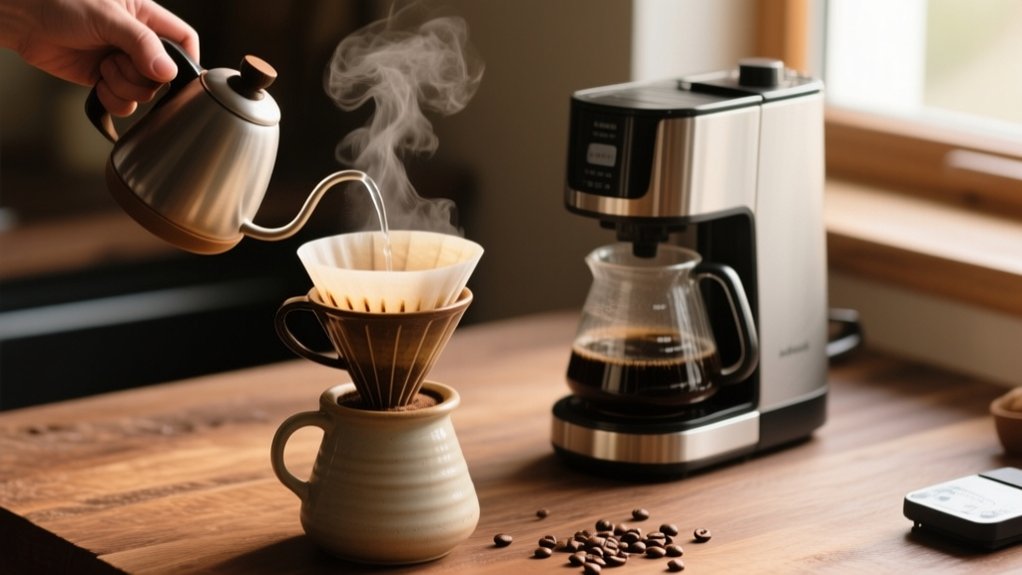
For pour over equipment, you’ll want a pour over cone like a V60 or Chemex, a gooseneck kettle for precise pouring, a grinder for medium-fine coffee grounds, and filters.
Essential pour over gear includes a V60 or Chemex cone, gooseneck kettle, grinder, and filters for perfect coffee.
This brewing method is ideal for 1-2 cups, offering simplicity and minimal maintenance. Usually, it just requires a quick rinse.
On the other hand, drip coffee equipment centers around automatic drip coffee machines, capable of brewing 4 to 12 cups per cycle.
These machines often include features like brew strength selectors and warming plates but require more maintenance, including regular descaling.
Plus, drip machines tend to use plastic parts, affecting durability compared to the sturdy glass or ceramic used in pour over gear.
Time and Effort: Manual Pour Over vs. Automated Drip
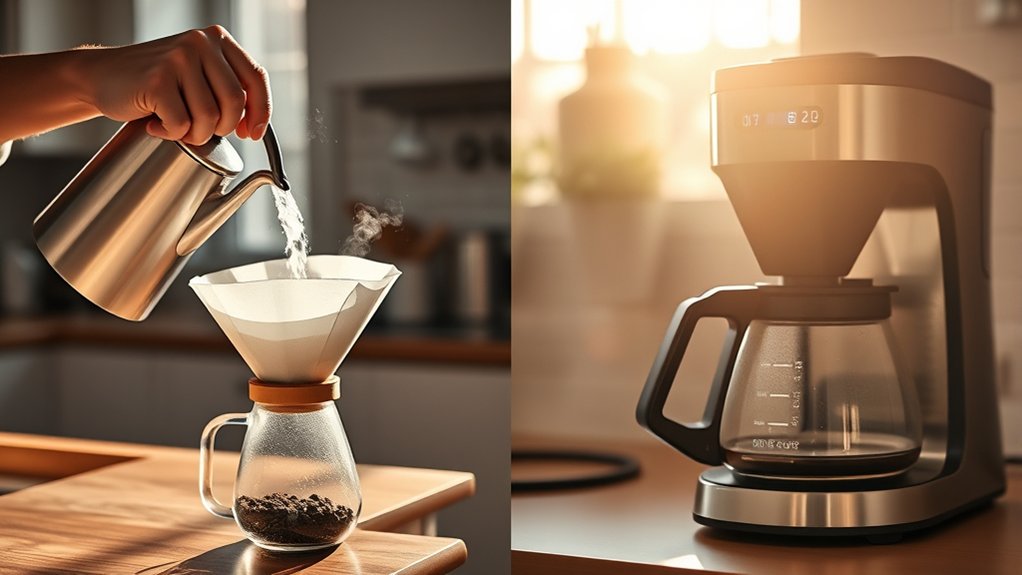
You’ll spend about 3-5 minutes manually brewing pour over coffee, which lets you engage with every step of the process.
It’s a bit more hands-on, so if you enjoy being involved, it’s a great choice.
On the other hand, automated drip machines take about 5-10 minutes but handle most of the work for you.
They’re perfect when you want convenience without much effort.
Brewing Time Comparison
While both pour over and drip coffee aim to deliver a great cup, they demand very different amounts of your time and effort.
Pour over coffee requires about 4-5 minutes of brewing time with active involvement in pouring and timing. This gives you full control and customization over the brewing process.
In contrast, a drip coffee maker brews 4-12 cups in 5-10 minutes with minimal hands-on effort. It emphasizes convenience over ritual. Your choice depends on how much time you want to invest and how many servings you need.
- Pour over coffee involves precise pouring and timing
- Drip coffee maker offers a mostly hands-off brewing process
- Pour over suits 1-2 cups; drip works better for larger quantities
- Brewing time for pour over is shorter but requires focus
- Drip coffee prioritizes convenience factor for busy routines
Convenience Versus Engagement
Although both methods produce coffee, manual pour over demands more time and effort than automated drip brewing.
When you pour manually, you engage deeply with each step, controlling water temperature, pouring speed, and grind size. This higher effort level offers unmatched quality control, letting you tailor the brewing process to your taste.
On the other hand, drip coffee makers prioritize convenience, brewing multiple cups with just a button press and minimal involvement.
If you’re pressed for time or need larger batches, drip machines are the clear choice.
But if you enjoy the ritual and precision of crafting a cup, pour over delivers a rewarding experience.
Ultimately, your preference depends on whether you value convenience or the hands-on engagement of manual brewing.
How Batch Size Affects Pour Over vs. Drip Coffee
When you brew smaller batches with a pour over, you get more control over flavor and extraction time. It’s usually perfect for making just 1 or 2 cups.
On the other hand, drip coffee makers are designed to handle larger volumes. They save you time but often sacrifice a bit of that rich flavor concentration.
Ideal Batch Sizes
If you usually make just a cup or two, pour over coffee suits your needs perfectly by offering a hands-on approach that brings out subtle flavors.
This brewing method excels at personalized brewing, allowing you to savor the flavor nuances in every cup.
However, if you need to serve larger quantities, drip coffee is more convenient and efficient. Its automated process handles bigger batch sizes effortlessly, making it ideal for multiple servings without sacrificing consistency.
Consider these points when choosing your brewing method:
- Pour over coffee is perfect for 1–2 cups
- Drip coffee handles 4 to 12 cups or more
- Pour over offers precise control per cup
- Drip coffee provides convenience for larger batches
- Batch sizes influence your choice between quality and volume
Brewing Time Differences
Because batch size directly impacts brewing time, you’ll notice distinct differences between pour over and drip coffee methods.
Pour over coffee typically takes 3 to 4 minutes per cup, demanding your full attention to control pouring speed and water temperature. This slower brewing time promotes better flavor extraction but limits you to small batch sizes, usually one or two cups.
On the other hand, drip coffee machines brew larger batch sizes of 4 to 12 cups in about 5 to 10 minutes, making them much more convenient for busy mornings or gatherings.
The automated nature of drip coffee sacrifices some nuanced flavors for speed and ease.
Flavor Impact By Volume
Two key factors, batch size and brewing method, play a huge role in shaping the flavor of your coffee.
When you brew pour over coffee in smaller batches, you get precise control over water temperature and pouring technique. This improves extraction and highlights a vibrant flavor profile.
Drip coffee machines, on the other hand, brew larger volumes. This often dilutes flavors and produces a more uniform but less nuanced taste.
Consider these points about flavor impact by volume:
- Small batch size in pour over allows better saturation of coffee grounds
- Slower brewing process enhances flavor clarity and complexity
- Larger drip batches can dilute extraction quality
- Pour over’s controlled water temperature sharpens flavor notes
- Drip coffee offers convenience but less flavor detail
Choosing your batch size influences how rich and defined your coffee tastes.
Is Pour Over Coffee Right for You?
Wondering whether pour over coffee suits your brewing style? If you’re a coffee enthusiast who values hands-on brewing and savoring a rich flavor profile, this brewing method might be perfect for you.
Pour over coffee lets you control water temperature, pouring speed, and grind size, enhancing the quality and complexity of each cup. It’s ideal if you typically brew one to two cups and enjoy experimenting with subtle taste notes.
However, if convenience and speed are priorities, especially when making larger quantities, a drip coffee maker may better fit your needs.
Pour over demands more time and attention but rewards you with brighter, more delicate flavors from high-quality beans. It’s perfect when quality matters more than quantity.
Common Mistakes When Switching Brewing Methods
If you decide to switch from drip coffee to pour over, you might encounter a few common mistakes that can affect your brew.
Pour over coffee demands attention to detail in your brewing method, especially since it differs from drip coffee.
Key errors include neglecting the blooming phase or ignoring proper water temperature, both essential for flavor extraction.
Also, inconsistent grinding size and improper pouring technique can lead to uneven extraction.
Finally, not adjusting brew ratios to suit pour over can throw off the balance of your coffee.
Common mistakes to avoid:
- Using inconsistent grinding size
- Ignoring ideal water temperature (195-205°F)
- Skipping the blooming phase
- Pouring too quickly or unevenly
- Not recalibrating brew ratios for pour over coffee
Why Fresh Beans Matter for Both Brewing Styles
Fresh coffee beans make all the difference when brewing both pour over and drip coffee. Using stale beans means losing the vibrant flavor profile that specialty-grade coffee offers.
Whether you prefer pour over coffee or drip coffee, fresh coffee beans guarantee your brewing methods deliver peak extraction and highlight unique flavors. Pay close attention to grind size; medium-fine works best for both styles to maximize taste.
Even the most advanced brewing techniques can’t fix dull coffee from old beans. Investing in freshly roasted, high-quality beans from artisanal roasters elevates your cup every time.
Choosing Between Pour Over and Drip Coffee
How do you decide between pour over and drip coffee? It comes down to what matters most in your brewing method: precision or convenience.
Pour over coffee lets you control brewing variables like water temperature and pouring speed, revealing a brighter, nuanced flavor profile.
Drip coffee machines, on the other hand, prioritize speed and quantity. They’re ideal for busy schedules or multiple cups.
Coffee enthusiasts who enjoy the ritual and exploration often prefer pour over, while those valuing ease lean toward drip.
Consider these points:
- Pour over offers detailed control over extraction
- Drip brews larger batches quickly
- Flavor profile in pour over is more complex
- Cleanup is simpler with pour over gear
- Drip machines require more maintenance
Choose based on your taste priorities and lifestyle.
Frequently Asked Questions
Can I Use the Same Grind Size for Both Pour Over and Drip Coffee?
You can use the same grind size for both pour over and drip coffee, but expect some differences.
Grind consistency affects flavor extraction and brewing time, and equipment differences play a role too.
Pour over’s manual technique and precise water temperature let you control coffee strength and taste profile more closely.
Drip machines work well with a slightly coarser grind to avoid over-extraction.
Adjusting grind size based on your brewing technique enhances your coffee’s flavor.
How Does Water Quality Affect Pour Over and Drip Coffee Taste?
Water quality directly shapes your pour over and drip coffee taste by influencing flavor extraction.
High water hardness and unbalanced mineral content can cause bitterness or flatness, while proper pH balance (6.5-7.5) helps highlight coffee oils and acidity.
Brewing temperature also matters. Too hot or cold water affects extraction.
Plus, your filter type interacts with water, affecting the taste profile.
Using filtered water guarantees consistent, vibrant flavor in both methods.
Are There Specific Coffee Bean Types Better Suited for Pour Over?
Yes, you’ll want single origin beans for pour over since they highlight unique flavor profiles from specific origin regions.
Light to medium roast types work best because they preserve acidity levels and delicate tasting notes.
Freshness factors matter too. Use freshly roasted Arabica beans to maximize brightness.
Your brewing techniques can then really bring out subtle nuances, making the cup vibrant and complex, perfect for appreciating those distinct bean characteristics.
Can I Use a Reusable Filter for Both Brewing Methods?
Yes, you can use a reusable filter for both brewing methods, but make sure it fits your device.
Reusable filter benefits include reducing environmental impact and saving money.
Different filter material choices like metal or cloth affect coffee extraction and flavor profiles.
Pour overs often highlight nuanced tastes, while drip machines emphasize convenience.
Maintain your filter by cleaning it regularly to avoid buildup.
This brewing method versatility lets you enjoy great coffee while supporting sustainability.
What’s the Best Way to Clean Pour Over and Drip Coffee Equipment?
To clean your pour over and drip coffee equipment effectively, use gentle cleaning solutions like warm soapy water for carafes and brew baskets.
Rinse thoroughly to remove oils, especially from reusable filters.
Follow maintenance frequency guidelines. Rinse pour over parts after each use and descale drip machines every 1-3 months using vinegar-water solutions.
Always air dry before storing equipment to avoid mold.
Troubleshoot clogging by checking filters and descaling regularly for peak performance.
Conclusion
Whether you choose pour over or drip coffee, you’re really deciding how much control you want over your brew. It’s funny how both methods rely on fresh beans and water quality, yet deliver such different experiences.
If you enjoy ritual and precision, pour over might be your thing. But if convenience and consistency win you over, drip’s got your back. Either way, you’re in for a great cup, just brewed your way.