How Many Coffee Beans In A Cup Of Coffee – Bean Count Explained
You’ll need between 35 and 120 coffee beans for a cup, depending on roast and size. Dark roasts use fewer beans since they’re lighter and less dense, while light roasts need more to hit the right strength.
A standard 6-ounce cup usually calls for around 40 medium-roast beans. Grind size and brewing method also affect the amount you use.
If you want to perfect your coffee, there’s plenty more to explore about bean types, ratios, and brewing styles.
How Many Coffee Beans Are Needed Per Cup?
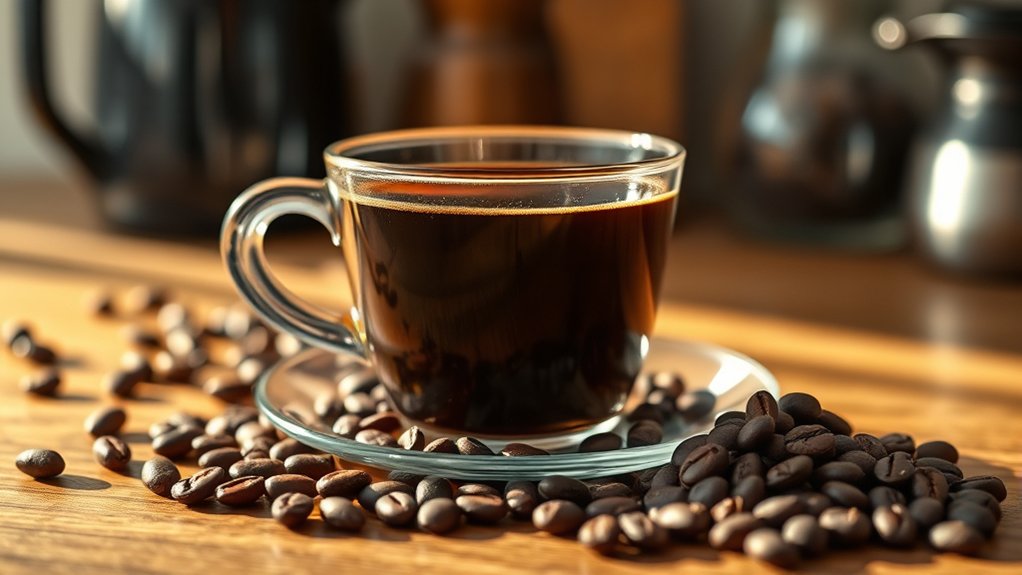
How many coffee beans do you need for a perfect cup? The number of coffee beans per cup depends largely on your brewing method and desired flavor profile.
For a standard 6-ounce cup, you’ll need about 40 medium-roast Arabica beans, which equals roughly 10-11 grams of coffee.
A standard 6-ounce cup requires about 40 medium-roast Arabica beans, or 10-11 grams of coffee.
If you’re brewing an 8-ounce cup, expect to use 70 to 80 beans, translating to 10 to 12 grams.
Dark roasts, being lighter, require fewer beans, around 35-38 per cup, while denser light roasts need about 42-45 beans to balance the coffee-to-water ratio.
For larger servings like 12 ounces, 100 to 120 beans maintain a rich flavor.
Understanding this helps you measure the precise number of coffee beans for your perfect brew.
How Bean Size and Density Affect Bean Count
You’ll notice that the size of coffee beans changes depending on the roast. This actually affects how many beans you need per cup.
For example, denser beans, like those in light roasts, require more beans to reach the right strength. On the other hand, lighter, darker roasts use fewer beans.
Bean Size Variations
Although coffee beans might look similar, their size and density can vary greatly depending on the roast level. This directly impacts how many beans you’ll need for a cup.
Darker roasts lose moisture, making beans smaller and less dense, so you’ll need fewer beans, around 35 to 38, for the same brew ratio.
Light roasts are denser and larger, requiring roughly 42 to 45 beans per 6-ounce cup. Medium roasts fall in between, with about 38 to 42 beans.
Since each bean weighs between 0.12 and 0.15 grams, understanding these size variations helps you adjust your coffee-to-water ratio.
Density Impact On Count
Several factors influence the number of coffee beans you need for a perfect cup, with bean density playing a key role. The density impact on count varies by bean type and roast level.
Dark roasts are lighter, so you need fewer beans, while light roasts are denser and require more. When measuring coffee, roast level, grind size, and bean type all affect the coffee strength and the coffee beans you need for consistent results.
| Bean Type | Roast Level | Beans per Cup (approx.) |
|---|---|---|
| Arabica | Light | 42-45 |
| Arabica | Dark | 35-38 |
| Robusta | Medium | 38-42 |
Understanding these factors guarantees you get the ideal coffee-to-water ratio every time.
How Roast Level Changes Beans Per Cup
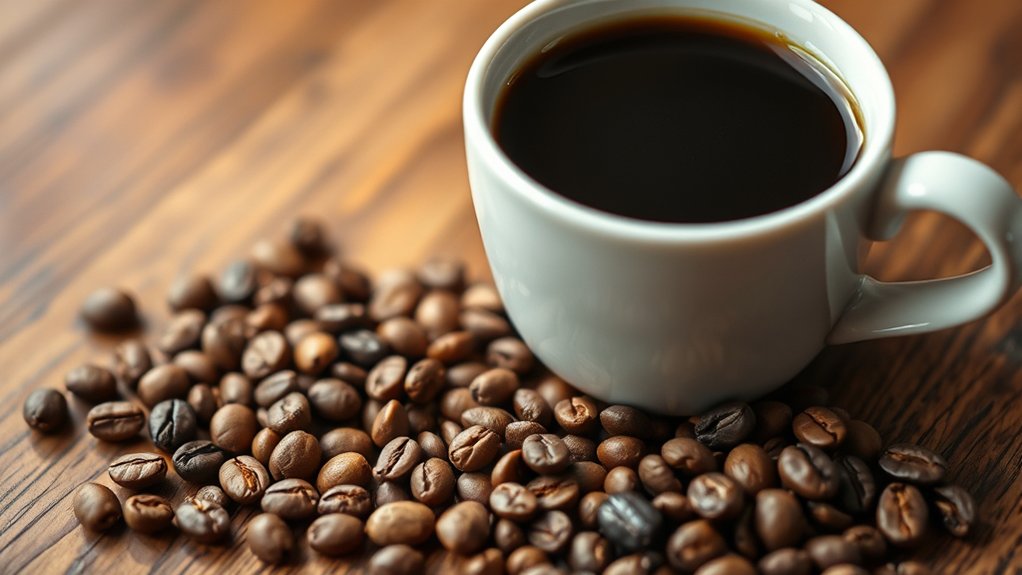
When you adjust the roast level, you change how many coffee beans go into each cup. Coffee roast affects the beans per cup because each roast varies in density and moisture.
Light roasts are denser and retain more moisture, so you’ll need about 42 to 45 beans per cup to get the right flavor and strength.
Medium roasts strike a balance, requiring roughly 38 to 42 beans per cup, offering a mix of boldness and smoothness.
Dark roast beans are lighter and drier, so fewer beans, around 35 to 38, are needed. This roast delivers bolder flavors but fewer beans per cup.
Understanding how roast level changes beans per cup helps you brew consistent coffee tailored to your taste.
Measuring Coffee Beans Accurately: Grams, Tablespoons, and Beans
To brew the perfect cup, you need to measure your coffee beans accurately using grams, tablespoons, or bean counts. For an 8-ounce cup, about 70 to 80 coffee beans equal 10 to 12 grams of ground coffee.
Using a digital scale guarantees precision, giving you consistent flavor every time. If you don’t have a scale, two tablespoons weigh roughly 10.6 grams, which is close to ideal for a 6-ounce cup.
Keep in mind that grind size affects how many beans you need. Finer grinds require more beans for stronger coffee, while coarser grinds need fewer.
Generally, 40 medium-roast Arabica beans equal about 10-11 grams, making it easier to gauge your coffee for every brew.
Measuring coffee beans accurately ensures a balanced, satisfying cup.
Grind Size and Coffee Quantity: What You Need to Know
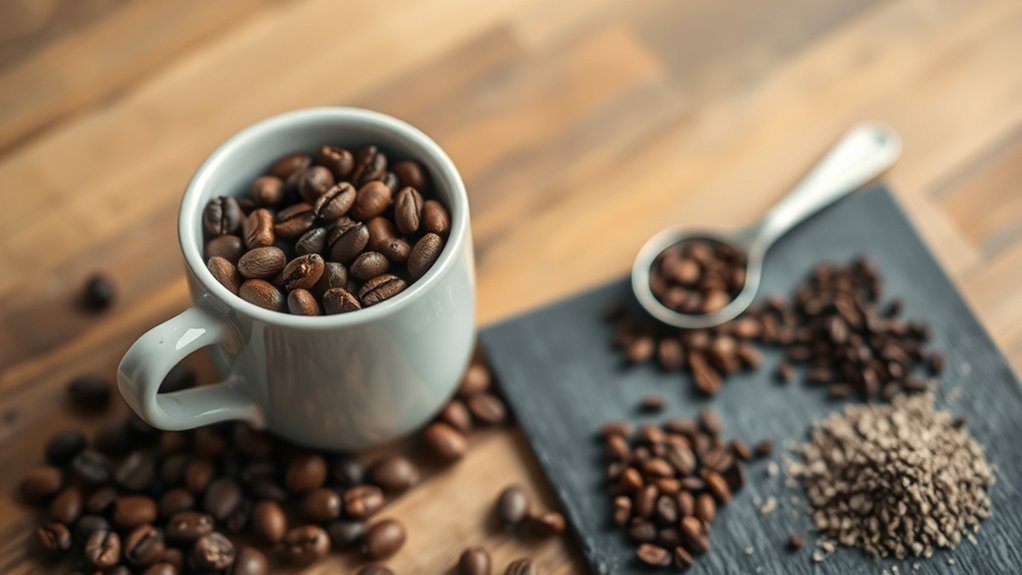
You’ll notice that grind size directly affects how many beans you need for a cup. Finer grinds actually require more beans than coarser ones.
Plus, your brewing method plays a big role too—French press calls for a coarse grind, while espresso needs a fine grind. That changes the bean count quite a bit.
Getting this right helps you achieve the perfect coffee strength every time.
Grind Size Effects
Although grind size might seem like a minor detail, it actually plays an essential role in determining how many coffee beans you’ll need for your brew. Your choice between a coarse grind and a fine grind affects the coffee-to-water ratios and the extraction process, influencing flavor intensity and bean quantity.
Consider these grind size effects:
- Coarse grind uses fewer medium-roast Arabica beans (around 40 for 6 ounces).
- Fine grind requires more beans (approximately 45) for stronger flavor.
- Finer grinds extract flavors faster, needing careful measurement.
- Matching grind size to brewing method guarantees ideal extraction.
- Adjusting grind size helps balance taste without wasting beans.
Understanding grind size lets you control your coffee’s strength and efficiency perfectly.
Bean Quantity Variations
When you adjust your grind size, you directly influence how many coffee beans you’ll need for each cup. Bean quantity variations depend heavily on the grind. Coarser grinds require fewer beans, while finer grinds need more to achieve the desired strength.
For a standard 6-ounce cup, about 40 medium-roast Arabica beans, roughly 10-11 grams, are typical. Light roasts, being denser, call for 42-45 beans, whereas dark roasts need fewer, around 35-38, due to moisture loss.
The coffee-to-water ratio for brewing, usually 1:15 to 1:18, further shapes your coffee per cup amount. Using a digital scale helps measure your coffee precisely, ensuring consistent flavor and strength regardless of grind or roast.
Understanding these variables refines your coffee brewing experience.
Brewing Method Impact
Since grind size directly affects how coffee extracts during brewing, it plays an essential role in determining how much coffee you’ll need for each cup.
Different brewing methods require adjustments in grind size and coffee quantity to balance flavor and strength. According to the Specialty Coffee Association, precise coffee-to-water ratios improve consistency, so tailoring your approach matters.
Keep these points in mind:
- Coarser grind suits methods like French Press, needing fewer coffee grounds but longer extraction time.
- Finer grind works well for espresso, requiring more coffee grounds and shorter extraction time.
- Drip brewing calls for a coffee-to-water ratio of about 1:15 to 1:18.
- French Press uses a richer ratio, around 1:12 to 1:16.
- Adjust grind size and quantity to fix bitterness or sourness.
Mastering these factors guarantees the perfect cup every time.
Coffee-to-Water Ratios for Different Cup Sizes
Getting the coffee-to-water ratio right is key to brewing a perfect cup, no matter the size. For a standard cup of coffee, about 6 ounces, you’ll need roughly 10 to 11 grams of coffee, which equals around 40 medium-roast Arabica beans.
When scaling up to a 12-ounce cup, aim for about 20 grams or two scoops, translating to roughly 100 to 120 beans.
The golden coffee-to-water ratio ranges between 1:15 and 1:18, meaning for every gram of coffee, use 15 to 18 grams of water.
Sticking to these coffee-to-water ratios guarantees you get consistent flavor and ideal extraction each time.
Using a kitchen scale helps you measure grams of coffee precisely, so your brew stays perfectly balanced, cup after cup.
How Brewing Methods Change How Many Beans You Need
Although the amount of coffee beans you need varies by brewing method, understanding these differences helps you achieve the perfect cup every time. The coffee-to-water ratio and grind size heavily influence the number of beans required. Depending on your brew method, the number can vary greatly.
French press uses coarse grinds and a 1:12 to 1:16 ratio, needing about 42-45 beans for a strong cup.
Drip coffee typically requires around 40 beans for 6 ounces.
Espresso demands fine grinds and more beans, about 120-140 for a double shot.
Cold brew’s extended extraction uses a higher coffee-to-water ratio (1:4 to 1:5), needing 100-120 beans.
Matching grind size to brew method guarantees the amount of coffee needed is perfectly balanced for flavor.
Fix Weak or Bitter Coffee by Adjusting Bean Amounts
If your coffee tastes weak, try adding about 5 more beans or half a tablespoon of grounds to boost the flavor. Adjusting the amount of coffee beans directly impacts the strength of your brew.
If you encounter bitter flavors, reduce the beans by roughly 5 or switch to a coarser grind size to avoid over-extraction. Grind size plays an essential role; finer grinds extract more quickly and can intensify bitterness, while coarser grinds create milder coffee.
Don’t forget to experiment with your coffee-to-water ratio, aiming for about 1:16 as a starting point.
How Much Coffee Can You Brew From a 12 Oz Bag?
Adjusting your coffee bean amount not only fine-tunes flavor but also influences how much coffee you can brew from a single bag.
A 12 oz bag contains about 340 grams of coffee, letting you brew a substantial amount. Here’s what to expect:
You can brew roughly 25 small 6-ounce cups or 15 large 12-ounce mugs. Using the golden ratio for coffee (1 gram coffee to 16-18 grams water), a 12 oz bag yields around 5.4 liters (182 ounces) of brewed coffee.
To brew 12 six-ounce cups, you’ll need about 127 grams of coffee. Brewing method and strength preferences can alter how much coffee you get.
A 12 oz bag typically lasts two weeks for casual drinkers, preserving freshness.
Knowing how much coffee your bag produces helps you plan each brew efficiently.
Choosing Coffee Bean Varieties That Affect Your Brew
You’ll notice that Arabica and Robusta beans bring very different flavors to your cup. Arabica offers smooth, aromatic notes, while Robusta delivers a stronger, more bitter taste.
Plus, the origin of your beans plays a big role too. Places like Kenya or India give you unique flavor profiles that can really change up your brew.
Arabica Vs Robusta
Because the type of coffee bean you choose directly shapes your brew’s flavor and strength, understanding the differences between Arabica and Robusta is essential.
Arabica beans offer a smoother taste with delicate flavor profiles, while Robusta beans bring a bolder, earthier punch. Here’s what to keep in mind:
- Arabica beans contain about 1.2% to 1.5% caffeine content.
- Robusta beans have nearly double the caffeine content, around 2.2% to 2.7%.
- Robusta provides higher brew strength and richer crema in espresso.
- Arabica thrives in cooler, high-altitude climates and is pricier.
- Blending both beans creates a balanced flavor profile with smoothness and robustness.
Choosing wisely lets you tailor your coffee’s strength and flavor just the way you like it.
Flavor Profiles Overview
While selecting the right coffee bean variety might seem simple, it dramatically shapes your brew’s flavor profile. Arabica beans offer smooth, aromatic notes, while Robusta delivers bolder, earthier tastes.
Your choice of roast level also plays a key role. Lighter roasts preserve nuanced flavors and more caffeine, whereas dark roasts produce robust, full-bodied brews.
Don’t forget how grind size affects extraction. Coarse grinds suit brewing methods like French press for milder flavors, while fine grinds work well with espresso, yielding stronger tastes.
Experimenting with different combinations of Arabica or Robusta beans, varying roast levels, and adjusting grind sizes based on your brewing method helps you discover the perfect flavor profile tailored to your palate.
Bean Origin Influence
Though selecting the right roast and grind is important, the origin of your coffee beans plays a crucial role in shaping your brew’s character. The bean origin influence goes beyond just geography; it determines the coffee flavors you’ll enjoy.
Choosing the right coffee bean varieties, such as Arabica beans or Robusta beans, directly impacts taste and caffeine levels. You should also consider the processing method, which affects the final profile.
Arabica beans offer smooth, aromatic coffee flavors. Robusta beans provide bold, earthy notes with more caffeine. Kenya Peaberry beans create delicate, nuanced brews. Dark Italian blends deliver robust, deep flavors. Monsoon Malabar’s unique processing method yields a rich, full-bodied cup.
Understanding these factors helps you craft the perfect cup every time.
Frequently Asked Questions
Can Stale Coffee Beans Affect the Number Needed per Cup?
Yes, stale beans definitely affect the number you need per cup.
Because stale beans suffer aroma loss and a weakened flavor profile, you’ll have to use more to maintain your desired brewing strength.
The extraction efficiency drops with stale beans, so your coffee won’t taste as robust.
To compensate for diminished coffee freshness, you might increase the bean count by 10-20%, ensuring your cup still delivers satisfying flavor.
How Does Water Temperature Impact Coffee Bean Extraction?
You control extraction efficiency by managing water temperature. At ideal temperatures between 195°F and 205°F, you maximize flavor profiles and balance bitterness and acidity.
Brewing methods like pour-over or French press demand consistent heat to guarantee even extraction time. Water chemistry also plays a role, affecting how compounds dissolve from beans.
If your water’s too hot or too cold, you’ll disrupt extraction efficiency, altering flavor profiles and weakening your coffee’s overall quality.
Do Flavored Coffee Beans Require Different Bean Counts?
No, flavored coffee beans don’t usually require a different bean count. You’ll find that flavor intensity, aroma profiles, and sweetness balance depend more on roasting techniques and bean types than quantity.
Adjusting grind size helps manage acidity levels and extraction. Since some flavored beans have added oils or sugars, you might tweak the amount slightly, but generally, stick to your usual bean count and focus on experimenting with brewing variables for the best taste.
Can Altitude Where Beans Are Grown Change Their Brewing Amount?
Yes, altitude effects definitely change how much coffee you’ll use.
Higher altitude beans usually have greater bean density and unique flavor profiles because of cooler growing conditions.
These regional differences mean you might adjust your brewing methods and grind size to get the best extraction.
Since denser beans pack more flavor, you may need fewer beans per cup, while lower altitude beans might require more.
Always experiment to suit your taste!
How Does Grind Freshness Influence the Taste, Not Just Bean Count?
Imagine brewing your coffee with a 19th-century hand grinder. Grind freshness dramatically shapes your flavor profile. When you grind just before brewing, you preserve aromatic oils, enhancing the taste regardless of bean origin or roast level.
Grind consistency is essential. Uneven grinds distort extraction time, hurting flavor.
Matching your grind size to the brewing method guarantees balanced extraction, letting your coffee’s unique characteristics shine through in every cup.
Conclusion
Think of brewing coffee like filling a jar with marbles. You need just the right number to hit the perfect weight. Remember, about 70 beans usually make a cup, but size, roast, and grind tweak that count.
Next time your coffee tastes off, imagine adjusting marbles in your jar. With a little practice, you’ll nail your perfect cup every time, turning bean counting into a simple, rewarding habit.