
Is Coffee Bean A Fruit – Everything You Need To Know
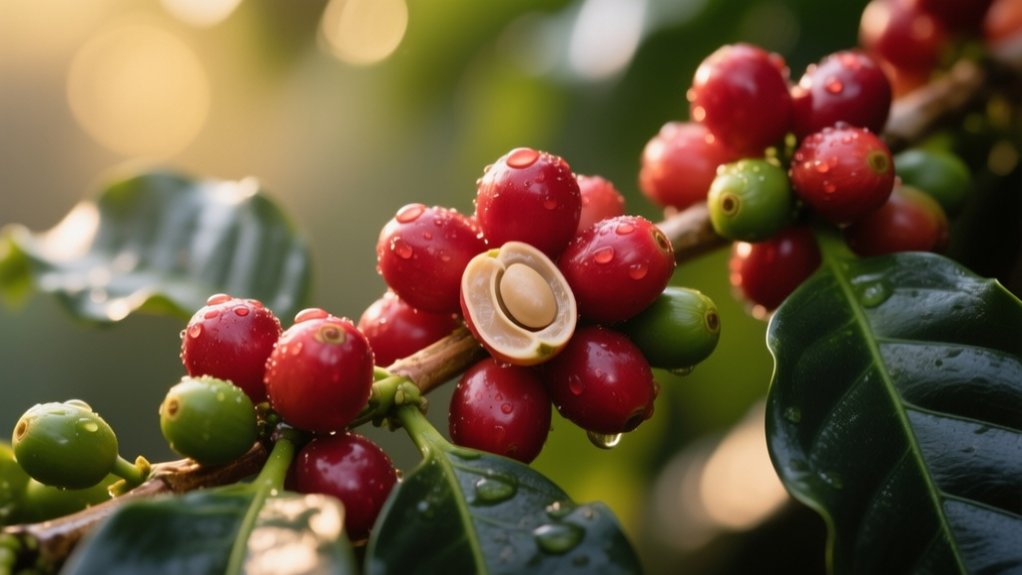
You might think coffee beans are just beans, but they’re actually seeds inside a fruit called a coffee cherry. This fruit’s layers—skin, sweet pulp, and hard shell—affect the bean’s flavor and quality.
Coffee grows best in tropical climates with specific altitude and rainfall, shaping its taste and caffeine content. Beyond brewing, coffee cherries offer antioxidants and nutrients.
Understanding these factors deepens your appreciation of coffee’s complexity and the careful processes behind each cup.
What Is a Coffee Bean, Really?
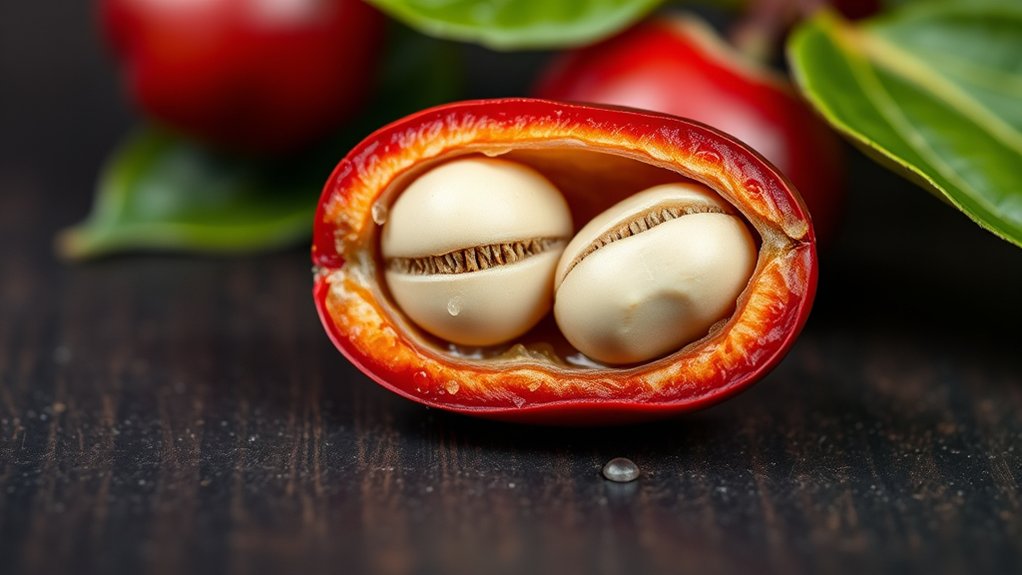
The term “coffee bean” can be misleading since what you’re actually dealing with are seeds inside coffee cherries, which are fruits rather than true beans. Each coffee cherry typically contains two seeds, commonly referred to as coffee beans, though occasionally, a single seed called a peaberry forms.
Coffee beans are actually seeds inside coffee cherries, which are fruits—not true beans.
These cherries ripen over nearly a year, changing color from green to red, yellow, or purple depending on the variety. Botanically, coffee cherries belong to the genus Coffea, and their seeds aren’t legumes, despite the “bean” label.
Besides housing the seeds, coffee cherries themselves are rich in antioxidants, fiber, and vitamins, with their pulp recognized for nutritional value.
Understanding this distinction clarifies why coffee beans are seeds within a fruit, not actual beans.
Development and Composition of Coffee Cherries
You’ll find that each coffee cherry holds two seeds, or beans, tucked inside a thin skin and a layer of pulp. This pulp is packed with antioxidants, fiber, and vitamins.
Over about a year, these cherries slowly mature, building up sugars and flavors that are key to the coffee’s final taste.
Knowing what makes up the cherry and how it’s put together helps make sense of how different processing methods can change the coffee you end up drinking.
It’s pretty interesting how all these little details come together in your cup!
Coffee Cherry Anatomy
Coffee cherries develop from the flowers of the Coffea plant and classify botanically as fruits, each housing two coffee beans. You’ll notice each coffee cherry consists of three distinct layers: the exocarp, or outer skin; the mesocarp, which serves as the sweet pulp; and the endocarp, a hard inner shell that encases the beans.
As the cherry matures over nearly a year, its outer skin changes from green to red, yellow, or purple, depending on the variety. The endocarp hardens during this phase, directly influencing the coffee beans’ size, which average about 10mm by 6mm.
Understanding this anatomy is essential because the protective layers impact how beans are processed, whether through wet or dry methods, to guarantee quality after harvesting.
Nutritional Components Inside
Understanding the structure of coffee cherries sets the stage for exploring their nutritional makeup, which plays a significant role in both flavor and health benefits.
Coffee cherries consist of three outer layers: the exocarp (skin), mesocarp (pulp), and endocarp (hard shell) that encloses two beans.
The mesocarp contains concentrated sugars, nutrients, and antioxidants, particularly polyphenols. These have been linked to immune support and weight management.
The fibrous pulp, when dried, forms cascara, a tea rich in these antioxidants.
This composition not only influences the coffee’s taste profile but also contributes bioactive compounds beneficial to health.
Cherry Maturation Timeline
Although it takes nearly a year after flowering for cherries to fully mature, you can observe significant changes throughout the 7 to 11 months of ripening.
Coffee cherries begin green and gradually shift to red, yellow, or purple hues, depending on the variety. This color change signals biochemical transformations, including increased sugar and antioxidant concentration in the pulp, which shapes the fruit’s flavor profile.
Each cherry typically houses two beans surrounded by thin skin and pulp.
Environmental factors, particularly rainfall, play an essential role in the maturation timeline by influencing ripening speed and cherry quality.
Understanding this development helps you appreciate the complexity behind coffee cherries and the precision required to harvest them at peak maturity for superior taste and composition.
Why Coffee Beans Are Seeds, Not Beans
Since the term “bean” typically refers to seeds from legume plants, calling coffee beans by that name can be misleading. Coffee beans are actually the seeds found inside coffee cherries, the fruit of the coffee plant.
Each cherry usually contains two seeds, which develop over nearly a year after flowering. Unlike true beans, coffee seeds don’t belong to the legume family, making the term “bean” a misnomer.
These seeds consist of distinct layers, including the outer silver skin and a nutrient-rich endosperm that greatly influences flavor.
Understanding coffee beans as seeds rather than beans clarifies their botanical classification and highlights their origin as a fruit product. This distinction sets coffee apart from legumes and other true beans you might be familiar with.
Where Coffee Trees Grow and How Environment Affects Coffee Beans
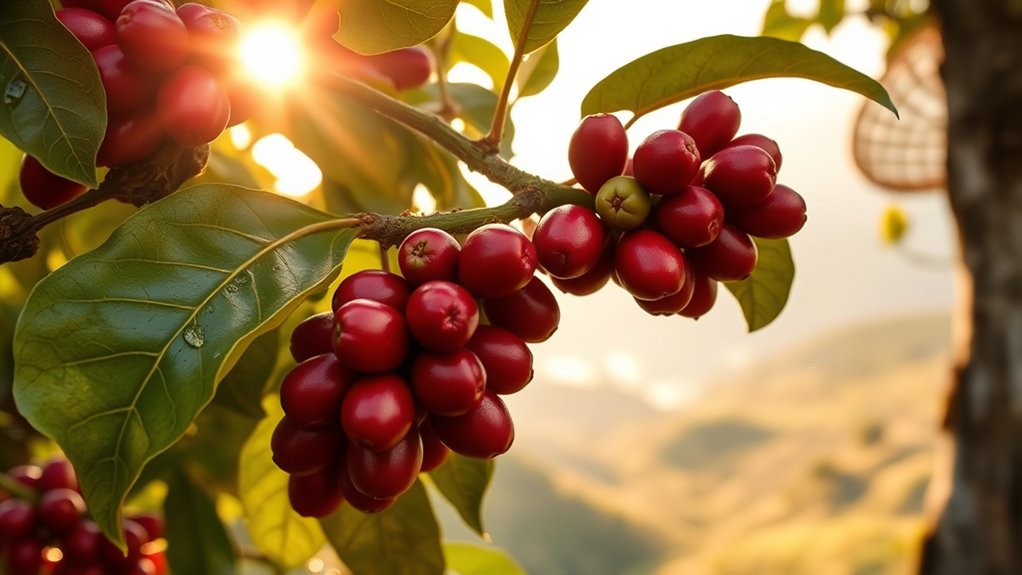
You’ll find coffee trees mainly within the bean belt because the temperatures and rainfall there create the perfect conditions for them to thrive.
Altitude also plays a big role—higher elevations often mean beans with unique flavors and even more caffeine.
Ideal Coffee Growing Zones
When you explore where coffee trees flourish, you’ll find they thrive exclusively within the “bean belt,” a tropical zone between the Tropics of Cancer and Capricorn that offers ideal temperature, rainfall, and altitude conditions.
Coffee plants demand precise environmental factors: Arabica plants grow best between 15-24°C (59-75°F), while Robusta prefers warmer ranges of 24-30°C (75-86°F).
Annual rainfall must fall between 500-3000mm (20-118 inches) to support robust growth and fruit development.
Brazil, as the leading coffee producer, exemplifies these conditions, contributing roughly 45% of global coffee exports.
Understanding these zones is crucial since environmental factors directly influence coffee plants’ health and the quality of the beans they produce, shaping the global coffee industry’s cultivation strategies.
Altitude Impact On Beans
Although coffee trees can grow across a range of altitudes, those cultivated between 600 and 2,000 meters consistently produce superior beans due to slower maturation rates and enhanced flavor complexity.
You’ll find Arabica coffee thriving at higher altitudes (1,200–2,000 meters), yielding nuanced flavor profiles and increased acidity.
In contrast, Robusta grows at lower elevations (200–800 meters) and generally lacks this complexity.
Altitude influences temperature and rainfall patterns, which affect bean size, density, and flavor characteristics.
Significantly, coffee beans grown at higher altitudes demonstrate elevated caffeine content, a natural response to environmental stressors that bolster pest resistance.
Understanding how altitude impacts coffee beans helps you appreciate the environmental factors shaping bean quality, ensuring you select beans with the desired flavor intensity and chemical composition for your brew.
Climate Effects On Flavor
Altitude plays a significant role in shaping coffee bean characteristics, but it’s just one piece of the environmental puzzle.
Coffee beans come from the “bean belt,” where temperatures between 15-30°C and annual rainfall of 500-3000mm create ideal conditions.
You’ll find that climate factors like soil composition, temperature fluctuations, and rainfall patterns during growth directly influence flavor and aroma.
For example, Brazil’s diverse climates yield distinct profiles in robusta and arabica beans.
Arabica, grown at higher altitudes, develops complex flavors and lower caffeine (0.8–1.4%), while robusta thrives in warmer areas with higher caffeine (1.7–4.0%) and a stronger taste.
Understanding where coffee beans come from helps you appreciate how climate intricately shapes their final flavor profile.
How Coffee Beans Are Harvested and Processed
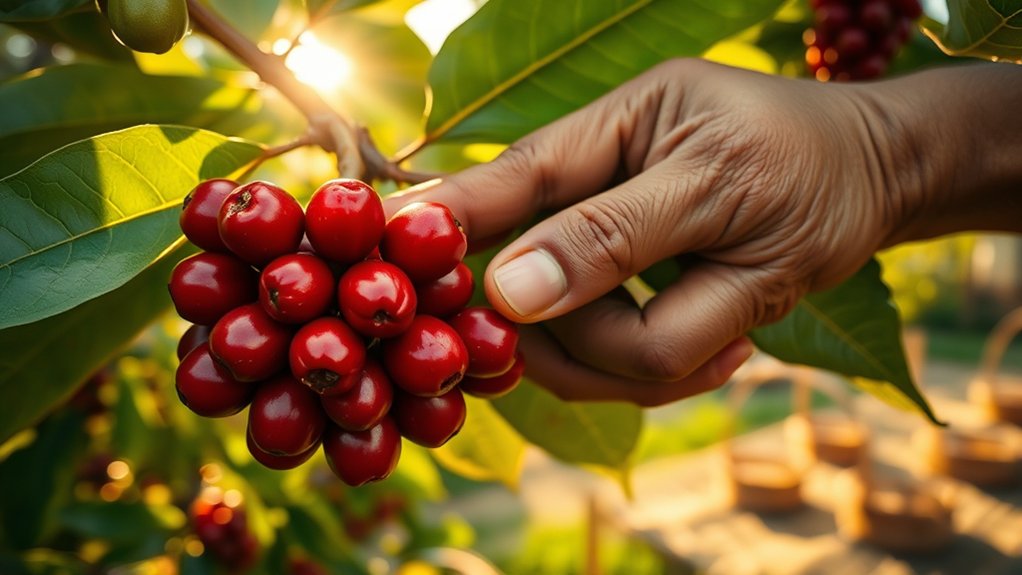
Farmers handpick coffee cherries as they shift from green to red, signaling ripeness after nearly a year of growth.
Once harvested, the cherries undergo one of two processing methods that impact the final coffee quality.
The wet method removes pulp before drying, while the dry method dries cherries intact. Both require careful moisture control, targeting 11% moisture content before hulling to preserve bean integrity.
You’ll notice:
- Handpicking guarantees only ripe coffee cherries are selected, optimizing flavor potential.
- The wet method tends to produce cleaner, brighter profiles by eliminating fruit pulp early.
- The dry method can impart heavier, fruitier notes as drying occurs with the cherry intact.
Each step demands precision to prevent off-flavors and maintain the coffee’s inherent characteristics.
Arabica vs. Robusta: What’s the Difference?
When comparing Arabica and Robusta coffee beans, you’ll find distinct differences in flavor, caffeine content, and growing conditions that influence their use and popularity.
Arabica, comprising 60-70% of global production, grows at higher altitudes (600-2,000 meters) with cooler temperatures. It offers a mild flavor with fruity and sugary notes, higher acidity, and contains 0.8-1.4% caffeine.
Arabica coffee thrives at high altitudes, offering mild, fruity flavors with bright acidity and moderate caffeine.
In contrast, Robusta thrives at lower altitudes (0-600 meters) in warmer climates, is hardier against pests, and accounts for 30-40% of production. Its beans have a stronger, more bitter taste with earthy, nutty flavors and a heavier body, containing 1.7-4.0% caffeine.
Arabica’s higher lipid and sugar content creates complex flavors, while Robusta’s elevated caffeine gives it a robust bitterness, defining their distinct profiles in coffee beans.
Roasting’s Effect on Coffee Beans and Flavor
You’ll notice that roasting coffee beans at around 550°F really changes their chemical makeup and flavor profile.
When you adjust the temperature and roasting time, it affects how compounds like trigonelline break down. This compound plays a big role in the coffee’s bitterness and aroma.
Knowing how these factors work means you can better control the flavor development.
Plus, it helps you avoid unwanted defects like those burnt notes you don’t want in your cup.
Roasting Temperature Impact
Although roasting coffee beans typically occurs at around 550°F (288°C), the precise temperature and duration you choose profoundly influence the beans’ chemical makeup and flavor profile.
During roasting, the Maillard reaction transforms the beans, generating complex flavors while reducing moisture. However, if you push the temperature too high, bitter compounds may form, spoiling the taste.
Roasting duration also matters: lighter roasts preserve original bean traits, whereas darker roasts highlight roasting effects.
To achieve ideal results, you must guarantee even heat exposure through constant rotation, preventing uneven cooking that causes off-flavors.
Key roasting temperature impacts include:
- Flavor complexity driven by Maillard reaction intensity
- Risk of bitterness from excessive heat
- Importance of consistent rotation for uniform roast
Flavor Development Process
Because roasting triggers complex chemical reactions at around 550°F, it critically shapes the flavor development of coffee beans. During roasting, the Maillard reaction transforms sugars and amino acids, crafting aroma and taste while creating bitter compounds from trigonelline degradation.
The flavor development process hinges on roasting degree: lighter roasts preserve original bean notes, darker roasts highlight bold, deep flavors. Roasting time and temperature also modulate caffeine and chlorogenic acid solubility, influencing bitterness and acidity.
Proper storage is essential, as freshly roasted beans peak within weeks.
| Roasting Level | Flavor Profile | Emotional Response |
|---|---|---|
| Light | Bright, fruity | Invigorating |
| Medium | Balanced, sweet | Comforting |
| Dark | Bold, smoky | Intense |
| Freshness | Peak flavor window | Satisfying |
| Overroasted | Bitter, flat | Disappointing |
How Caffeine and Chlorogenic Acids Influence Coffee Flavor
When you explore the flavor profile of coffee, understanding the roles of caffeine and chlorogenic acids is essential. Caffeine content, ranging from 1.0% to 2.5% in dry beans, imparts bitterness, especially prominent in robusta varieties.
Chlorogenic acids, abundant in green beans, modulate bitterness and sourness but degrade considerably during roasting, altering flavor complexity. Their interaction affects not only taste but aroma and quality.
Consider these points:
- Caffeine increases bitterness and solubility with heat, enhancing extraction.
- Chlorogenic acids shift from bitter to sour taste depending on concentration.
- Roasting reduces chlorogenic acids by over 70%, softening harsh flavors.
Health Effects of Caffeine and Chlorogenic Acids in Coffee
Since caffeine and chlorogenic acids are primary bioactive compounds in coffee, understanding their health effects is essential for evaluating coffee’s benefits.
Caffeine, comprising 1.0% to 2.5% of dry green coffee beans, enhances alertness and cognitive performance. It may also support weight management by improving metabolic rates.
Caffeine boosts alertness, sharpens cognition, and may aid weight management by enhancing metabolism.
Chlorogenic acids are phenolic antioxidants present at higher levels in Robusta (140mg/g) than Arabica (65mg/g). They largely degrade during roasting, reducing their concentration in brewed coffee to below 30mg/g.
Despite this reduction, both compounds contribute to coffee’s protective effects against oxidative stress.
Research also suggests chlorogenic acids may benefit cardiovascular health. When you consume coffee, caffeine and residual chlorogenic acids work together to provide these health advantages.
This makes coffee a functional beverage beyond its stimulating effects.
Can You Eat Coffee Cherries? Uses and Benefits
Beyond the well-studied bioactive compounds like caffeine and chlorogenic acids, the coffee plant offers other edible components worth considering.
Coffee cherries, the fruit surrounding the coffee beans, are edible and differ in flavor from brewed coffee, tasting more like watermelon or red currant. Their pulp is rich in antioxidants, fiber, and vitamins, which adds nutritional value often overlooked.
You can consume coffee cherries in several ways: eat fresh cherries for their mildly sweet, fruity flavor.
Drink cascara, a tea made from dried coffee cherries, popular in coffee-growing regions.
Utilize the pulp in compost or animal feed to minimize waste and promote sustainable use.
These uses highlight coffee cherries’ versatility beyond traditional coffee brewing.
Sustainability and Coffee Fruit and Bean Production
Although coffee beans are the seeds of a fruit classified botanically as a drupe, sustainable production requires looking beyond the beans themselves.
Sustainable coffee production hinges on practices like intercropping with shade trees, which boost biodiversity and enhance soil health.
You can also reduce waste by repurposing discarded coffee cherries as compost or animal feed, lowering environmental impact.
Economically, coffee plays a crucial role, especially in developing nations where it accounts for over half of foreign exchange earnings.
By supporting sustainable sourcing initiatives, including fair trade from local roasters, you help guarantee farmers receive fair compensation, promoting long-term viability.
Adopting these evidence-based strategies makes sustainable coffee production more environmentally responsible and economically equitable, benefiting both ecosystems and communities involved in coffee fruit and bean cultivation.
How Knowing Coffee Beans Enhances Your Coffee Experience
When you understand that coffee beans are actually seeds encased within coffee cherries, you gain a deeper appreciation for the intricate process behind your cup of coffee.
Knowing the origin of coffee cherries reveals the complexity of cultivation and processing that shapes flavor and quality.
This knowledge enhances your coffee experience by highlighting:
- The dual seeds inside each coffee cherry, emphasizing the labor-intensive harvesting process.
- The antioxidants and fiber in coffee cherries, which contribute to the fruit’s nutritional significance beyond roasting.
- The impact of wet and dry processing methods on the taste profile and aroma of the final brew.
Frequently Asked Questions
How Do Different Brewing Methods Affect Coffee Bean Flavor Profiles?
Like revealing a secret melody, brewing techniques shape your coffee’s flavor profile. Finer grounds in espresso yield intense, quick extractions, while coarser grinds in cold brew provide smooth, mellow notes.
Pour-over highlights fruity, floral tones by controlling water flow and temperature, whereas French press immerses grounds longer for earthy richness.
What Are the Best Storage Practices for Roasted Coffee Beans?
The best storage techniques for roasted coffee beans involve keeping them in an airtight container to limit oxygen exposure, which degrades flavor.
Store your beans in a cool, dark place, avoiding heat and light.
Don’t refrigerate or freeze them, as moisture harms quality.
Use whole beans and consume within two to four weeks post-roast for peak freshness.
Label your storage with roasting dates, and consider vacuum-sealing for longer-term preservation.
Can Coffee Beans Be Used for Purposes Other Than Brewing Coffee?
Yes, coffee beans have diverse culinary uses beyond brewing. You can grind them to add a rich, bitter flavor to desserts like ice cream and chocolate, enhancing complexity.
Coffee bean extracts also serve as natural flavoring agents in sauces and marinades.
Furthermore, their antioxidant properties make them valuable in health-focused recipes.
Exploring these culinary applications lets you enjoy coffee’s unique profile in innovative and delicious ways.
How Do Coffee Bean Varieties Influence Espresso Extraction?
Different coffee bean varieties directly influence espresso extraction by altering flavor complexity.
When you use Arabica beans, you’ll get a sweeter, more nuanced shot due to their higher chlorogenic acid content and lower caffeine levels.
Robusta beans, with more caffeine and bitterness, produce a stronger, more robust espresso.
These chemical differences affect solubility during extraction, so understanding bean variety helps you tailor the espresso’s taste profile precisely to your preference.
What Is the History Behind Coffee Bean Cultivation Worldwide?
You’ll find coffee bean cultivation began in Ethiopia around 850 AD, gaining cultural significance as it spread through India and Europe by the 17th century.
By the 18th century, coffee became essential in the Caribbean and Dutch East Indies, shaping social rituals.
Brazil’s dominance today reflects this historical progression.
Understanding this timeline helps you appreciate coffee’s role beyond a beverage, highlighting its deep cultural roots worldwide.
Conclusion
Understanding that coffee beans are actually seeds inside a fruit reshapes how you view your daily cup. Like uncovering layers in a complex puzzle, knowing the growth, harvesting, and chemical makeup of coffee cherries deepens your appreciation.
This knowledge isn’t just trivia. It grounds your coffee experience in science and sustainability, helping you make informed choices that benefit both your palate and the planet.