Does Coffee Grounds Repel Mosquitoes – Effectiveness Explained
You can use coffee grounds to repel mosquitoes because their compounds interfere with mosquito sensory receptors and mask attractant cues, reducing their presence. Fresh or toasted grounds work best, and burning them creates smoke that further disrupts mosquito navigation.
While coffee grounds offer temporary, natural deterrence, their effectiveness varies with application method and environmental factors. They’re not a permanent solution but can help lower mosquito activity.
Exploring their preparation and safety details can optimize results.
How Coffee Grounds Repel Mosquitoes Naturally

Although mosquitoes rely heavily on scent cues to locate hosts and breeding sites, coffee grounds emit a strong aroma that masks these signals, effectively repelling them.
When you use coffee grounds for mosquito control, the compounds present act as chemical deterrents, particularly against gravid females, inhibiting oviposition and disrupting larval development.
Coffee grounds deter mosquitoes chemically, targeting egg-laying females and hindering larval growth.
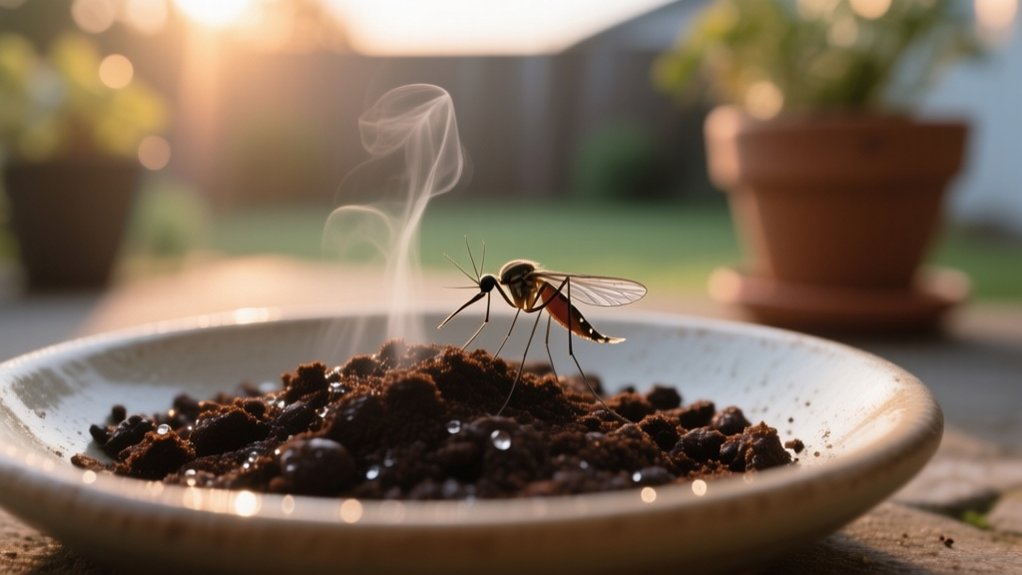
Burning coffee grounds produces dense smoke, which further interferes with mosquitoes’ sensory perception, creating a protective barrier around outdoor areas.
Scientific studies confirm that high concentrations of coffee extracts reduce oviposition rates in Aedes albopictus, a key vector for diseases such as dengue.
Which Coffee Grounds Work Best for Mosquito Control
You’ll find that fresh, used, and burnt coffee grounds each offer different levels of mosquito control.
Burnt grounds, in particular, give off a stronger aroma that mosquitoes seem to avoid.
How you prepare and apply the grounds also matters—whether you dry them out, grind them finer, or mix them with other substances can change how well they work.
Plus, using higher concentrations of coffee extracts can really cut down on mosquito egg-laying, so the strength of what you use is definitely something to keep in mind.
Fresh Vs Used Grounds
When comparing fresh and used coffee grounds for mosquito control, fresh grounds demonstrate greater effectiveness due to their stronger aroma and higher concentration of repellent compounds.
You’ll find fresh grounds inhibit mosquito oviposition more notably, reducing egg-laying in treated areas.
While used grounds still offer some repellent properties, particularly when burned to release residual aroma, they don’t match the potency of fresh grounds.
To maximize mosquito deterrence, consider these points:
- Fresh grounds contain higher levels of active repellent compounds.
- Used grounds are less effective unless burned to release aroma.
- Application method influences repellent efficiency, with fresh grounds providing a more pronounced deterrent zone.
Ground Preparation Methods
Several preparation methods influence coffee grounds’ effectiveness in repelling mosquitoes, with fresh, used, and burnt grounds each offering distinct advantages. Among these, burnt coffee grounds provide a stronger aroma that greatly enhances mosquito deterrence.
The key mechanism involves masking scents that attract mosquitoes, disrupting their host-seeking behavior. To maximize this effect, you should toast or burn the grounds before application, as this intensifies their odor profile.
When deploying coffee grounds, spread them strategically in mosquito breeding sites like gardens or near stagnant water to interrupt their lifecycle.
Keep in mind, environmental factors such as rain and wind reduce efficacy, so regular replacement is necessary.
Concentration And Potency
Building on how preparation methods enhance coffee grounds’ mosquito-repelling properties, the concentration and potency of these grounds play a significant role in their effectiveness.
You’ll find that highly concentrated coffee extracts exhibit the strongest deterrent effects, particularly reducing egg deposition and larval development in Aedes albopictus.
Freshness also impacts potency; unused or fresh grounds release a stronger aroma that masks mosquito-attracting scents more effectively than stale or used coffee.
When selecting coffee grounds for mosquito control, consider these factors:
- Use highly concentrated coffee extracts for maximum oviposition inhibition.
- Prioritize fresh, unused coffee grounds to guarantee strong chemical potency.
- Avoid low concentration blends, as they produce less significant repellent effects.
Concentration directly correlates with repellent success, making potency a key factor in mosquito control strategies.
Does Burning Coffee Grounds Improve Mosquito Repellent Effects?
Although many natural repellents rely on scent to deter mosquitoes, burning coffee grounds uniquely combines olfactory masking with sensory disruption.
When you burn coffee grounds, the strong aroma masks human scents mosquitoes use to locate hosts, similar to citronella.
Moreover, the dense smoke interferes with their sensory perception, impairing their ability to navigate.
Scientific studies indicate that smoke from burning coffee grounds can considerably reduce mosquito presence in outdoor environments.
You can enhance repellent effects by placing burnt coffee grounds in multiple containers, broadening the protective zone.
This method is especially effective around picnic areas and gardens, creating a more comfortable environment by minimizing mosquito activity.
Consequently, burning coffee grounds offers a scientifically supported, dual-action approach that improves mosquito repellent efficacy.
How to Prepare and Apply Coffee Grounds in Your Yard

When you prepare coffee grounds for mosquito repellent use, enhancing their aroma through burning or toasting greatly improves their effectiveness by masking scents that attract mosquitoes.
To maximize results, you need to know how to prepare and apply coffee grounds in your yard precisely.
Start by selecting fresh or used coffee grounds and treating them as follows:
Burn or toast coffee grounds to intensify their scent and repel mosquitoes effectively.
Evenly spread grounds around high-traffic zones like patios, gardens, and pool edges to form a scent barrier.
Regularly inspect and replace coffee grounds every few days, especially after rain or wind, to sustain repellent properties.
How to Make a Coffee Ground Mosquito Spray
You’ll start by boiling a mixture of water and used coffee grounds in a 2:1 ratio. This helps to extract the active compounds from the coffee.
Once it’s boiled, let the mixture cool down before you move it into a spray bottle.
If you want to boost the mosquito-repelling power, try adding a few drops of essential oils like citrus or floral extracts. They not only smell great but also make the spray more effective.
When you’re ready, just spray it on the areas where mosquitoes tend to hang out.
Make sure to store the spray properly and remember to reapply it every few days to keep those pesky bugs away.
Preparing Coffee Mixture
To prepare an effective coffee ground mosquito spray, start by combining two parts water with one part used coffee grounds and bring the mixture to a boil. This process extracts the aromatic compounds responsible for repelling mosquitoes.
After boiling, allow the mixture to cool completely.
Then, strain it to remove solid residues, ensuring smooth application. Transfer the liquid to a spray bottle for convenience and accuracy when targeting mosquito-prone areas.
Key steps for preparing coffee mixture include:
- Boiling the water and coffee grounds at a 2:1 ratio to maximize extraction
- Cooling and straining the solution before use
- Using a spray bottle to apply the mixture precisely on outdoor surfaces
This method leverages the natural properties of coffee grounds to create an efficient mosquito deterrent.
Adding Essential Oils
Although the coffee ground mixture effectively repels mosquitoes on its own, incorporating essential oils such as citronella, lavender, or eucalyptus greatly enhances its potency.
You start by boiling used coffee grounds and water in a 2:1 ratio to extract aromatic compounds that deter mosquitoes.
After the mixture cools, add a few drops of your chosen essential oils to amplify repellent effects. Essential oils contain volatile compounds that disrupt mosquito sensory receptors, complementing the bitter, pungent qualities of coffee grounds.
This combination creates a multi-modal deterrent, increasing efficacy against mosquitoes. Using this blend in a spray bottle allows targeted application in areas prone to mosquito activity.
Application And Storage
Enhancing your coffee ground mosquito spray with essential oils sets the stage for effective application and proper storage.
To maximize repellent properties, boil a 2:1 water-to-used coffee grounds mixture, then cool it before transferring to a spray bottle. This makes it easy to target areas around patios and gardens.
For sustained mosquito deterrence, reapply every few days, especially after rain or wind. Proper storage guarantees the solution remains potent. Keep it in a cool, dark place away from direct sunlight.
- Apply spray evenly to high-traffic mosquito areas.
- Reapply regularly to maintain efficacy.
- Store in a sealed container, away from heat and light.
How Often Should You Use Coffee Grounds to Keep Mosquitoes Away?
How frequently should you apply coffee grounds to effectively repel mosquitoes? You should reapply coffee grounds every few days, especially after rainfall or windy conditions that diminish their potency.
During warm, humid periods when mosquito activity spikes, increase the frequency of application to maintain consistent repellent effects.
Increase coffee ground applications during warm, humid weather to keep mosquito repellency strong and consistent.
To optimize results, distribute coffee grounds in high-traffic zones like gardens and patios where mosquitoes congregate.
You can also enhance their efficacy by combining coffee grounds with natural repellents such as essential oils, which prolong their deterrent properties.
Regularly monitoring the treated areas allows you to assess coffee grounds’ condition and replace them promptly, ensuring sustained mosquito control.
Are Coffee Grounds Safe for Pets and Wildlife?

Why should you be cautious when using coffee grounds around pets and wildlife? Coffee grounds contain caffeine, which poses toxicity risks, especially to dogs and cats.
Even small amounts can cause symptoms like restlessness, rapid heart rate, and stomach upset in pets.
Wildlife, including birds and small mammals, can also have disrupted behavior and bodily functions if they eat coffee grounds.
To protect both pets and wildlife, consider the following:
Keep coffee grounds out of reach to prevent accidental ingestion by pets.
Avoid applying coffee grounds in areas where local wildlife often visits.
Also, watch where and how much coffee grounds you use to reduce any environmental impact.
Do Coffee Grounds Repel Mosquitoes and Other Insects?
You’ll find that coffee grounds repel mosquitoes because they mask the chemical cues these insects use to find their hosts.
Basically, the strong aroma of the grounds, plus the smoke when you burn them, messes with how mosquitoes and other bugs sense their environment. This disruption makes it harder for them to locate you.
So, knowing how this works helps explain why coffee grounds can actually reduce the number of mosquitoes around.
But keep in mind, you need to use them in the right way to get the best results.
Mosquito Repellent Properties
Several studies have shown that coffee grounds have natural mosquito repellent properties by masking the scents mosquitoes use to find hosts. You can use their strong aroma to deter mosquitoes effectively. The compounds have repellent effects similar to citronella and lemongrass.
Burning coffee grounds also produces dense smoke that disrupts mosquito sensory perception, creating a protective zone.
Consider these mosquito repellent properties of coffee grounds:
- The aromatic compounds mask human odors, reducing mosquito attraction.
- Coffee extracts inhibit oviposition in gravid Aedes albopictus females, potentially lowering populations.
- The smoke from burning grounds acts as a physical and chemical deterrent.
Keep in mind, while coffee grounds help repel mosquitoes, combining them with other pest control methods gives you better results.
Insect Deterrent Mechanism
Although coffee grounds are commonly discarded as waste, they possess notable insect deterrent mechanisms that affect mosquitoes and other insects. The strong odors released by coffee grounds mask the scents mosquitoes use to locate hosts, functioning similarly to natural repellents like citronella.
When burned, coffee grounds produce dense smoke that disrupts insect sensory perception, establishing a deterrent zone.
Scientific studies reveal that coffee extracts inhibit oviposition behavior in gravid Aedes albopictus females, reducing egg-laying and larval development.
Applying concentrated coffee grounds lowers mosquito oviposition rates, highlighting their potential in mosquito control. However, while coffee grounds can serve as an effective DIY deterrent, they don’t guarantee complete mosquito elimination, especially in severe infestations.
Understanding these mechanisms helps you use coffee grounds strategically for insect management.
Limitations of Coffee Grounds for Effective Mosquito Control
While coffee grounds emit a strong odor that can deter mosquitoes, they don’t guarantee complete elimination and shouldn’t replace professional pest control in severe infestations.
You should understand the limitations of using coffee grounds for effective mosquito control. Their efficacy depends heavily on environmental factors like weather and mosquito activity, requiring frequent reapplication.
Moreover, coffee grounds primarily serve as a temporary deterrent rather than a sustainable solution. You must also consider safety risks, as coffee grounds can harm pets and wildlife if ingested.
Key limitations include:
- Variable effectiveness influenced by environmental conditions
- Temporary deterrence rather than long-term control
- Potential hazards to non-target animals if improperly placed
Recognizing these constraints is essential for managing expectations and ensuring safe use.
When to Consider Professional Mosquito Control
If you find that coffee grounds and other home remedies fail to greatly reduce mosquito populations around your property, it may be time to explore professional mosquito control.
When DIY methods prove insufficient, especially if you face frequent infestations or notice breeding in stagnant water, professional interventions offer targeted, effective solutions.
Experts analyze your property’s unique conditions and local mosquito species to design customized control plans. They employ specialized equipment and scientifically validated techniques that surpass the efficacy of home remedies, guaranteeing thorough management of severe infestations.
Furthermore, professional mosquito control assesses and mitigates health risks linked to mosquito-borne diseases, safeguarding your family and pets.
Turning to professionals guarantees precision and reliability in mosquito management when simpler methods like coffee grounds fall short.
Frequently Asked Questions
Can Coffee Grounds Attract Beneficial Insects to My Garden?
Yes, coffee grounds can attract beneficial insects to your garden. Their organic matter enriches soil structure and moisture, creating an inviting habitat for these insects.
The aroma may lure predatory beneficial insects that help control pests, supporting a balanced ecosystem.
By fostering beneficial microorganisms, coffee grounds indirectly promote plant health and sustain beneficial insect populations, enhancing biodiversity and overall garden vigor.
Incorporating coffee grounds can be a strategic step to boost beneficial insects effectively.
How Do Coffee Grounds Affect Soil Quality Over Time?
Over time, coffee grounds enhance your soil quality by gradually releasing essential soil nutrients, particularly nitrogen.
They improve soil structure, boosting aeration and drainage, which helps roots absorb nutrients more efficiently.
The added organic matter increases microbial activity, fostering a healthier soil ecosystem.
Coffee grounds also retain moisture, reducing watering frequency.
However, they can increase soil acidity, so you should monitor pH levels to guarantee ideal conditions for your specific plants.
Can Used Coffee Grounds Be Composted Safely With Other Garden Waste?
Yes, you can safely compost used coffee grounds with other garden waste by following proper composting methods.
Coffee grounds contribute nitrogen, which is essential for balancing the carbon-to-nitrogen ratio in your compost pile.
To prevent clumping and promote even decomposition, mix them thoroughly with carbon-rich materials like leaves or vegetable scraps.
This practice enhances soil nutrient content and supports beneficial microorganisms, optimizing your compost’s efficiency and improving overall soil health.
Are There Any Plants That Pair Well With Coffee Grounds for Mosquito Control?
You’ll find that pairing coffee grounds with certain herb companions boosts mosquito control by up to 40%.
Plants like basil, lavender, and rosemary release essential oils mosquitoes avoid, and coffee grounds enhance soil nutrients for these herbs.
Using coffee grounds around marigolds and citronella further strengthens this effect, as these plants emit insect-repellent compounds.
Strategically combining coffee grounds with these herb companions creates a scientifically supported, natural mosquito deterrent in your garden.
Do Coffee Grounds Stain Outdoor Surfaces or Furniture?
Yes, coffee grounds can cause surface staining on outdoor surfaces or furniture, especially porous materials like wood and concrete.
The natural oils and pigments in the grounds increase staining risk when they’re wet or left sitting too long.
To minimize surface staining, use a barrier such as a cloth or tray underneath the grounds and clean the area promptly.
For existing stains, a baking soda and water mixture can help lift discoloration effectively.
Conclusion
You might be surprised how coffee grounds can naturally deter mosquitoes, but don’t expect them to work like a magic wand. While certain types and burning methods boost effectiveness, their repellent power has clear limits.
They’re safe for pets and other insects, yet relying solely on coffee grounds won’t solve major infestations. When mosquitoes persist, it’s wise to contemplate professional control because no amount of coffee can single-handedly save you from a mosquito army!