Are Coffee Beans A Fruit – Botanical Facts Explained
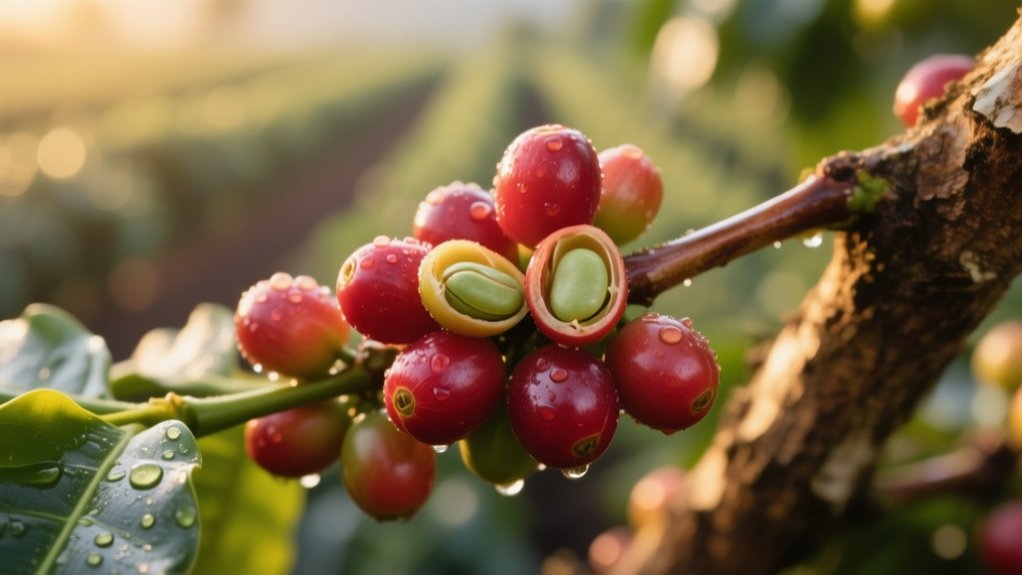
Coffee beans aren’t actually beans. They’re seeds inside a fruit called a coffee cherry. Each cherry usually holds two seeds, surrounded by layers like the skin, pulp, and a protective shell.
These cherries ripen over months, changing from green to red, which influences flavor. How the fruit is processed also shapes the coffee you brew.
If you want to understand how these fruity secrets affect your daily cup, there’s much more to explore about coffee’s journey from plant to mug.
Are Coffee Beans Actually Seeds?
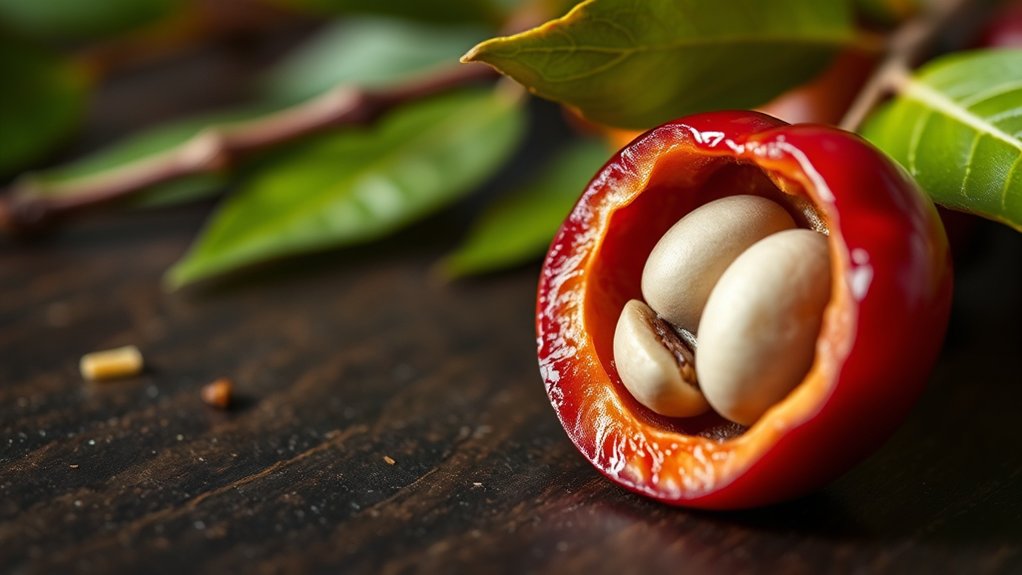
Have you ever wondered if coffee beans are actually seeds? Yes, they are. Coffee beans come from the coffee cherry, a fruit that grows on coffee plants.
Inside each cherry, you’ll usually find two seeds, which we commonly call coffee beans. These seeds develop within the cherry’s protective layers, ensuring their growth.
Curiously, some cherries produce just one seed, known as a peaberry.
When you enjoy your Arabica beans, you’re savoring the seeds of this fruit, not true beans like those from legumes.
While the coffee cherry’s sweet flesh and tough skin surround the seeds, they’re rarely eaten.
How Coffee Cherries Develop and Ripen
Now that you know coffee beans are the seeds inside coffee cherries, it’s interesting to explore how these cherries develop and ripen. Coffee cherries form from the coffee plant’s flowers, which bloom briefly before the cherries start growing.
Each cherry usually holds two coffee beans, though about 5% contain a single seed called a peaberry. The ripening process takes 7 to 11 months and depends heavily on rainfall and temperature.
As the cherries mature, their color changes from green to yellow, then to red, signaling they’re ready for harvest.
You’ll find that careful hand-picking of ripe coffee cherries is essential to maintain quality, preventing unripe or overripe cherries from affecting the flavor of the coffee beans inside.
The Structure and Layers of a Coffee Cherry
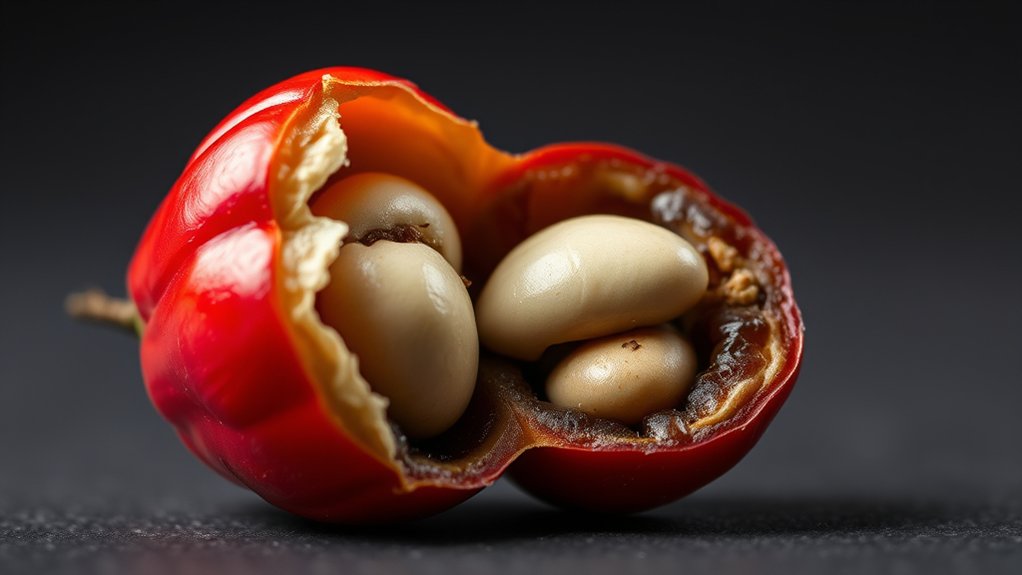
Although coffee cherries look simple on the outside, they’ve a complex structure made up of several distinct layers. The outermost layer, called the exocarp, is a thin, smooth skin that changes color from green to red as the fruit ripens.
Beneath this is the mesocarp, the juicy pulp that surrounds the beans and helps protect them. Inside the mesocarp lies the endocarp, a hard shell that encases the seeds, commonly known as coffee beans.
Usually, a coffee cherry contains two flat seeds, but occasionally you’ll find a single seed called a peaberry, which many consider sweeter.
Understanding these layers helps you appreciate how coffee cherries develop and protect the valuable seeds inside this unique fruit.
Arabica vs. Robusta: Coffee Fruit Differences
You’ll notice that Arabica coffee tends to have a sweeter, more complex flavor.
On the other hand, Robusta delivers a stronger, more bitter taste.
It’s pretty interesting how the caffeine content also sets them apart—Robusta contains nearly double the amount found in Arabica.
Knowing these differences really helps you appreciate how the fruit influences your cup.
Flavor Profiles Comparison
When comparing Arabica and Robusta coffee beans, you’ll notice distinct differences in their flavor profiles that stem from their unique fruit characteristics.
Arabica coffee cherries often produce beans with sweeter, more complex flavors, while Robusta cherries yield beans with a stronger, more bitter taste. This contrast arises from their chemical makeup and how the beans develop within their fruit.
Arabica beans boast fruity and floral flavor notes. Robusta beans offer a more straightforward, bitter flavor.
Arabica coffee cherries usually contain two seeds, enhancing complexity. Robusta cherries sometimes produce peaberries with concentrated flavor. Higher chlorogenic acids in Robusta contribute to its bitterness.
Understanding these differences helps you appreciate how coffee cherries influence the final flavor in your cup.
Caffeine Content Differences
Since caffeine plays a key role in coffee’s taste and effects, understanding its differences between Arabica and Robusta beans can help you choose the right brew. Both come from coffee cherries, but Arabica coffee has a caffeine content of 0.8–1.4%, while robusta beans pack 1.7–4.0%, making robusta stronger and more bitter.
Arabica dominates global production with about 60%, offering a sweeter taste. Caffeine content in Arabica stays stable as it matures, unlike robusta, which varies by growing conditions.
| Aspect | Arabica Coffee | Robusta Beans |
|---|---|---|
| Caffeine Content | 0.8–1.4% | 1.7–4.0% |
| Flavor Profile | Sweet, complex | Bitter, earthy |
| Global Production | 60% | 40% |
| Stability of Caffeine | Stable | Variable |
| Source | Coffee cherries | Coffee cherries |
How Coffee Beans Grow Within the Coffee Belt
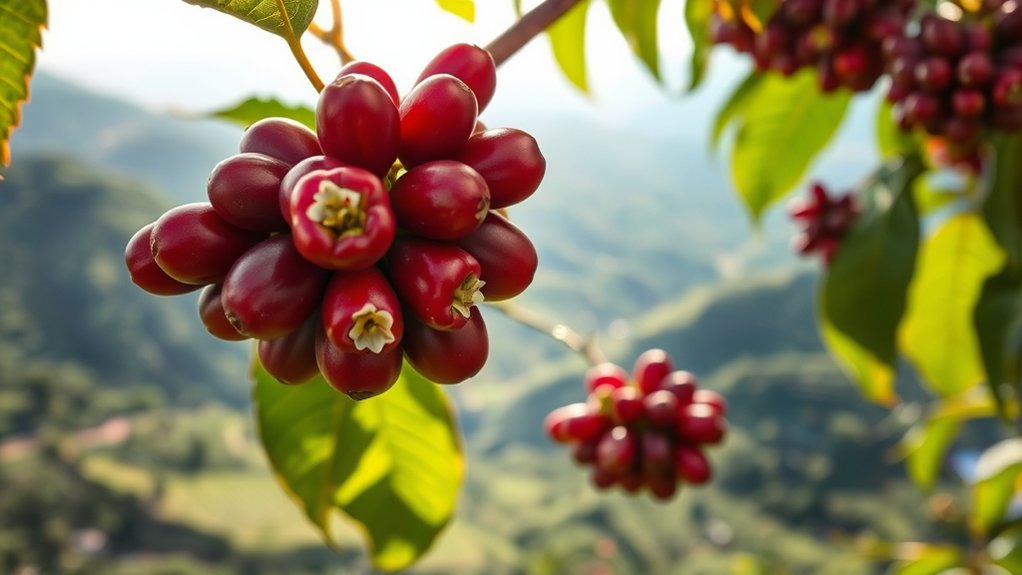
Three key factors define how coffee beans grow within the Coffee Belt: location, altitude, and climate.
Coffee beans come from coffee cherries that develop on coffee trees thriving in a tropical zone between the Tropics of Cancer and Capricorn. These coffee trees grow best at elevations between 600 and 2,000 meters, where temperatures suit Arabica or Robusta varieties.
You’ll find coffee cherries maturing over almost a year, turning from green to vibrant red when ripe.
- Coffee trees start producing cherries at about three years old
- Full production occurs between five to seven years
- Coffee cherries take nearly one year to ripen
- Best growing altitude ranges from 600 to 2,000 meters
- Ideal temperatures vary for Arabica (15–24°C) and Robusta (24–30°C)
Understanding these helps you appreciate how coffee beans come to life within the Coffee Belt.
What Makes Peaberries Special in Coffee Fruit
Among the coffee cherries that ripen on trees within the Coffee Belt, you’ll occasionally find a rare variation known as peaberries. Unlike typical coffee cherries that contain two seeds, peaberries develop from a single seed, making up about 5-10% of the harvest.
You’ll notice their rounder shape impacts roasting, enhancing the flavor and aroma uniquely. Peaberries are prized for their concentrated nutrients, which often result in a sweeter taste and improved quality of coffee. Coffee enthusiasts specifically seek them out, appreciating their rarity and distinct profile.
| Feature | Standard Coffee Bean | Peaberry |
|---|---|---|
| Seed Count | Two per cherry | One per cherry |
| Shape | Flat, oval | Round |
| Flavor & Aroma | Balanced, classic | Sweeter, more intense |
| Nutrient Absorption | Shared by two seeds | Concentrated in one seed |
| Market Demand | Common | Higher due to uniqueness |
How Coffee Beans Are Processed From Fruit to Seed
When you harvest coffee cherries, you get to decide between wet and dry processing to separate the seeds from the fruit.
Each method changes how the beans dry out and develop their unique flavors before hulling. Knowing these steps really helps you appreciate the journey from cherry to coffee seed.
Harvesting Coffee Cherries
Harvesters pick coffee cherries by hand, carefully selecting only the ripe, red fruits to assure the best quality beans. This selective harvesting guarantees that only mature coffee cherries enter the processing stage, preserving flavor and quality.
Each cherry typically holds two seeds, known as coffee beans, though occasionally, a single peaberry appears. You’ll notice that coffee harvesting demands patience and skill, as the cherries don’t ripen all at once.
During harvesting, keep in mind:
- Coffee cherries are handpicked to avoid unripe fruit.
- Ripe cherries turn a vibrant red color.
- Each cherry usually contains two coffee beans.
- Peaberries, a rare single-seeded variant, occur in about 5% of cherries.
- The timing of the harvest influences the entire processing outcome.
This careful harvesting is essential for quality coffee beans.
Wet Versus Dry Processing
Because the way coffee cherries are processed directly affects the flavor and quality of your brew, understanding wet and dry processing methods is essential.
Wet processing removes the fruit pulp from the cherries before drying the seeds, resulting in a cleaner flavor profile. The cherries are soaked in water, allowing fermentation to separate the beans from the mucilage efficiently.
Dry processing, on the other hand, dries the coffee cherries whole under the sun, which can impart a fruitier taste but may cause more flavor variability.
Both methods require the seeds to reach 11% moisture before hulling to preserve quality.
While wet processing is generally favored for high-quality Arabica beans, each method uniquely shapes the final taste and aroma you experience in your cup.
Seed Drying And Hulling
Although coffee cherries start as vibrant fruit, the journey to becoming the beans you brew involves careful drying and hulling. After harvesting, whether using the Wet Method, soaking and fermenting the cherries, or the Dry Method, sun-drying them whole, the seeds inside must reach about 11% moisture. This drying step is critical to preserving flavor.
Once dried, the parchment layer is removed through hulling, revealing the green coffee beans. These beans are then sorted by quality before roasting.
Here’s what happens during seed drying and hulling:
- Coffee cherries are processed via Wet or Dry Method
- Seeds dry to ideal moisture levels
- Pulp and skin are removed
- Parchment layer is hulled off
- Green coffee beans are sorted for quality
This process shapes the flavor of your coffee.
Five Common Misconceptions About Coffee Beans
What exactly are coffee beans, and why do so many people get them wrong? Many think coffee beans are just beans, but they’re actually seeds inside coffee cherries, the fruit of the coffee tree.
The coffee tree begins its cycle by producing these cherries, each typically containing two seeds, or beans.
Another misconception is that coffee cherries are eaten like fruit, but their slimy texture makes them unsuitable for direct consumption.
People also often confuse coffee beans with true beans, though coffee seeds come from a drupe, not legumes.
Ultimately, many overlook the health benefits linked to compounds found within these beans, which contribute to coffee’s popularity worldwide.
Understanding these facts clears up common myths about coffee beans.
Why Knowing Coffee as a Fruit Matters to Growers and Drinkers
Knowing that coffee is actually a fruit changes the way you approach growing it. When you think of it as a fruit, you start paying more attention to the right climate and soil needed to produce the best cherries. This matters because the quality of those cherries directly impacts the flavors you get in your cup.
And it’s not just about growing—understanding coffee as a fruit helps you appreciate how ripeness and processing methods shape the taste.
Impact On Cultivation
Because coffee beans are actually seeds inside a fruit, growers can tailor their cultivation techniques to boost both yield and quality.
Understanding the coffee cherries’ ripening process helps you pick them at peak ripeness, which is essential for preserving the best flavor profile.
You’ll also appreciate how specific processing methods, like wet or dry, maintain the fruit’s natural sweetness.
Knowing coffee as a fruit affects how you manage growing conditions, especially in subtropical climates within the coffee belt, ensuring ideal fruit development.
Key cultivation impacts include:
- Timing harvests to pick ripe coffee cherries
- Adjusting irrigation for fruit health
- Selecting shade levels for optimal growth
- Applying suitable processing methods
- Monitoring climate to enhance flavor profile
This knowledge helps both growers and drinkers value coffee’s complexity.
Influence On Flavor
When you recognize coffee beans as seeds within a fruit, you can better appreciate how the ripeness of coffee cherries shapes the drink’s flavor. Fully ripe cherries hold sugars and acids that develop complex sweetness, while underripe or overripe ones mute desirable notes.
The processing method, wet or dry, further influences how these flavors emerge. For example, wet processing highlights brightness, while dry processing emphasizes fruity notes. Knowing the anatomy of the cherry helps you understand why Arabica bean cherries often deliver richer, nuanced flavor profiles compared to others.
| Ripeness | Processing Method | Flavor Outcome |
|---|---|---|
| Underripe | Wet | Tart, acidic |
| Ripe | Wet | Sweet, bright |
| Ripe | Dry | Fruity, complex |
| Overripe | Dry | Fermented, heavy |
How Coffee Fruit Biology Affects Coffee Flavor and Quality
Although you might focus on the beans themselves, the entire coffee cherry plays an essential role in shaping your coffee’s flavor and quality. The coffee cherries’ layers, from the outer skin to the pulp and the seed coating, each influence the taste you experience.
The sugar in the pulp adds natural sweetness, while the seed’s carbohydrates and proteins develop complex aromas during roasting. Harvesting fully ripe coffee cherries guarantees your brew captures the best flavor and quality.
Consider these key factors:
- Coffee cherries are fruits housing the seeds you know as beans.
- The mesocarp pulp contributes sweetness to flavor.
- Endocarp protects beans affecting flavor development during roasting.
- Seed composition influences aroma and taste profiles.
- Ripeness at harvest directly impacts coffee quality and complexity.
Understanding fruit biology helps you appreciate what shapes your perfect cup.
Frequently Asked Questions
Can Coffee Fruit Be Eaten Fresh Like Other Berries?
You can eat fresh coffee cherries, but they’re not as appealing as other berries because of their slimy texture.
If you’re interested in fresh coffee consumption, trying coffee cherry recipes might be more enjoyable.
These recipes let you explore their unique mango-like flavor profile. Plus, these cherries offer health benefits compared to other fruits, as they contain antioxidants.
Do Coffee Cherries Have Nutritional Benefits for Humans?
You might wonder if coffee cherries really offer nutritional benefits beyond just brewing your morning cup. They do!
Coffee cherries pack a surprising nutritional value, rich in antioxidants that help fight oxidative stress and inflammation.
Their health benefits include supporting digestion and metabolism, thanks to fiber and essential vitamins.
While their culinary uses are limited due to texture, incorporating them as extracts or supplements can boost your wellness routine effectively.
How Long Does It Take for a Coffee Cherry to Mature?
It takes about 7 to 11 months for a coffee cherry to mature during its coffee cherry lifecycle.
You’ll notice maturation factors like rainfall and temperature affecting this timeline.
Climate effects are essential; Arabica prefers cooler 15-24°C, while Robusta thrives in warmer 24-30°C conditions.
When cherries turn bright red, harvesting techniques come into play.
This signals they’re ripe and ready for picking, ensuring ideal quality and flavor in your coffee.
Are There Any Pests That Specifically Target Coffee Cherries?
You should know that coffee pests like the coffee borer beetle can reduce yields by up to 40% by burrowing into coffee cherries.
Yes, there are pests that specifically target coffee cherries, causing serious damage.
To combat these cherry diseases, effective insect control and pest management strategies are essential.
Can Coffee Cherries Be Used for Products Other Than Coffee?
Yes, you can definitely use coffee cherries for more than just coffee. Through coffee cherry processing, you get cascara, a tea-like drink made from dried husks.
Coffee byproducts benefits also include organic fertilizer from the pulp, natural sweeteners, and coffee flour. These uses support sustainable coffee practices by reducing waste and promoting eco-friendly farming.
Exploring coffee cherry uses adds value to the entire coffee plant beyond the beans themselves.
Conclusion
Now that you know coffee beans are seeds nestled inside vibrant cherries, you can see coffee as more than just a morning ritual. It’s nature’s little treasure chest. Like a hidden gem in a lush fruit, each bean carries the story of sun, rain, and earth.
Understanding this journey lets you savor every sip with fresh appreciation, connecting you to the blossoming orchards where your favorite brew begins its flavorful dance.