Coffee How Many Scoops Per Cup – Coffee Ratio Guide
You’ll want about one coffee scoop holding two tablespoons or 10 grams per 6-ounce cup to get the best coffee-to-water ratio, roughly 1:16, for balanced flavor. Keep in mind, cup sizes vary, so adjust scoops accordingly.
Using a digital scale helps maintain precision since grind size affects volume but not weight. Consistent measurements and fresh beans truly elevate your brew. There’s more to perfecting your coffee, including grind size and freshness, that can boost your results.
What Is a Coffee Scoop and How Much Does It Hold?
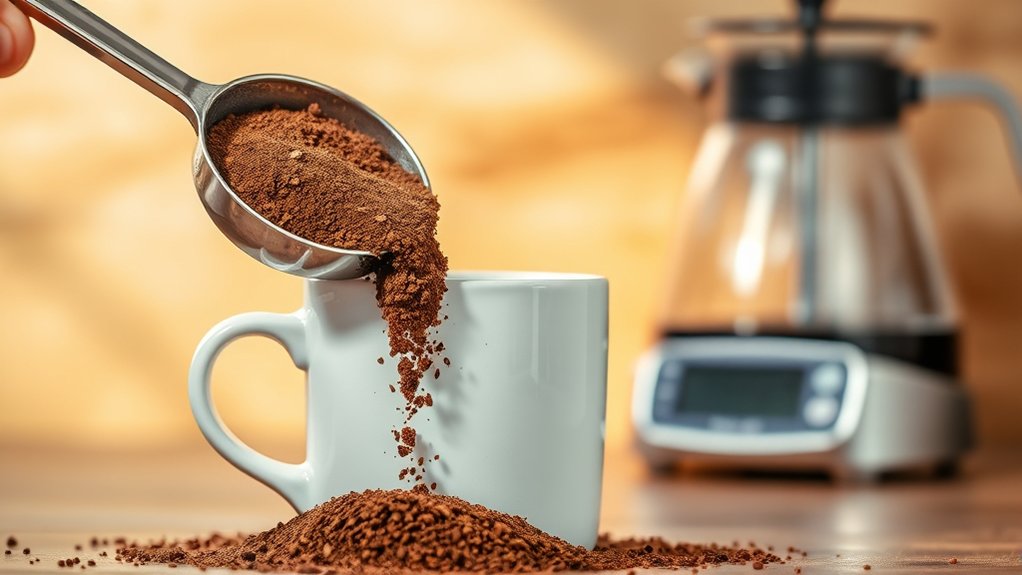
A coffee scoop is a specialized measuring tool designed to hold about 2 tablespoons, or roughly 10 grams, of ground coffee. It’s tailored specifically for coffee measurements, differing from a standard tablespoon to help you maintain an accurate coffee ratio.
The standard recommendation suggests using one coffee scoop per 6-ounce cup of brewed coffee. When measuring coffee, using a scoop offers convenience but can introduce slight variations in strength.
For greater consistency, many prefer using a scale to weigh their ground coffee precisely. Understanding the exact capacity of your coffee scoop helps you control the brewing process, ensuring each cup meets your taste expectations.
How Many Coffee Scoops Do You Need Per Cup?
How many coffee scoops do you need per cup to get the perfect brew? For a standard 6-ounce cup of coffee, use one scoop, about 2 tablespoons or 10 grams, of ground coffee.
This fits the standard coffee-to-water ratio of roughly 1:16, meaning one gram of coffee per sixteen grams of water. Your brewing method and taste preference might lead you to adjust the amount. For a bolder cup, try ratios like 1:15 or 1:12.
If you’re making a larger batch, say a 12-cup pot, you’ll need 10 to 12 scoops accordingly.
Why Does the Definition of a “Cup” Matter for Coffee Measurements?
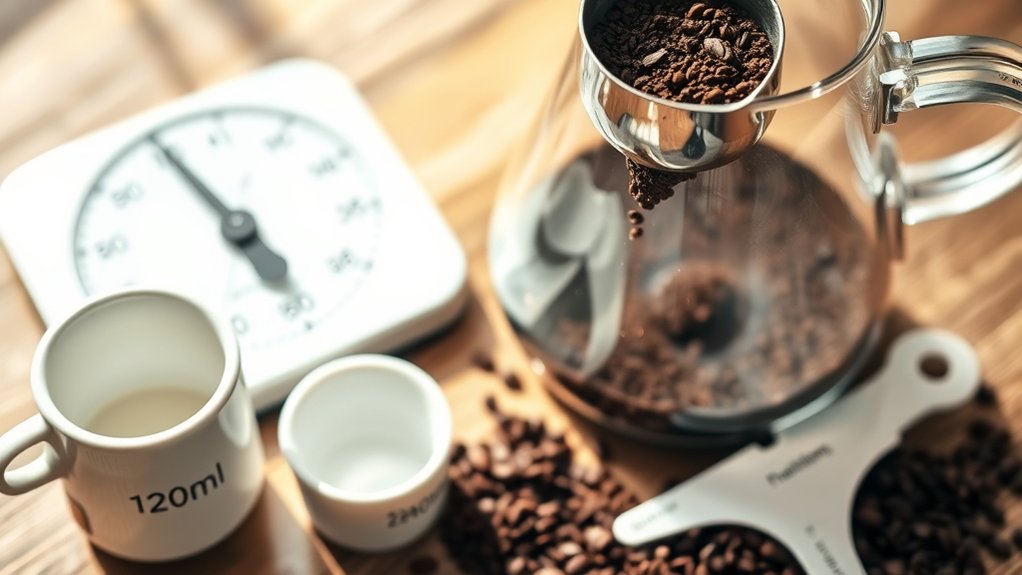
Since coffee measurements hinge on volume, knowing the exact definition of a “cup” is essential for brewing consistency. A coffee cup is generally 6 ounces, but many coffee makers use 5-ounce cups, causing confusion.
This affects how many scoops you use because a standard coffee scoop holds about 2 tablespoons of ground coffee. Without proper measurements, your coffee-to-water ratio shifts, risking overly strong or weak coffee.
Understanding this helps you maintain a balanced flavor when brewing coffee.
| Coffee Cup Size | Scoop Amount | Result | Coffee-to-Water Ratio | Emotion |
|---|---|---|---|---|
| 5 oz | 1 scoop | Weak coffee | Off | Frustration |
| 6 oz | 1 scoop | Balanced flavor | 1:16 | Satisfaction |
| 6 oz | 2 scoops | Overly strong | Too concentrated | Discomfort |
| 8 oz | 2 scoops | Balanced flavor | 1:16 | Comfort |
| 8 oz | 1 scoop | Weak coffee | Too diluted | Disappointment |
How to Calculate Coffee Amounts for Different Coffee Maker Sizes
Knowing your coffee maker’s capacity helps you measure coffee accurately for each brew. For a standard drip coffee maker, use one scoop, about 10 grams or 2 tablespoons, of coffee per 6-ounce cup.
If you have a 10-cup coffee maker, you’ll need 10 scoops (around 100 grams of coffee grounds) to maintain the ideal coffee-to-water ratio. For an 8-cup pot, aim for 7 to 8 scoops, or 70 to 80 grams.
Your brewing method affects how you adjust the amount of coffee, so tweak the coffee-to-water ratio based on taste preferences.
Remember, the ideal coffee-to-water ratio hovers around 1:16, but you can shift this slightly for stronger or lighter brews.
Calculating coffee amounts by cup size guarantees balanced flavor every time.
What’s the Ideal Coffee-to-Water Ratio for Brewing?
Why does the coffee-to-water ratio matter so much when brewing? It guarantees you get the perfect balance of flavor and strength every time.
The ideal coffee-to-water ratio is about 1:16, meaning 1 gram of coffee per 16 grams (or mL) of water. For a standard 6-ounce cup, that’s roughly 10-11 grams or one coffee scoop (2 tablespoons).
Adjust the ratio for a stronger brew, say 1:15, or a lighter one around 1:18.
Different brewing methods call for tweaks. For example, a French press uses between 1:12 and 1:15 to extract bolder flavors.
Maintaining consistency in measurements is key, whether you rely on scoops or scales, so you can replicate your favorite cup every time without guesswork.
How to Measure Coffee Accurately Without a Scale
Getting the coffee-to-water ratio just right often means measuring your coffee accurately, even if you don’t have a scale on hand. Use a coffee scoop, which holds about 2 tablespoons of coffee grounds, to measure coffee consistently.
For one standard cup (6 ounces), one scoop guarantees the perfect ratio, balancing flavor and strength. If you prefer tablespoons, remember that two level tablespoons equal one scoop, so you can easily measure tablespoons per 6-ounce cup.
Accurately measuring the amount of coffee grounds helps maintain consistency, especially if your coffee maker’s “cup” size differs from the standard.
How to Adjust Coffee Scoops for Brew Strength and Taste
You can easily fine-tune your coffee’s strength by playing around with the coffee-to-water ratio. If you want a bolder taste, just use more scoops. For a lighter cup, go with fewer scoops.
A good place to start is one scoop per 6 ounces of water. From there, feel free to adjust it however you like. Maybe add a little more or cut back a bit until it tastes just right to you.
Keep in mind, even small changes in the ratio can make a big difference in flavor. So, don’t be afraid to experiment and find your perfect brew!
Adjusting Coffee-to-Water Ratio
Three key coffee-to-water ratios can transform your brew’s strength and flavor to suit your taste. For a balanced brew, use one scoop per 6 ounces of water, about 10 grams of coffee grounds.
Want stronger coffee? Adjust your ratio to 1:15, using roughly 15 grams per 250 mL of water. Prefer a lighter brew? Try a 1:18 ratio, with about 11 grams per 250 mL. Measuring scoops per cup accurately with a measuring cup guarantees consistency.
Remember, grind size affects extraction too. Finer grounds can yield a stronger brew with less coffee.
Experiment with these ratios to find your perfect balance, then adjust your coffee-to-water ratio accordingly to enhance flavor and strength in every cup you brew.
Personalizing Brew Strength
How much coffee you use per cup directly shapes your brew’s strength and flavor.
To personalize your coffee experience, start by adjusting the coffee-to-water ratio according to your personal taste preferences.
Here’s how you can fine-tune your brew strength:
- For a balanced cup, use one scoop (about 10 grams) per 6 ounces of water.
- If you want a stronger cup, increase the coffee amount to a 1:15 ratio, around 15 grams per 250 mL.
- For a lighter flavor, decrease the coffee amount to a 1:18 ratio, about 13.9 grams per 250 mL.
How Does Grind Size Affect the Amount of Coffee You Use?
Why does grind size matter when measuring your coffee? Grind size directly impacts extraction rates, so you’ll need to adjust your coffee-to-water ratio accordingly.
Finer grinds extract flavors faster, requiring less coffee and shorter brewing time, like in espresso.
Medium grinds, ideal for drip coffee, balance extraction and brewing time with a standard 1:16 ratio.
Coarse grinds, used in the French press or cold brew, demand more coffee, with ratios around 1:12 to 1:15, because longer brewing time is necessary to extract flavors fully.
Consistent grind size is essential; uneven particles lead to inconsistent extraction, affecting taste and strength.
Coffee Scoops vs. Grams: Which Makes Better Coffee?
When you’re aiming for the perfect cup, should you rely on coffee scoops or grams? A standard coffee scoop holds about 10 grams of coffee, making it quick for brewing coffee. However, measuring coffee by weight with a digital scale offers more accuracy, ensuring you hit the ideal coffee ratio every time.
Here’s why grams often outperform scoops:
- Coffee scoops vary with grind size, affecting volume but not weight, which leads to inconsistent results.
- Measuring coffee by weight accounts for roast density, maintaining a consistent coffee-to-water ratio.
- Using grams of coffee lets you customize your brew precisely, refining flavor based on exact measurements.
For the best balance, trust measuring coffee by weight over scoops to control your brew’s quality consistently.
Tips for Consistent Coffee Measurement and Better Brewing
To brew consistently great coffee, you’ve got to get the coffee-to-water ratio just right. Using precise tools, like a digital scale, really helps with that.
Adjusting the ratio lets you control the strength of your coffee. For example, a smooth 1:16 balance gives you a lighter cup, while a bolder 1:12 ratio packs more punch.
By measuring carefully and tweaking those ratios, you’ll dial in the flavor you want every single time.
It’s all about finding what works best for your taste!
Accurate Coffee-To-Water Ratio
Although many coffee lovers rely on scoops, you’ll get the most consistent brew by measuring your coffee-to-water ratio with a digital scale. The ideal ratio is 1:16, meaning 1 gram of freshly ground coffee for every 16 grams of filtered water.
That’s about 2 tablespoons or 10-11 grams of coffee per 6-ounce cup using a standard coffee scoop.
To brew good coffee consistently, measure coffee grounds by weight, not volume, since grind size affects density. You can adjust ratios to 1:12 for stronger brews or 1:18 for lighter ones based on your taste.
Always use filtered water and freshly ground coffee for the best flavor.
Tools For Precise Measurement
Getting your coffee-to-water ratio right is only part of the equation; using the right tools can make a big difference in brewing consistency and flavor quality. A digital scale lets you weigh ground coffee precisely, ensuring you stick to the ideal 1:16 coffee-to-water ratio.
While a standard coffee scoop holds about 10 grams (2 tablespoons) of coffee, it’s best for quick, approximate measures rather than exactness. For water measurements, use graduated measuring cups since coffee makers often use 6 oz cups instead of the standard 8 oz.
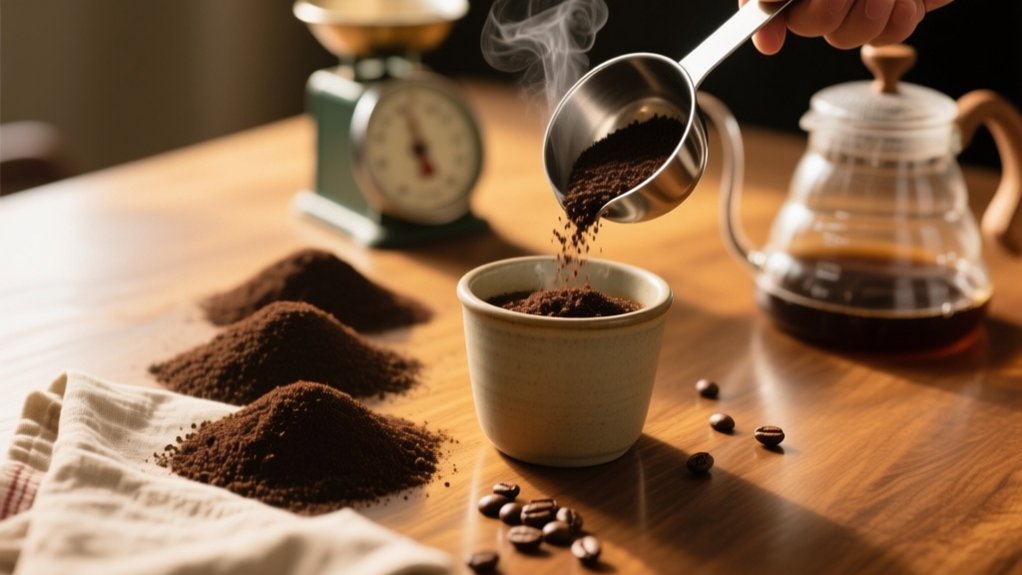
Consistency in grind size also matters. Fine for espresso, coarse for cold brew helps balance extraction.
Using fresh-roasted coffee, filtered water, and quality tools guarantees you achieve the full flavor potential in every cup.
Adjusting Strength By Ratio
When you want to tailor your coffee’s strength, adjusting the coffee-to-water ratio is your most effective tool. Start with a balanced brew ratio of 1:16, about 1 scoop of coffee per 6 ounces of water, and then tweak it to suit your personal taste preferences.
Consistency in measuring coffee is essential, so use a scale for accurate scoops of coffee per cup, regardless of grind size or brewing method.
To adjust strength:
- For stronger coffee, decrease the ratio to 1:15 or 1:12, adding more coffee for a bolder flavor.
- For lighter brews, increase the ratio to 1:18 or higher, reducing coffee for a milder taste.
- Always maintain consistency in your coffee-to-water ratio to enjoy repeatable, satisfying results.
How Bean Freshness and Quality Affect Your Coffee Brewing
Since the quality and freshness of your coffee beans directly impact the flavor and aroma of each cup, you’ll want to use beans roasted within the last month for the best results. Freshly roasted coffee delivers vibrant flavor profiles that degrade quickly if not stored properly.
Using quality coffee beans, especially specialty beans, can elevate your brew with unique characteristics.
Pay attention to grind size, as it affects extraction. Finer grinds extract faster, while coarser ones need more time, influencing taste balance.
Your brewing method and water temperature also play essential roles in highlighting or muting these flavors.
To maintain freshness, store beans in an airtight container away from air, moisture, and light. This guarantees every cup maximizes the potential of your carefully chosen beans.
Frequently Asked Questions
Can I Use a Regular Tablespoon Instead of a Coffee Scoop?
Yes, you can use a regular tablespoon instead of a coffee scoop, but keep in mind scoop size variations. Since one scoop equals two tablespoons, you’ll need to adjust your coffee measurement tips accordingly.
For brewing consistency and measuring accuracy, double your tablespoon amount to match scoop volume. This helps maintain flavor intensity and coffee strength adjustments across different ground coffee types.
Using tablespoon conversions as your scoop alternative keeps your coffee tasting just right.
How Does Water Temperature Impact Coffee Extraction?
Think of water temperature as the conductor of a flavor orchestra. Get it right, and extraction efficiency sings. Staying within temperature ranges of 195°F to 205°F guarantees ideal extraction, balancing acidity levels and enhancing flavor profiles.
Different brewing methods and coffee grind sizes demand tweaks in thermal stability to improve infusion time.
Plus, water quality plays a silent but vital role. If temperature’s off, you’ll either under-extract or over-extract, spoiling the harmony.
Should I Adjust Scoops for Espresso Versus Drip Coffee?
Yes, you should adjust scoops for espresso versus drip coffee. Espresso strength demands a finer grind size and a tighter coffee-to-water ratio, so you’ll use fewer scoops but more coffee per serving to achieve that concentrated flavor.
Drip flavor relies on a coarser grind and larger serving sizes, with milder coffee strength.
Consider your brewing methods, bean freshness, extraction time, and taste preferences to tweak scoops for the perfect cup every time.
How Long Should I Brew Coffee for Optimal Flavor?
You should tailor your brewing time to your chosen brewing methods and grind size for the best flavor profile.
Drip coffee benefits from a 4 to 6 minute steeping time, while espresso demands a quick 25 to 30 second extraction time. Cold brew needs 12 to 24 hours of infusion.
Adjusting steeping time influences coffee strength and taste.
Use quality brewing equipment and rely on taste testing to refine infusion techniques, ensuring every cup hits your perfect flavor mark.
Can Different Coffee Beans Require Different Scoop Measurements?
Yes, different bean types definitely require varying scoop measurements. Depending on roast level, grind size, and bean origin, the density changes, affecting how much coffee you need for your serving size.
The freshness factor and aroma intensity also play roles in dialing in your flavor profile. Adjust your scoops based on your brewing method to achieve the perfect balance.
Experimenting helps you find the ideal scoop measurement that suits your taste and maximizes flavor.
Conclusion
Now that you’ve got the scoop on scoops, you’re set to brew with confidence and finesse. Remember, a little precision goes a long way. Think of it as the secret handshake to revealing richer, more satisfying coffee moments.
Whether you measure by scoops or grams, adjusting to your taste and gear will elevate your daily ritual. So, go ahead, stir up your perfect cup and savor the subtle art behind every sip.