How Do You Make Coffee Less Acidic – Simple Tips That Work
To make your coffee less acidic, start by choosing low-acid beans from regions like Brazil or opting for dark roasts that naturally break down acids during roasting. Try brewing with coarser grounds and water slightly below boiling to limit acid extraction.
Cold brewing is especially effective, cutting acidity by up to 70%. You can also balance acidity with natural additives like a pinch of baking soda or milk. Keep these tips in mind, and soon you’ll discover even more ways to enjoy a smoother, richer cup.
What Causes Coffee Acidity and Why It Matters
Although coffee’s vibrant acidity adds brightness and complexity to its flavor, it’s mainly caused by organic acids in the beans, especially chlorogenic acid. This acid strongly influences both taste and pH.
You’ll notice coffee acidity varies with factors like altitude and brewing methods. These elements shape the flavor complexity you experience. Higher-altitude beans develop more acidity due to slower maturation, enriching your cup’s profile.
Coffee acidity changes with altitude and brewing, enhancing flavor complexity and enriching your cup’s profile.
If you have digestive sensitivities, this acidity can cause discomfort. Luckily, brewing methods like cold brewing considerably reduce acidity, up to 70% less, making your coffee gentler on the stomach.
Opting for low-acid coffee with a pH between 5.50 and 6.00 can also help you enjoy rich flavor without harshness.
Understanding these elements lets you tailor your brew to your taste and tolerance.
How to Choose Low-Acid Coffee Beans That Taste Great
When selecting low-acid coffee beans that still deliver rich flavor, you’ll want to focus on their origin and roast level. Beans from low-altitude regions like Brazil, Honduras, or Peru naturally have lower acidity.
Opting for dark roast coffee further reduces acidity by breaking down chlorogenic acids. You can also explore coffee varieties such as Brazilian or Sumatran, known for smooth flavor profiles.
Don’t overlook Robusta beans, as they tend to have less acidity than Arabica and offer unique tastes. Finally, check out low-acid coffee brands that guarantee gentle yet flavorful brews.
| Factor | Recommendation |
|---|---|
| Origin | Low-altitude regions |
| Roast Level | Dark roast coffee |
| Coffee Varieties | Brazilian, Sumatran |
| Bean Type | Robusta beans |
| Brand | Low-acid coffee brands |
Why Dark Roasts Are Best for Low-Acid Coffee

You’ll notice that dark roasts have noticeably lower acidity because the longer roasting process breaks down chlorogenic acids. This means the coffee isn’t as sharp or bright as lighter roasts.
Plus, this roasting method brings out rich flavors like chocolate and nuts, which help cover up any leftover acidity.
Acid Breakdown During Roasting
Because dark roasts undergo a longer roasting process, they break down chlorogenic acids more thoroughly, resulting in coffee that’s considerably less acidic and gentler on your stomach.
During this extended roasting, natural acids degrade considerably, leading to a notable acid breakdown. This process reduces the acidity level, with dark roast coffee typically having a pH between 5.2 and 5.6, making it less acidic coffee compared to lighter roasts.
The roasting process also triggers Maillard reactions and caramelization, which subtly shift the flavor profile away from sharp acidity toward smoother, richer tones.
Flavor Profiles in Dark Roasts
Although many coffee lovers focus on acidity levels, the rich flavor profiles developed in dark roasts truly set them apart for those seeking a low-acid brew.
Dark roasts undergo longer roasting, breaking down chlorogenic acids, which results in lower acidity, often between pH 5.2 and 5.6. This makes them an ideal choice if you have a sensitive stomach or find coffee acidic.
Beyond just being less acidic, dark roasts offer complex flavors like dark chocolate, caramel, and nuts, delivering a smooth, rich taste.
Beans from low-altitude origins, typical in dark roasts, naturally contain fewer acidic compounds, further enhancing this gentler coffee experience.
Choosing dark roasts means you get both a less acidic brew and a satisfying depth of flavor.
Roasting Levels Affect Acidity
When coffee beans undergo longer roasting, their acidity markedly decreases as chlorogenic acids break down, making dark roasts a superior choice for those seeking a gentler cup.
Dark roast coffee typically has a 50-95% lower acidity level compared to light roasts, thanks to this chemical transformation.
If you prefer low acid coffee, choosing roasted coffee beans with a darker profile reduces acidity naturally, making your brew easier on the stomach.
Dark roasts, often made from Arabica beans grown at lower altitudes, balance rich chocolate and caramel flavors with less acidity.
Adjusting your brewing methods to complement dark roast’s smoother profile enhances your enjoyment while minimizing digestive discomfort.
How Cold Brew and Other Brewing Methods Lower Acidity
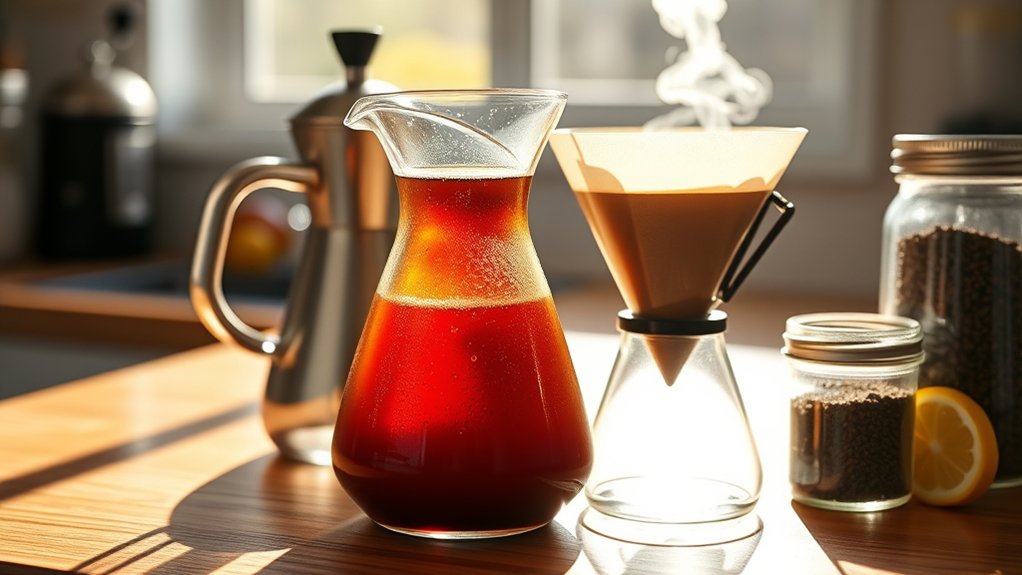
You’ll notice cold brew coffee often tastes smoother because its long steeping time and cooler temperatures reduce acidity by up to 70% compared to hot brewing.
On top of that, choosing the right filter—like paper instead of metal—also plays an essential role by trapping acidic oils that metal filters let through.
Plus, brewing at slightly lower temperatures between 190°F and 195°F can further mellow acidity, giving you a cleaner, gentler cup.
Cold Brew Acidity Reduction
Cold brew coffee reduces acidity by up to 70% compared to hot brewing methods, thanks to its longer steeping time and cooler extraction temperature.
When you use cold brew, you extract fewer acidic compounds because the brewing temperature stays around room temperature or slightly chilled. This limits harsh acid release.
To reduce coffee acidity effectively, opt for a coarse grind; it slows extraction, helping create a smoother, less acidic cup.
Furthermore, using paper filters during your cold brew process traps oils and some acids, enhancing smoothness while lowering acidity further.
This method results in a brew with a higher pH, typically between 5.10 and 6.00, making your coffee gentler on your stomach without sacrificing flavor.
Filter Types Impact
Among the key factors influencing coffee acidity, the type of filter you use plays an essential role in shaping your cup’s flavor profile.
Filter types impact how much acidity in coffee ends up in your brew.
For example, paper filters trap more oils and acidic compounds, delivering a smoother, less acidic cup. In contrast, metal filters allow more oils and acids to pass through, often resulting in a brighter, more acidic taste.
Pairing paper filters with cold brew or pour-over methods maximizes your ability to reduce acidity.
Furthermore, brewing methods like cold brew naturally lower acidity by extracting fewer acidic compounds over time.
Temperature Effects
The type of filter you choose certainly influences acidity, but the temperature at which you brew plays an equally significant role in shaping your coffee’s flavor profile.
Temperature effects are essential: cold brewing, done at room temperature over 12-24 hours, reduces acidic compounds by up to 70% compared to hot brewing methods.
Hot water between 195°F and 205°F extracts more acidity quickly, while cooler water slows this process, yielding a smoother cup.
Pairing cold brewing with a coarser grind further limits acid extraction by reducing surface area contact.
Adjusting brewing time also matters. Longer steeping reduces acidity, while shorter brews tend to heighten it.
Reduce Coffee Acidity With Grind Size and Water Temperature
Adjusting your grind size and water temperature plays an essential role in reducing coffee acidity while preserving rich flavors.
By using a coarser grind, you limit the extraction process of acidic compounds, resulting in a smoother coffee that’s less sharp. This is perfect for brewing methods like the French press.
Finer grinds increase surface area, which can cause over-extraction, boosting acidity and bitterness.
Pair this with water temperatures between 195°F and 205°F (90-96°C) to optimize flavor extraction. Lowering the water temperature slightly within this range helps reduce acid without sacrificing complexity.
Experimenting with these variables lets you tailor your brew to reduce acid effectively, balancing taste and smoothness.
Mastering grind size and water temperature guarantees every cup delights without harsh acidity.
Using Paper Filters and Tricks to Reduce Acidity
When you use paper filters in brewing methods like Chemex or pour-over, you effectively trap oils and acidic compounds that contribute to harshness. This gives you a smoother, cleaner cup.
Using paper filters can reduce acidity more than metal ones, ensuring a less bitter, more balanced flavor.
Opt for unbleached filters to avoid chemical residues that might affect flavor, especially if you’re brewing low-acid coffee.
Pairing paper filters with coarser grind sizes and carefully controlled brewing temperatures further enhances flavor balance. This highlights natural sweetness while minimizing sharpness.
This combination lets you enjoy a smooth cup that emphasizes nuanced notes rather than acidity.
Mastering these small but essential details will transform your coffee experience, making each brew gentler and more enjoyable without sacrificing complexity.
Natural Additives That Neutralize Coffee Acidity Without Changing Flavor
Although acidity gives coffee its bright character, you can soften that sharp edge naturally by adding simple ingredients without compromising flavor.
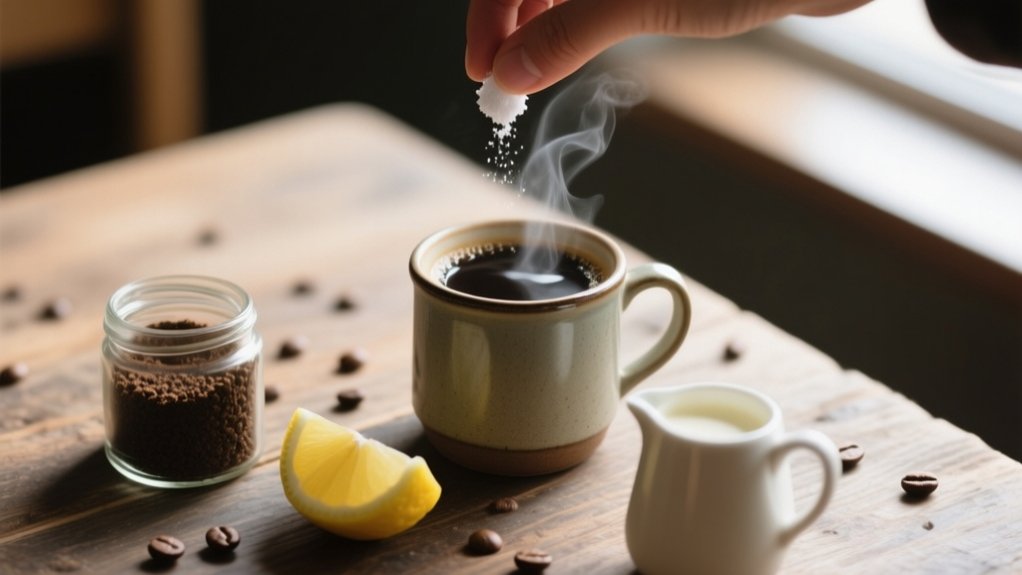
To neutralize acidity, try a small pinch of baking soda, about ¼ teaspoon, especially in dark roasts. It effectively balances natural acidity without altering taste.
A pinch of baking soda, around ¼ teaspoon, gently balances acidity in dark roast coffee without changing flavor.
Adding one clean, crushed eggshell per four cups introduces calcium carbonate, which also neutralizes acidity gently.
Incorporating milk, whether dairy or plant-based like oat or almond, helps bind acids and reduces acidity smoothly.
A pinch of salt enhances flavor while cutting bitterness and acidity, making your brew smoother.
Finally, a sprinkle of cinnamon not only adds warmth but subtly lowers perceived acidity without changing the essential flavor profile.
These natural additives let you enjoy a balanced, less acidic cup effortlessly.
How Water Quality Influences Coffee Acidity
You’ll notice that the minerals in your water, especially calcium and magnesium found in hard water, play an important role in balancing coffee’s acidity. They help smooth out those sharp flavors you mightn’t enjoy.
On the other hand, soft water, which lacks these minerals, tends to let the acidity stand out more. That can make your cup taste brighter—or even a bit sour.
Also, keeping your water’s pH close to neutral is key. It ensures you extract the best flavors without bringing out any unwanted acidity.
Hard Water Effects
Since water makes up most of your coffee, its quality directly shapes the drink’s acidity and flavor profile.
Using hard water, rich in calcium and magnesium, can greatly reduce the perceived acidity in your cup. These minerals act as natural acid buffers, smoothing out sharp notes and helping you achieve a smooth cup.
When brewing coffee with hard water, you facilitate better extraction of soluble compounds, enhancing flavor while taming acidity. If you prefer low-acid brewing, experimenting with water hardness is essential.
Soft water, by contrast, allows the coffee’s natural acidity to shine, sometimes resulting in a brighter, tangier taste.
Mineral Content Role
When you adjust the mineral content in your brewing water, you directly influence how coffee’s flavors and acidity develop.
Mineral content plays an essential role in coffee brewing by affecting the extraction of flavor compounds and acidity levels.
Hard water, rich in calcium and magnesium, buffers acidity, creating a smoother cup. Conversely, soft water lacks these minerals, allowing acidity to shine through with sharper notes.
Understanding this helps you control extraction and balance flavors effectively.
Consider these key points:
- Hard water reduces perceived acidity by neutralizing some acids.
- Soft water enhances acidity, leading to brighter, sharper flavors.
- Mineral-rich water improves extraction efficiency within ideal brewing temperatures.
- Experimenting with water types refines your desired acidity and flavor profile.
Water pH Impact
Although water’s mineral content plays an essential role, the pH level of your brewing water directly shapes the acidity you experience in every cup. Water pH influences how acidic your brewed coffee tastes.
Hard water, with a pH of 7.0 or higher, contains minerals that buffer acidity, resulting in a smoother, less sharp taste profile. Conversely, soft water lacks these minerals, often amplifying acidity and making coffee taste brighter and more sour.
Using filtered water with a balanced pH can help you control acidity consistently, avoiding extremes caused by either hard or soft water. Experimenting with your water source allows you to find the perfect balance, customizing the acidity and enhancing the flavor nuances in every brew.
Step-by-Step Cold Brew Recipe to Reduce Coffee Acidity
Mastering a smooth, low-acid cold brew starts with selecting one cup (100g) of coarsely ground dark roast coffee from low-acid regions like Brazil or Peru.
To reduce acidity effectively, combine the grounds with 4 cups (950ml) of filtered water in a large glass jar. Follow this step-by-step process:
Combine coffee grounds with filtered water in a glass jar, then follow the simple steps for low-acid cold brew.
- Mix the dark roast coffee with filtered water, ensuring an even blend.
- Steep the mixture at room temperature for 12-18 hours to extract rich flavors while keeping acidity low.
- Strain through a fine mesh strainer lined with a paper filter or cheesecloth to remove grounds and oils that increase acidity.
- Store the resulting coffee concentrate in the fridge for up to two weeks; dilute when serving for an even gentler taste.
This cold brew method can reduce acidity by up to 70%, delivering a smooth, low-acid coffee experience.
Who Benefits Most From Drinking Low-Acid Coffee
Many coffee lovers discover that switching to low-acid coffee makes a big difference in their daily comfort and enjoyment. If you suffer from acid reflux or digestive issues, low-acid coffee eases stomach irritation without sacrificing rich flavors. Even coffee drinkers seeking a balanced flavor appreciate how low-acid beans highlight chocolate and nutty notes, especially with hot brewing methods.
| Who Benefits Most | Why |
|---|---|
| Acid reflux sufferers | Gentler on the stomach, reduces heartburn |
| Digestive sensitivities | Minimizes discomfort, ideal for IBS |
| Sensitive coffee drinkers | Smooth, less harsh acidity |
| Medication users | Limits acid intake without flavor loss |
| Mild flavor enthusiasts | Balanced, rounded flavor profiles |
Choosing low-acid coffee lets you enjoy every cup without the harshness of high acidity.
Frequently Asked Questions
Can Decaffeinated Coffee Be Less Acidic Than Regular Coffee?
Decaf coffee isn’t automatically less acidic than regular coffee; acidity depends more on decaf roasting, brewing methods, and coffee terroir.
You can find low-acid decaf options by choosing darker roasts or beans from low-altitude regions, which influence flavor profiles and acidity.
Your taste preferences and health benefits matter too.
Cold brewing decaf often reduces acidity and caffeine content, offering a smoother cup without compromising your enjoyment or wellness.
Does the Age of Coffee Beans Affect Acidity Levels?
Think of coffee bean freshness as a ticking clock that softens acidity over time. Yes, the age of your beans directly influences acidity levels. Fresher beans, especially light roasts, pack vibrant acids, while older ones mellow out.
But don’t forget roasting levels, brewing methods, and water quality. They all dance together with grind size, coffee origin, and bean varietals to shape flavor.
How Does Altitude Impact the Acidity of Coffee Beans?
Altitude effects play a big role in your coffee’s acidity because higher elevations slow bean maturation, boosting organic acids.
The bean variety matters too. Arabica grown high up is more acidic than low-altitude Robusta.
Roasting temperature can tame acidity, while brewing methods and water quality influence your final cup’s sharpness.
Soil composition and climate conditions at altitude also shape flavor complexity. Understanding these factors helps you appreciate and adjust acidity in your coffee.
Are Single-Origin Coffees More or Less Acidic Than Blends?
You’ll find single-origin coffees often have brighter acidity due to their unique regional differences and processing methods, which highlight distinct single origin flavors.
Blends, on the other hand, balance acidity perception by combining various beans, creating smoother blend characteristics and more complex flavor profiles.
Roast levels also matter. Darker roasts reduce acidity in both.
Can Storing Coffee Improperly Increase Its Acidity?
Yes, improper coffee storage can increase acidity levels. When you don’t control humidity effects or temperature fluctuations, your beans absorb moisture, which alters freshness impact and boosts acidity.
Choosing the right airtight container matters. You want to block light exposure and air to keep flavors stable.
Storing coffee in a cool, dark place preserves its ideal pH.
Conclusion
So, if your coffee’s got you feeling like you’ve just kissed a lemon, it’s time to fight back. Swap those bright, acidic beans for dark roasts. Embrace cold brew like a caffeinated zen master, and tweak your grind and water like a barista ninja.
Remember, you don’t have to suffer through coffee that bites. Craft your cup with savvy choices and enjoy a smoother, gentler sip that lets your taste buds breathe easy.