How Many Tablespoons For 12 Cups Of Coffee – Coffee Ratio Guide
You’ll want between 10 and 20 tablespoons of coffee grounds for 12 cups, with 15 tablespoons hitting the sweet spot for balanced flavor using a 1:16 coffee-to-water ratio.
For more precision, measure by weight, about 75 grams for 15 tablespoons. Adjust the amount for stronger or milder brews, and consider your brewing method since drip, French press, and cold brew vary.
Understanding these basics will help you brew consistently great coffee every time.
How Many Tablespoons of Coffee Grounds Do You Need for 12 Cups?
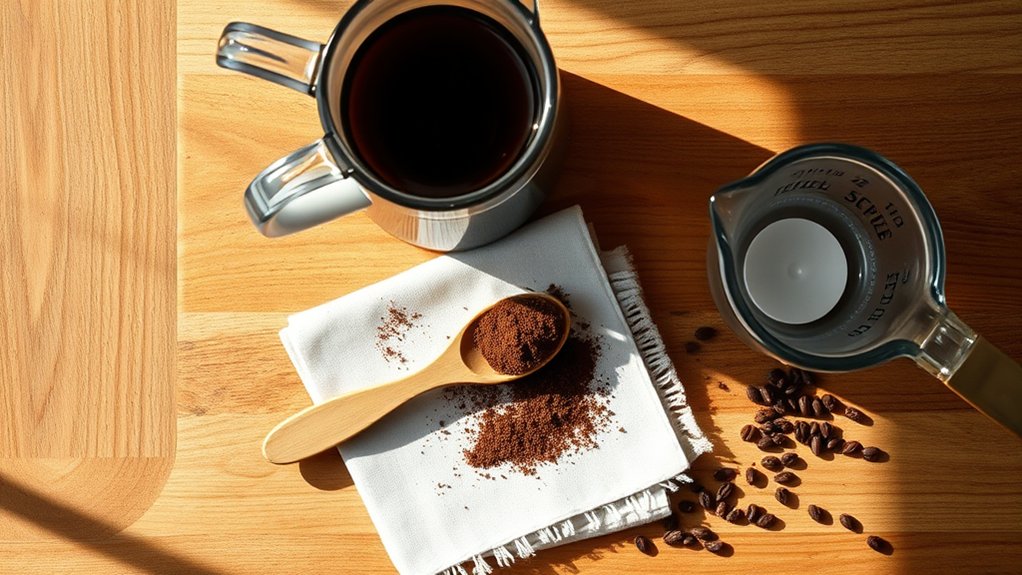
When brewing 12 cups of coffee, you’ll need between 10 and 20 tablespoons of coffee grounds, depending on how strong you like it.
For a standard 12-cup coffee maker, the recommended starting point is about 15 tablespoons, which aligns with a coffee-to-water ratio of roughly 1:16. This guarantees a balanced flavor and strength for a full pot.
Start with 15 tablespoons of coffee for a balanced 12-cup brew at a 1:16 ratio.
Each tablespoon weighs around 5 grams, so you’re using approximately 75 grams of coffee grounds total. If you prefer a stronger brew, adjust the amount up to 20 tablespoons.
Conversely, reduce it to 10 tablespoons for a milder taste. Remember to use freshly ground beans for the best flavor extraction.
Adjust the amount thoughtfully to suit your personal preference without compromising the brew’s balance.
Why the Coffee-to-Water Ratio Is Crucial for Flavor and Strength
You control the strength and flavor of your coffee by adjusting the coffee-to-water ratio.
It’s all about finding that sweet spot. When you get this balance right, you make sure the coffee extracts properly.
That way, your brew isn’t too weak or overly bitter. Plus, tweaking the ratio to match your taste means you can enjoy every cup just the way you like it.
Balance Between Strength
Although dialing in the perfect coffee-to-water ratio might seem subtle, it directly shapes the strength and flavor of your brew. For a 12-cup pot, about 10 to 12 tablespoons of coffee is standard, balancing extraction and taste.
If you want a stronger cup, you can adjust the coffee amount by adding 1-2 tablespoons per six ounces of water. But be careful. Too little coffee leads to weak, underwhelming flavor, while too much causes bitterness.
Using fresh, quality beans and the right grind size also enhances strength and flavor by ensuring efficient brewing.
Ultimately, your preferences should guide adjustments to the coffee-to-water ratio, letting you craft a brew that’s just right for your palate.
Impact On Extraction
Getting the right coffee-to-water ratio doesn’t just affect strength; it directly impacts extraction, which shapes both flavor and aroma.
When brewing 12 cups, using 10 to 20 tablespoons of coffee secures ideal flavor extraction by providing enough grounds for water interaction. Here’s what you need to contemplate:
- A standard coffee-to-water ratio of 1:16 balances extraction without overpowering bitterness or weakness.
- Stronger ratios, like 1:12 for French Press, boost flavor but may need longer brew times.
- Grind size is essential: finer grounds speed up extraction, releasing more flavor, while coarser grounds yield a milder cup.
- Consistent measurements help you dial in the perfect balance for your taste.
Mastering these variables guarantees a flavorful, well-extracted brew every time.
Personal Taste Preferences
One to two tablespoons of coffee grounds per six ounces of water form the foundation for tailoring your brew’s strength and flavor. Your personal taste preferences dictate how you adjust the coffee-to-water ratio to suit your ideal cup.
If you prefer a lighter brew, use closer to one tablespoon per six ounces. For a bolder flavor, increase to two tablespoons.
When brewing 12 cups (about 60 ounces), aim for 10 to 20 tablespoons of coffee, depending on your taste.
Keep in mind that your chosen brew method can affect extraction, so experimenting with tablespoons of coffee per volume helps you find the perfect balance.
Comparing Tablespoons, Scoops, and Grams for Accurate Coffee Measurement
To get consistent coffee flavor, it helps to know how tablespoons, scoops, and grams stack up against each other.
For example, a standard scoop usually holds about two tablespoons.
But if you really want precision, using grams on a scale is the way to go.
Once you get the hang of these measurements, adjusting your coffee-to-water ratio for any brew strength becomes a breeze.
Tablespoons Versus Scoops
Measuring coffee with tablespoons or scoops can greatly affect your brew’s strength and flavor, so understanding their differences is key. One coffee scoop equals about 2 tablespoons, so knowing which you use helps you measure coffee grounds accurately and maintain the ideal coffee-to-water ratio.
For 12 cups, aim for 10 to 20 tablespoons of coffee grounds depending on strength preference. Or use 6 to 12 coffee scoops for the same volume, since 1 scoop = 2 tablespoons.
Keep in mind, it’s approximately 5 grams per tablespoon for reference. Consistency in measurement guarantees balanced flavor every time.
Using tablespoons or a coffee scoop impacts your brew’s precision, so pick one method and stick with it to avoid under or over-extraction.
Grams For Precision
Using grams for coffee measurement gives you unmatched precision compared to tablespoons or scoops. While tablespoons vary in how tightly coffee grounds are packed, grams provide an exact weight, ensuring you consistently hit your desired coffee-to-water ratio.
For example, 10 to 20 tablespoons translate to about 50 to 100 grams, but weighing coffee lets you fine-tune that amount for your taste. Since one scoop usually holds 2 tablespoons or roughly 10 grams, relying solely on scoops can introduce variability.
Measuring coffee by grams lets you maintain a balanced ratio, around 15 grams of coffee per 250 mL of water, which is critical for achieving ideal extraction.
Using a digital scale for measuring coffee removes guesswork, giving you precise control over strength and flavor every time you brew.
Measurement Consistency Tips
Although tablespoons and scoops offer convenience, they often lead to inconsistent coffee measurements due to varying grind density and packing. To guarantee accuracy and maintain your ideal coffee-to-water ratio, consider these tips:
- Use a digital kitchen scale to weigh coffee grounds precisely, targeting about 5 grams per tablespoon of ground coffee.
- Remember one coffee scoop equals 2 tablespoons, so adjust accordingly for your 12-cup measuring cup.
- Measure coffee grounds, not whole beans, since density impacts volume and weight consistency.
- Adapt your coffee-to-water ratio based on brewing methods; drip machines differ from French presses.
How to Measure Coffee Grounds Accurately for Consistent Results
To get consistent results every time, you’ll want to use between 10 and 20 tablespoons of coffee grounds for a 12-cup coffee maker, which corresponds to about 60 ounces of water. The key is to measure your coffee precisely, aiming for 1 to 2 tablespoons per 6 ounces of water.
Using a digital scale helps maintain your ideal coffee-to-water ratio of 1:16, ensuring balanced flavor. Always level off your tablespoons to avoid uneven strength. Here’s a quick reference:
| Coffee Grounds Per Cup | Tablespoons Per 6 oz Water |
|---|---|
| Weak | 1 |
| Medium | 1.5 |
| Strong | 2 |
| Exact Ratio (grams) | 1 g coffee : 16 g water |
Measuring accurately makes your brew predictable and satisfying every time.
Which Brewing Methods Need More or Less Coffee Grounds?
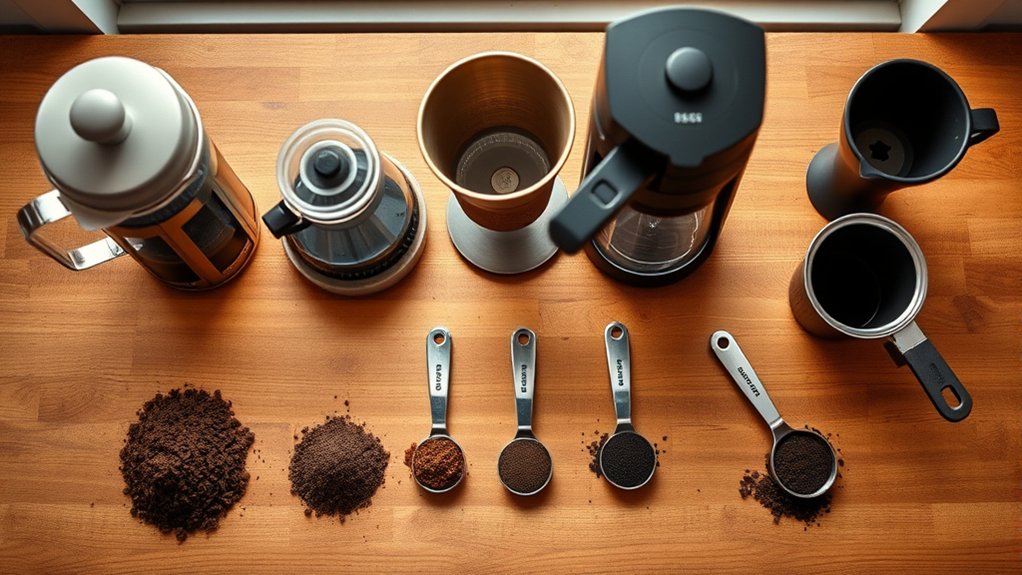
Different brewing methods demand varying amounts of coffee grounds to achieve the best flavor. Knowing the right coffee-to-water ratio guarantees your 12-cup brew tastes just right.
Here’s how the amount of coffee grounds changes by method:
- Drip coffee makers need 10 to 20 tablespoons for a 12-cup pot (60 ounces), depending on strength preference.
- French press requires about 15 tablespoons, using 2 tablespoons per 4 ounces of water.
- Pour-over calls for roughly 15 tablespoons, based on 1.5 tablespoons per 6 ounces.
- Cold brew uses a much stronger coffee-to-water ratio, around 1:4, meaning you’ll use considerably more coffee grounds than other methods.
Adjusting the tablespoon amount to your brewing method helps you master the perfect coffee-to-water ratio every time.
How Roast Level Changes the Amount of Coffee Needed for 12 Cups
Since roast level affects the density and flavor intensity of coffee beans, you’ll need to adjust the amount of grounds when brewing 12 cups. Light roasts are less dense and require more coffee, about 11 to 12 tablespoons, to extract full flavor.
Medium roasts strike a balance, needing around 10 tablespoons for a smooth cup. Dark roasts are denser and more intense, so using 8 to 9 tablespoons prevents bitterness.
This roast-dependent ratio guarantees the best flavor without overpowering your brew.
| Roast Level | Tablespoons for 12 Cups |
|---|---|
| Light | 11–12 |
| Medium | 10 |
| Dark | 8–9 |
Adjusting your coffee amount by roast helps you achieve the ideal strength and taste every time.
Adjusting Coffee Amounts for Stronger or Milder 12-Cup Brews
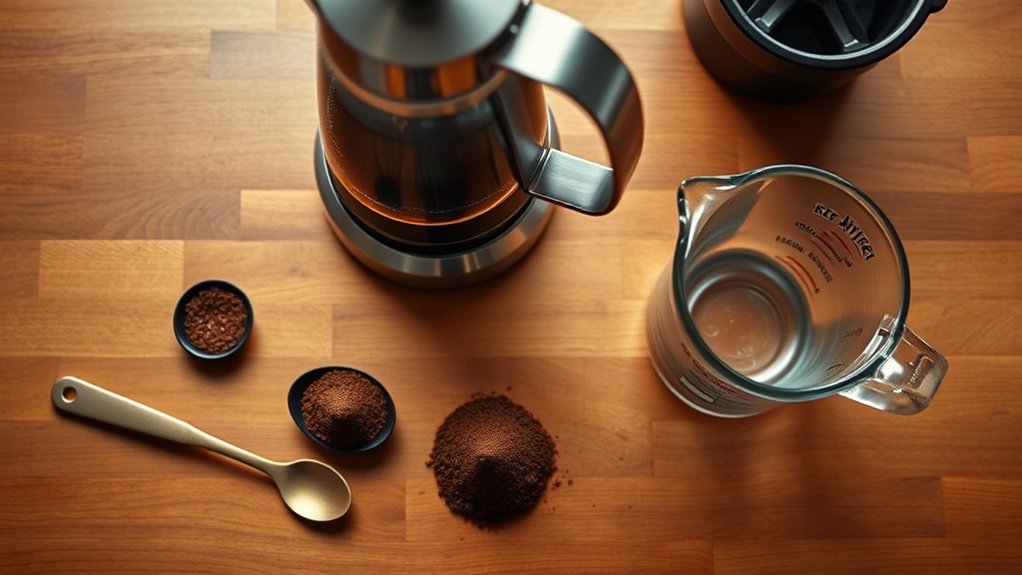
You can easily adjust the strength of your 12-cup brew by changing how much coffee grounds you use.
Want a stronger cup? Just add a bit more coffee per six ounces of water.
On the other hand, if you prefer something milder, go ahead and use less.
Measuring carefully helps you find that perfect balance and tailor the taste exactly how you like it.
Adjusting Coffee Strength
Although a standard 12-cup coffee maker typically calls for 10 to 20 tablespoons of coffee grounds, adjusting the amount lets you control the brew’s strength precisely.
To tailor your coffee strength, consider these guidelines:
- Use 12 to 22 tablespoons for a stronger brew, increasing by 1-2 tablespoons per six ounces of water.
- For a milder taste, reduce to 8 to 15 tablespoons, keeping less than one tablespoon per six ounces.
- Remember, more coffee grounds generally extend brew time due to longer extraction.
- Experiment within these ranges to find your ideal balance of flavor and strength.
Measuring For Desired Taste
When aiming for the perfect cup from your 12-cup coffee maker, measuring coffee grounds accurately is essential. The key to measuring for desired taste lies in adjusting the amount of coffee to suit your preference.
Use between 10 to 20 tablespoons of ground coffee, depending on whether you want a milder or stronger brew. For a milder flavor, stick to 10 to 12 tablespoons; for a stronger cup, increase to 13 to 20 tablespoons.
Since each tablespoon contains about 5 grams, this translates to 50 to 100 grams per full pot.
Fine-tune your coffee-to-water ratio by adding 1-2 tablespoons per 6 ounces of water. Experiment with these measurements to achieve a balance that matches your ideal strength and flavor.
Best Grind Size for Brewing 12 Cups With the Right Coffee Amount
Since the grind size greatly impacts the flavor and extraction of your coffee, choosing the right one is essential for brewing 12 cups. For a standard drip coffee maker, a medium grind size works best to balance flavor extraction and prevent clogging.
Choosing the right grind size is key for flavor and smooth brewing in a 12-cup drip coffee maker.
Adjusting the coffee amount within 10 to 20 tablespoons allows you to control strength while maintaining the ideal coffee-to-water ratio.
Here’s a quick guide:
- Use medium grind size for optimal extraction.
- Measure 10-20 tablespoons of ground coffee based on taste.
- Avoid finely ground coffee to prevent bitterness.
- Choose coarser grinds for a lighter brew if preferred.
Experiment with these variables to find your perfect 12-cup brew.
How Water Quality Affects Your 12-Cup Coffee Brew
One essential factor that directly shapes the flavor and aroma of your 12-cup coffee brew is the quality of the water you use. Using filtered or fresh, clean water guarantees that the delicate flavors in your coffee grounds extract properly, resulting in a balanced and vibrant cup.
Avoid water with strong odors or off-flavors, as these can mask the coffee’s subtle notes. Hard water, rich in minerals, not only affects taste but also causes scale buildup in your coffee maker. This reduces brewing efficiency and compromises flavor extraction.
To maintain the best water quality, regularly clean your equipment to prevent mineral deposits from accumulating.
Prioritizing water quality will enhance your coffee’s taste and prolong the life of your brewing machine, making every 12-cup batch consistently satisfying.
Using a Scale for Precise Coffee Measurement When Brewing 12 Cups
Measuring your coffee grounds with a digital kitchen scale guarantees you get the perfect 12-cup brew every time. Instead of relying solely on a standard coffee scoop, a kitchen scale lets you precisely control the coffee-to-water ratio for balanced flavor.
For 12 cups (60 ounces), follow these steps:
- Weigh out 75 grams of freshly ground coffee (about 15 tablespoons) to start.
- Use a 1:16 coffee-to-water ratio by multiplying coffee weight by 16 to determine water weight (75g × 16 = 1200g water).
- Adjust coffee weight up or down to reach your desired strength.
- Always measure grounds after grinding for accuracy.
Using a scale guarantees consistency and precision, eliminating guesswork and improving your brew’s taste every time.
Common Mistakes to Avoid When Measuring Coffee for 12 Cups
Getting the coffee-to-water ratio right with a scale sets a solid foundation, but small errors in how you measure can still undermine your brew. Ask yourself, “What coffee should I use?” Avoid using whole beans when measuring; ground coffee per tablespoon differs in density, so always measure it after grinding.
Remember, a standard cup is 6 oz, so a 12-cup maker brews about 72 oz, not 96 oz. Level off tablespoons to maintain the perfect coffee-to-water ratio. Also, adjust your coffee amount based on grind size—coarser grounds need slightly more coffee for ideal extraction.
| Mistake | Impact | Solution |
|---|---|---|
| Using whole beans | Inaccurate measurement | Measure post-grind |
| Ignoring standard cup | Skewed ratio | Use 6 oz per standard cup |
| Uneven spoon leveling | Inconsistent taste | Level off tablespoons |
| Using pre-ground coffee | Loss of freshness | Grind fresh before measuring |
| Neglecting grind size | Poor extraction | Adjust coffee amount accordingly |
Top Tips to Perfect Your Coffee Measurement and Brewing for 12 Cups
Although dialing in the perfect coffee measurement can seem tricky, using 10 to 20 tablespoons of ground coffee for your 12-cup maker guarantees a balanced 1:16 coffee-to-water ratio that yields consistently flavorful results.
Using 10 to 20 tablespoons for 12 cups ensures a perfect 1:16 coffee-to-water balance every brew.
To perfect your brewing for 12 cups, follow these tips:
- Use a medium roast ground to a medium size for ideal extraction with drip coffee makers.
- Measure coffee precisely, one tablespoon per 5 grams, preferably with a digital scale for accuracy.
- Follow the Golden Ratio of coffee-to-water ratio (1:16) but feel free to adjust up to 1 or 2 extra tablespoons per 6 ounces if you want stronger coffee.
- Always brew with fresh, filtered water and clean your equipment regularly to maintain flavor quality.
These steps guarantee a consistently balanced and rich 12-cup brew every time.
Frequently Asked Questions
Can I Use Pre-Ground Coffee Instead of Whole Beans for 12 Cups?
Yes, you can use pre-ground coffee for 12 cups, and it offers brewing convenience since you skip grinding.
However, pre-ground benefits come with trade-offs; flavor differences are noticeable because it lacks the freshness whole beans provide.
Also, grind consistency might vary, affecting extraction.
For best results, choose a medium grind and use it quickly after opening. This way, you balance ease with decent flavor, even if it’s not as vibrant as freshly ground coffee.
How Long Should I Brew 12 Cups of Coffee for Optimal Flavor?
You should brew 12 cups of coffee for about 4 to 6 minutes to achieve ideal flavor. This brewing time allows proper flavor extraction, balancing coffee strength without bitterness or sourness.
Remember, grind size plays a key role. Finer grounds need less time to avoid over-extraction, while coarser grounds may require longer.
Adjust within this window to match your taste, ensuring each cup delivers the perfect balance you’re aiming for.
What Is the Ideal Water Temperature for Brewing 12 Cups of Coffee?
The ideal brewing temperature for 12 cups of coffee is between 195°F and 205°F. This range guarantees the best coffee extraction process, balancing flavor without bitterness or sourness.
You’ll want to maintain thermal stability throughout brewing, as fluctuations can harm taste quality.
Depending on your brewing method variations, adjusting temperature slightly may be necessary, but staying within this window assures a well-extracted, flavorful cup every time you brew a full pot.
How Does Altitude Affect Brewing 12 Cups of Coffee?
Altitude affects brewing 12 cups of coffee by lowering boiling temperatures, which can hinder proper coffee extraction. You might think it’s tricky to adjust, but with the right altitude adjustments, you can still nail your flavor profile.
Try tweaking your brewing techniques. Use a coarser grind and increase the coffee-to-water ratio slightly to compensate.
Experiment with brew time and temperature to balance extraction and enjoy a rich, flavorful cup every time.
Can I Store Brewed 12-Cup Coffee for Later Consumption Safely?
Yes, you can store brewed 12-cup coffee safely by using proper coffee storage techniques.
Pour it into an airtight container to preserve flavor and extend shelf life up to three days in the refrigerator.
When reheating, only warm the amount you plan to drink to avoid flavor loss.
Avoid leaving coffee at room temperature over two hours, and consider a thermal carafe to keep it hot without overcooking.
This maintains freshness and safety.
Conclusion
Want to brew the perfect 12 cups of coffee every time? It all comes down to getting your coffee-to-water ratio just right, usually about 12 to 18 tablespoons of grounds.
Measuring accurately, whether by tablespoon, scoop, or scale, guarantees consistent flavor and strength. Don’t forget, water quality and your brewing method also play key roles.
So, why settle for guesswork when precision can elevate your coffee experience? Take control and enjoy every cup.