How To Make Your Own Coffee Brand – Step-By-Step Guide
To make your own coffee brand, start by defining a clear vision and target audience to shape your unique identity. Select high-quality coffee products and roast profiles that align with your brand’s story.
Develop standout branding and sustainable packaging to attract customers. Choose a reliable private label supplier for consistent quality, then market creatively through social media, events, and partnerships.
Focus on loyalty and quality while expanding product lines. Keep moving forward to uncover expert strategies that elevate your brand further.
Define Your Coffee Brand’s Vision and Target Audience

Before you launch your coffee brand, you need to define a clear vision that captures your mission, values, and what sets you apart in a crowded market of over 72,000 brands in the U.S. alone.
Start by researching market trends to identify gaps your coffee brand can fill.
Begin with thorough market trend research to uncover unique opportunities for your coffee brand.
Develop a detailed customer profile to understand your target audience’s demographics, preferences, and habits. This insight helps you craft a unique selling proposition (USP) that highlights quality sourcing, sustainability, or flavor uniqueness.
Your USP distinguishes you and builds brand loyalty by resonating authentically with your audience.
Engage them through compelling storytelling that reflects your mission and values.
Select Coffee Products and Roast Profiles to Match Your Brand
While defining your brand’s vision lays the foundation, selecting the right coffee products and roast profiles brings your identity to life. You’ll want to use market research to pinpoint what your target audience prefers, whether whole beans, pods, or cold brew. Then choose roast profiles that reflect your brand’s character.
Prioritize high-quality sourcing by building relationships with farmers or co-ops to guarantee traceability and sustainability. Experiment with blending origins like Brazilian and Rwandan beans to craft unique flavor profiles that set you apart.
| Coffee Products | Roast Profiles | Sourcing Focus |
|---|---|---|
| Whole Beans | Light, Medium | Direct Farmer Links |
| Pods | Dark | Sustainable Co-ops |
| Cold Brew | Custom Blends | Traceability Emphasis |
Develop Unique Branding and Packaging That Stands Out
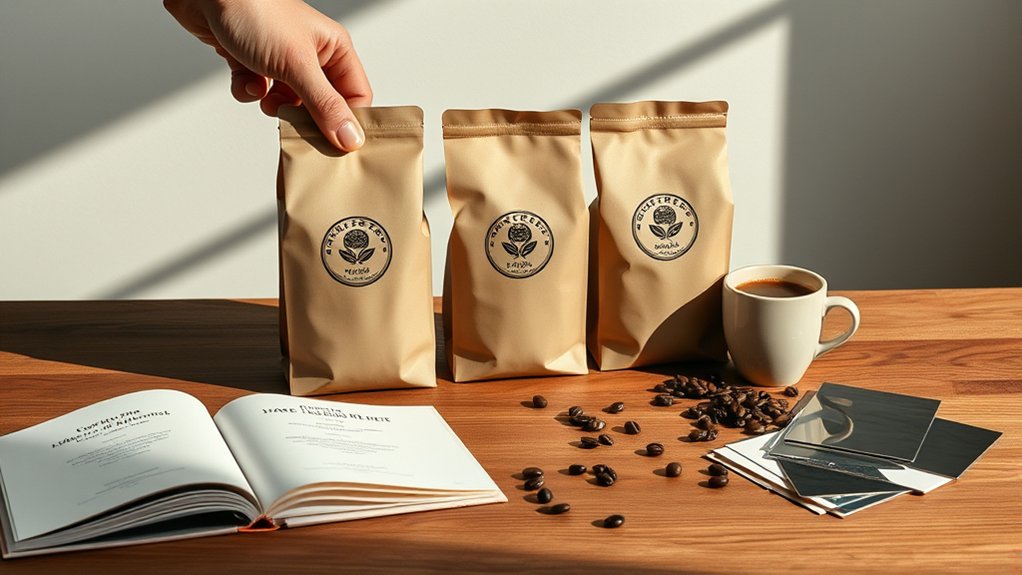
You want to create a brand identity that really tells your coffee’s story and connects with your audience.
Think about designing packaging that stands out—bold colors, unique logos, and top-notch materials will make your product impossible to miss.
Also, don’t forget to put sustainability front and center.
Being clear about your coffee’s quality helps build trust and keeps customers coming back for more.
Craft Distinctive Brand Identity
Although the coffee market is crowded with over 72,000 brands in the U.S. alone, crafting a distinctive brand identity can set your coffee apart and build lasting customer loyalty.
To create a unique coffee brand, focus on these essentials:
Develop a compelling brand story that highlights your values and mission. This connection emotionally engages customers and enhances loyalty.
Showcase the quality coffee you offer through clear communication of sourcing, flavor profiles, and blend uniqueness. This reinforces your brand’s authenticity.
Design packaging that reflects your brand story and coffee experience. Make sure it stands out on shelves and resonates with your target market.
Design Eye-Catching Packaging
Crafting a distinctive brand identity naturally leads to the next step: designing packaging that captures attention and tells your coffee’s story at a glance. Your packaging should highlight quality through clear visuals and details like sourcing and flavor profile, reinforcing your branding. Use sustainable materials to appeal to eco-conscious consumers while investing in professional design to guarantee your packaging stands out in a crowded market.
| Aspect | Purpose | Example |
|---|---|---|
| Visuals | Attract attention | Bold colors, unique logo |
| Quality Info | Communicate product excellence | Roasting date, origin |
| Sustainability | Reflect brand values | Recyclable bags, eco ink |
Prioritize packaging that speaks volumes about your coffee’s personality and quality.
Choose the Best Private Label Supplier or Roaster for Your Coffee Brand
Since your coffee brand’s reputation hinges on quality and consistency, choosing the right private label supplier or roaster is critical. You want a partner who excels in sourcing and roasting premium quality beans and offers flexibility with minimum order quantities. This is especially important if you’re just building a brand.
Your coffee brand’s success depends on partnering with a supplier who ensures quality and flexible order options.
Focus on private label coffee providers who deliver exclusive branding and can elevate your coffee product beyond generic options.
Keep these essentials in mind when selecting coffee roasters:
- Verify their transparency in sourcing and roasting methods to guarantee authenticity.
- Confirm minimum order quantities align with your startup capacity without excessive upfront costs.
- Assess their support in packaging design and marketing to boost your brand’s appeal.
Choosing wisely guarantees a strong foundation for your coffee brand’s success.
Set Competitive Prices Your Customers Will Love
You need to really get a good handle on market pricing if you want to position your coffee brand competitively. That way, you won’t undervalue the quality you’re offering.
One smart move is to implement tiered pricing. This lets you cater to different customer segments by offering both standard and premium options.
It’s a great way to boost the perceived value of your brand. By balancing these strategies, you’ll attract a wider audience and maximize your brand’s profitability.
It’s all about finding that sweet spot that works for both you and your customers.
Understand Market Pricing
Although setting prices can feel challenging, understanding market pricing is essential to making your coffee brand stand out and attract loyal customers. Start by researching market standards and your competitors’ pricing to guarantee your pricing strategy aligns with potential customers’ expectations.
This balance helps maintain profitability without alienating buyers. Keep these key points in mind:
Analyze all costs, from sourcing and roasting to packaging, to set prices that cover expenses and deliver profit.
Use customer feedback and purchasing patterns to refine your pricing strategy, ensuring it resonates with your audience.
Consider premium pricing for unique blends or special editions once your coffee brand gains recognition, capturing higher margins.
Implement Tiered Pricing
After establishing a solid understanding of market pricing, the next step involves tailoring your approach to meet diverse customer needs through tiered pricing. By analyzing competitors’ pricing strategies, you can set competitive price points that attract customers while protecting profit margins.
Implement tiered pricing by offering a variety of products, like standard blends for budget-conscious buyers and premium options for those seeking specialty blends. This approach aligns perfectly with evolving customer preferences and lets you appeal to a broader market.
Don’t forget to promote special editions with premium pricing to build exclusivity as your coffee brand gains reputation.
Regularly monitor customer feedback to fine-tune your tiers, ensuring every price reflects perceived value and sustains profitability across sourcing, roasting, and packaging costs.
Launch Your Coffee Brand With Effective Marketing and Promotion
When launching your coffee brand, crafting an effective marketing and promotion strategy is essential to stand out in a competitive market. You need to actively engage customers and build a coffee brand that resonates.
Focus your marketing efforts on channels where your audience spends time, particularly social media. Leverage Instagram and Facebook to share your story and visually appealing content, keeping a consistent posting schedule. Use promotional strategies that spark interest and encourage first-time purchases.
Consider these tactics to grow your customer base:
- Collaborate with local influencers to boost credibility and reach.
- Optimize your website and Google My Business for local SEO to attract nearby customers.
- Host coffee tastings or community events to deepen engagement and encourage word-of-mouth.
These approaches will position your brand effectively and attract loyal customers.
Build Customer Loyalty Through Quality and Engagement
Marketing your coffee brand effectively draws customers in, but keeping them coming back depends largely on the consistent quality of your coffee and meaningful engagement. You must prioritize delivering specialty coffee that excels in flavor and freshness, as quality is key to repeat purchases.
Build brand loyalty by offering customers personalized experiences, such as exclusive tastings or events that create memorable moments tied to your brand. Engage actively by requesting and valuing customer feedback, showing you care about their opinions and continuously improving your offerings.
Implement loyalty programs to reward repeat buyers, boosting retention rates considerably.
Scale Your Coffee Brand With New Products and Partners
Expanding your coffee brand’s product range and forging strategic partnerships can substantially accelerate growth and increase market presence.
To scale your coffee brand effectively, focus on introducing new product lines based on customer feedback and industry trends.
Consider these strategies: Gradually add complementary products like branded merchandise or flavored syrups to enhance customer experience.
Collaborate with local businesses or influencers to create unique co-branded items, leveraging their audience for broader reach.
Partner with specialty coffee shops or roasters to offer exclusive blends or limited-edition products, boosting brand prestige.
Frequently Asked Questions
How Do I Legally Trademark My Coffee Brand Name?
To legally trademark your coffee brand name, start with a thorough brand name search to avoid common trademark mistakes.
Follow the trademark registration process by filing with the USPTO and meeting all legal requirements.
Understand trademark maintenance tips like timely renewals to protect your rights.
Trademarking offers benefits like exclusive brand use and legal protection.
If you plan global reach, consider international trademark considerations.
Consulting a trademark attorney can boost your success and guarantee full compliance.
What Equipment Do I Need for Small-Batch Coffee Roasting?
Did you know that roasting just 1 to 5 kilograms per batch optimizes flavor and freshness?
For small-batch coffee roasting, you’ll need cost-effective roasters with precise roasting temperature control, quality home roasting techniques, and careful coffee bean selection.
Incorporate flavor profiling methods to refine your blends.
Don’t forget equipment maintenance tips to keep performance consistent.
Batch size optimization guarantees even roasting, delivering rich, balanced coffee every time you brew.
How Can I Ensure My Coffee Packaging Is Eco-Friendly?
You can guarantee your coffee packaging is eco-friendly by choosing sustainable materials like biodegradable bags and compostable labels.
Design your packaging to be fully recyclable and partner with suppliers who hold eco certifications to strengthen your supply chain’s integrity.
Boost consumer awareness by highlighting these efforts on your packaging and marketing.
This approach not only minimizes environmental impact but also builds trust and loyalty among eco-conscious customers.
What Are Common Challenges in International Coffee Shipping?
You’ll face common challenges like maneuvering complex customs regulations and managing shipping logistics across borders.
Temperature control is vital to preserve coffee quality, so you must choose packaging materials that protect against heat and moisture.
Transit times can be unpredictable, impacting freshness and supply chain reliability.
Cost management is fundamental since tariffs and specialized packaging increase expenses.
How Do I Handle Customer Complaints About Coffee Quality?
You handle customer complaints by prioritizing prompt complaint resolution and actively gathering detailed customer feedback.
Use taste testing and strict roasting standards to maintain product consistency.
Implement a robust quality assurance system to catch issues early, ensuring your coffee meets expectations.
Analyzing feedback helps you refine roasting and sourcing, boosting customer satisfaction.
Offering solutions like replacements or discounts shows you value their experience, turning complaints into opportunities for brand loyalty and improvement.
Conclusion
Launching your coffee brand is like planting a seed. You’ll nurture it with vision, quality, and connection until it blossoms.
By defining your audience, crafting unique products, and partnering with the right roaster, you set a strong foundation.
With thoughtful pricing and strategic marketing, you’ll capture loyal customers who keep coming back. Stay committed to growth and innovation, and your brand will thrive, turning your passion into a flourishing business that truly stands out.