Is Cold Brew Stronger Than Regular Coffee – Strength And Caffeine Comparison
You might think cold brew is always stronger, but it depends on how you define strength: flavor intensity or caffeine content. Cold brew uses a long, cold steep that yields a smooth, less acidic taste. It can pack more caffeine if brewed with a higher coffee-to-water ratio.
Regular hot coffee extracts quickly and often offers comparable caffeine in smaller servings. Your coffee’s strength varies with brewing methods and ratios. Understanding these factors helps you figure out which suits your needs best.
What Does “Strong” Mean When Comparing Coffees?
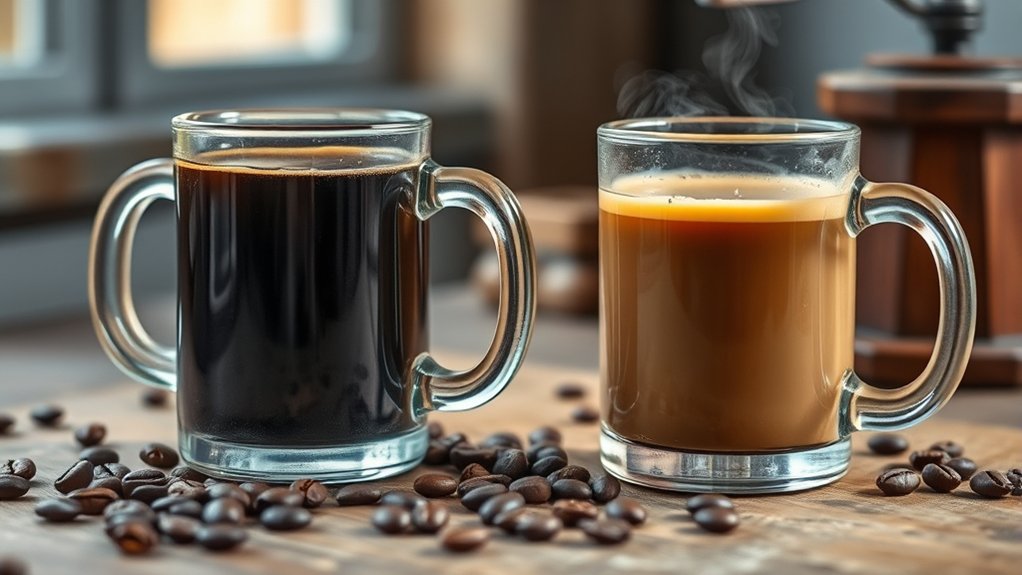
When you hear people talk about coffee being “strong,” it’s easy to assume they mean caffeine content, but strength actually refers to a combination of factors including flavor intensity, body, and concentration.
You need to take into account how flavor profiles vary based on the coffee beans and roasting level, which influence perceived strength.
Brewing methods also play a critical role. Techniques like espresso extraction yield a concentrated cup with a heavier body, while drip brewing produces a lighter, more diluted profile.
Strength isn’t just about how much caffeine is present but how robust and full-bodied the coffee tastes on your palate.
Understanding these nuances helps you distinguish between a coffee that’s “strong” in flavor versus simply high in caffeine, providing a clearer perspective when comparing cold brew and regular coffee.
How Cold Brew and Hot Coffee Are Made Differently
You make cold brew coffee by using cold water and letting it steep for 12 to 24 hours.
On the other hand, hot coffee needs near-boiling water and just a few minutes to brew.
These differences in temperature and time really change how the flavors and compounds come out of the grounds.
Once you get how this works, it’s easier to understand why cold brew and hot coffee taste and feel so different.
Brewing Temperature Differences
Although both cold brew and hot coffee start with the same basic ingredient, coffee grounds, their brewing temperatures set them apart fundamentally. Brewing temperature plays a vital role in flavor extraction, influencing acidity, bitterness, and aroma.
Hot coffee uses near-boiling water (195–205°F), which rapidly dissolves oils and acids. This produces a bright, intense profile. Cold brew, steeped at room temperature or colder (35–70°F), extracts flavors slowly, resulting in smoother, less acidic notes.
| Coffee Type | Brewing Temperature | Flavor Extraction Characteristics |
|---|---|---|
| Hot Coffee | 195–205°F | Rapid extraction, pronounced acidity |
| Cold Brew | 35–70°F | Slow extraction, smooth, low acidity |
| Result | Distinct taste profiles due to temp |
Understanding these differences helps you appreciate each method’s unique strength and flavor.
Extraction Time Variations
The temperature differences in brewing not only shape flavor but also dictate how long coffee grounds steep in water. When you make cold brew, you extract coffee over 12 to 24 hours at a low serving temperature. This allows slow, gentle extraction that highlights smooth, less acidic flavor profiles.
In contrast, hot coffee brews quickly, usually 4 to 6 minutes, at high temperatures. It rapidly pulls out oils and acids that create a brighter, more pronounced flavor profile. These extraction time variations profoundly affect the compounds dissolved from the grounds, influencing both taste and caffeine concentration.
Understanding this lets you appreciate how cold brew’s extended steeping results in a mellow, rich cup. Meanwhile, hot coffee’s brief extraction emphasizes vibrancy and sharpness, all tailored to their respective serving temperatures.
How Coffee-to-Water Ratios Impact Brew Strength and Caffeine
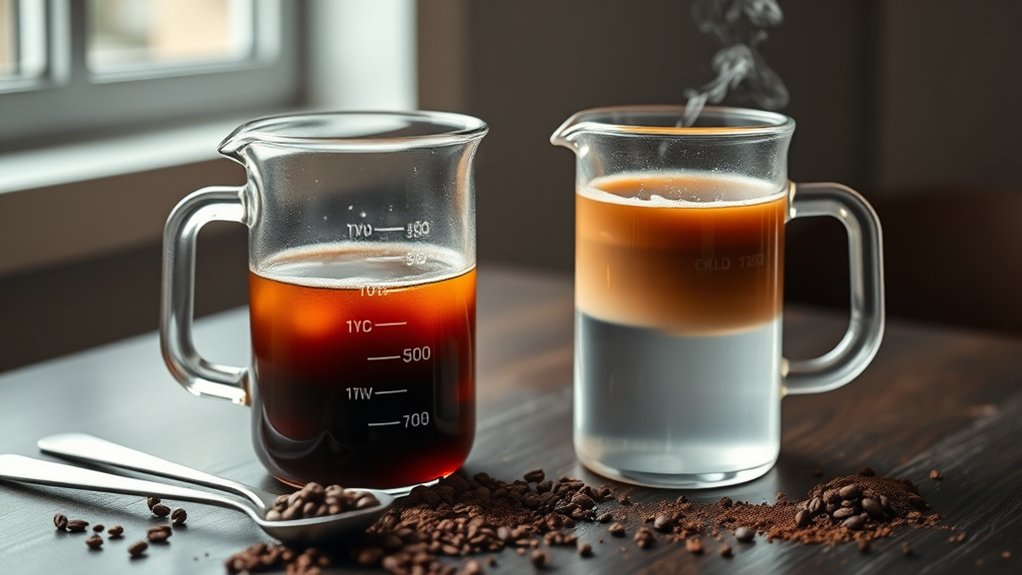
Since the ratio of coffee grounds to water directly influences extraction, understanding this balance is essential when evaluating brew strength and caffeine content. When you increase coffee grounds relative to water, you intensify both flavor concentration and caffeine levels.
However, the exact impact varies depending on coffee bean varieties, as some beans naturally contain more caffeine.
Brewing equipment differences also affect how efficiently caffeine and solubles are extracted at given ratios. For example, immersion methods like cold brew require higher ratios to achieve comparable strength to drip machines, which extract more rapidly and thoroughly.
Adjusting your coffee-to-water ratio allows you to tailor the brew’s potency.
But you also have to consider how your chosen beans and equipment interact to optimize both taste and caffeine yield precisely. It’s all about finding that sweet spot that works best for your preferences and setup.
Does Brewing Time Affect Caffeine in Cold Brew and Hot Coffee?
You’ll find that brewing time directly influences how much caffeine comes out of the coffee grounds in both cold brew and hot coffee. Hot water works quickly, pulling caffeine out in just a few minutes.
On the other hand, cold brew takes its time—it needs hours to reach similar caffeine levels. So, knowing how these extraction rates work can help you control the caffeine content depending on how long you decide to brew.
Brewing Duration Impact
Although brewing duration plays an essential role in extracting caffeine from coffee grounds, its impact varies considerably between cold brew and hot coffee methods. When you brew hot coffee, shorter extraction times, typically 4 to 6 minutes, are sufficient because high temperatures accelerate caffeine solubility.
Conversely, cold brew relies on extended steeping, often 12 to 24 hours, to compensate for lower temperatures. This prolonged contact time subtly influences the flavor profile, yielding smoother, less acidic notes.
Your choice of brewing equipment also matters. Immersion devices like French presses maximize extraction during cold brewing, while drip machines regulate flow and extraction time precisely for hot coffee.
Understanding how brewing duration interacts with temperature and equipment helps you optimize caffeine extraction without compromising taste.
Caffeine Extraction Rates
When examining caffeine extraction rates, brewing time plays a crucial role but interacts differently with cold brew and hot coffee methods. You’ll find that the temperature and duration influence how much caffeine is extracted, impacting the flavor profiles and overall strength.
For cold brew, longer steeping compensates for lower temperatures, whereas hot coffee extracts caffeine quickly but risks bitterness if over-extracted.
Consider these factors:
- Cold brew requires 12–24 hours to extract caffeine gently, preserving smooth flavors
- Hot coffee extracts caffeine within minutes, intensified by hotter water and pressure
- Brewing equipment choice, such as immersion vs. drip, affects extraction efficiency
- Over-extraction in hot coffee can degrade flavor profiles despite high caffeine
- You must balance brewing time and equipment to optimize caffeine without sacrificing taste
Comparing Caffeine Content: Cold Brew vs. Hot Coffee
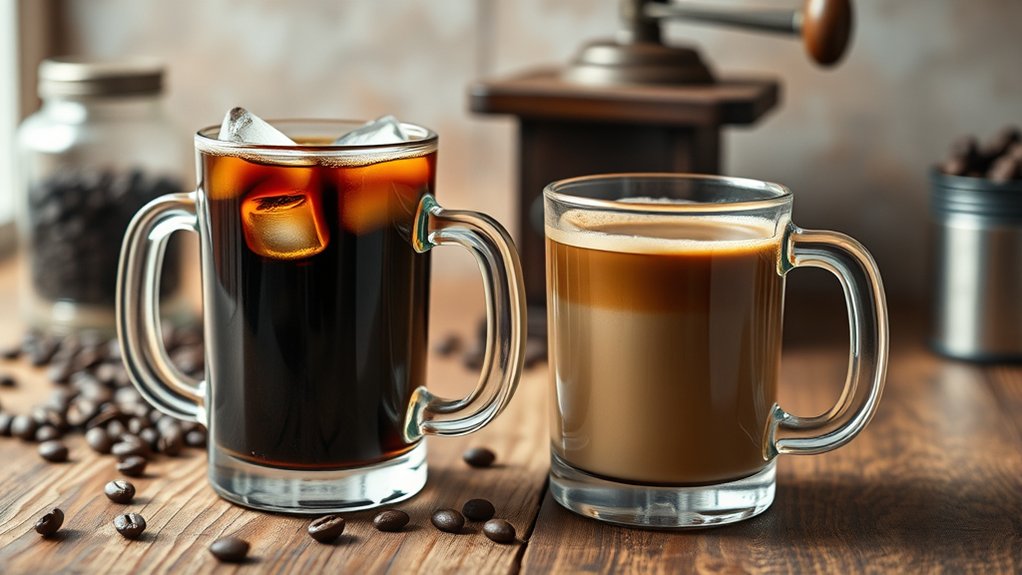
Since caffeine content considerably influences how you experience coffee’s effects, understanding the differences between cold brew and hot coffee becomes essential. Cold brew typically uses coarser grounds and longer steeping times with specialized brewing equipment, extracting caffeine steadily.
Hot coffee, brewed quickly with hot water, extracts caffeine and flavor compounds differently. This impacts flavor profiles and strength, making each brew unique in its own way.
| Coffee Type | Average Caffeine per 8 oz |
|---|---|
| Cold Brew | 100-150 mg |
| Hot Coffee | 95-165 mg |
| Espresso | 63 mg (per 1 oz shot) |
While caffeine ranges overlap, cold brew often contains more caffeine per serving due to higher coffee-to-water ratios. However, hot coffee’s extraction efficiency and technique affect its caffeine concentration. So, your choice of brewing equipment and method directly impacts caffeine content.
Why Cold Brew Often Tastes Milder Despite Its Strength
Even if cold brew packs a potent caffeine punch, you’ll notice it often tastes smoother and less bitter than hot coffee. This milder flavor profile comes mainly from different brewing techniques. Cold brew uses cold water over a longer time, which extracts fewer acidic compounds and oils that can make coffee bitter.
Cold brew delivers strong caffeine with a smoother, less bitter taste thanks to its slow, cold extraction process.
Hot brewing, on the other hand, releases more acids and tannins quickly, which amps up the bitterness. So, the way the coffee is brewed really changes how it tastes.
Here are some key reasons why cold brew tastes milder:
- Lower extraction of acidic compounds
- Reduced release of bitter oils
- Extended steeping time allowing gradual flavor release
- No heat, which limits harsh chemical reactions
- Different solubility of flavor compounds in cold versus hot water
Knowing this helps explain why cold brew can be surprisingly strong but still gentle on your palate.
How Serving Size Influences Your Caffeine Kick
You mightn’t realize just how much the serving size impacts your caffeine intake. That’s because cold brew and regular coffee often come in different cup sizes.
Sure, cold brew can be more concentrated, but if you’re drinking a bigger cup, you’re actually getting more caffeine overall.
Standard Serving Size Differences
A key factor that shapes your caffeine experience is the standard serving size of cold brew versus regular coffee. Serving sizes can vary widely, influencing both flavor profile and caffeine intake.
With cold brew, you often get larger servings because it’s brewed to be less acidic and smoother, using specialized brewing equipment like immersion steepers.
Regular coffee servings tend to be smaller but more concentrated in flavor, extracted quickly through drip or espresso machines.
Think about it like this: cold brew’s mild flavor lets you enjoy bigger servings without bitterness. On the other hand, regular coffee’s robust profile is best in moderate volumes.
Consider these serving size distinctions:
- Cold brew typically served in 12-16 oz portions
- Regular coffee usually offered in 8-12 oz cups
- Cold brew’s mild flavor allows for bigger servings without bitterness
- Regular coffee’s robust profile is best in moderate volumes
- Brewing equipment influences extraction rate and ideal serving size
Knowing these differences helps you tailor your caffeine kick effectively. It’s all about what works best for your taste and energy needs.
Concentration Versus Volume Impact
Serving size differences play a significant role, but the real impact on your caffeine boost comes from the interplay between concentration and volume.
When you pour a larger volume of a less concentrated coffee, you might still consume more caffeine than a smaller serving of a stronger brew.
Cold brew often has a higher concentration due to prolonged steeping, influenced by specific brewing equipment designed to extract smooth flavor profiles without bitterness.
In contrast, regular coffee’s shorter extraction in drip machines yields a different balance of compounds.
Understanding how these factors affect caffeine delivery allows you to tailor your intake precisely.
Measuring Your Caffeine Intake
How much caffeine do you actually consume with each cup of coffee? Serving size dramatically impacts your caffeine kick, and understanding this helps you manage intake effectively.
The flavor profiles you enjoy also hint at caffeine levels, influenced by your brewing equipment and method.
Consider these factors:
- Serving size: Larger cups naturally contain more caffeine.
- Brewing equipment: Drip machines, French presses, and cold brew setups extract caffeine differently.
- Coffee-to-water ratio: Higher ratios yield stronger, more caffeinated brews.
- Brew time: Longer extraction increases caffeine concentration.
- Temperature: Hotter water extracts more caffeine, altering flavor profiles.
When Is Cold Brew Stronger Than Hot Coffee?
Although cold brew and hot coffee both deliver caffeine, cold brew can be stronger than hot coffee when brewed with a higher coffee-to-water ratio or consumed as an undiluted concentrate.
If you adjust your brewing equipment to use more grounds per volume of water, you’ll extract a denser, more potent cold brew. This method intensifies the flavor profiles, resulting in bolder, richer notes compared to standard hot coffee.
Furthermore, since cold brew often undergoes a long steeping process without heat, it extracts caffeine differently, allowing you to achieve a higher concentration without the bitterness hot brewing can produce.
Which Coffee Gives You More Caffeine for Your Money?
Comparing the caffeine content per dollar spent reveals some important insights about cold brew and hot coffee’s value. When you’re trying to figure out which coffee gives you more caffeine for your money, it helps to think about how brewing equipment and flavor profiles influence cost and efficiency.
Cold brew needs more coffee grounds and usually some specialized equipment, which can raise those upfront expenses.
Hot coffee brewing is generally quicker and uses standard equipment, making it more caffeine-efficient.
Cold brew uses higher coffee-to-water ratios, so it consumes more beans overall. On the other hand, hot coffee extraction is faster and often gives you more servings from the same amount of beans.
The equipment for cold brew usually costs more at the start. Flavor profiles are different between the two, but that doesn’t really change how much caffeine you get.
Cold brew’s longer steeping time does extract caffeine steadily, but it’s less cost-effective.
Choosing Between Cold Brew and Hot Coffee for Your Caffeine Needs
When deciding between cold brew and hot coffee to meet your caffeine needs, consider more than just the caffeine content per dollar. You should also think about flavor profiles and brewing equipment because they really shape your experience.
Cold brew offers a smoother, less acidic taste. It’s made by steeping coarse grounds for a long time, and you’ll need specific gear like large jars or cold brew makers.
Hot coffee, on the other hand, brews quickly using drip machines or espresso makers. It brings out brighter, more complex flavors but can be a bit more bitter.
If you like a robust, sharp cup and have good brewing equipment, hot coffee might be your best bet. But if you want something mellow and easy to drink with a higher caffeine punch per ounce, cold brew is the way to go.
In the end, your choice comes down to what you prefer in taste and what brewing methods you have available.
Frequently Asked Questions
Can I Make Cold Brew Coffee at Home Without Special Equipment?
You can definitely make cold brew coffee at home without special equipment. Home brewing cold brew requires just coarsely ground coffee, cold water, and a container like a mason jar or pitcher.
The equipment necessity is minimal since you only need a fine mesh sieve or cheesecloth to strain the grounds after steeping for 12-24 hours.
This simple method guarantees you get smooth, rich cold brew without investing in expensive tools.
It’s really easy and doesn’t require any fancy gadgets. So go ahead and give it a try—you’ll be surprised how good homemade cold brew tastes!
Does the Type of Coffee Bean Affect Cold Brew Strength?
Of course, you think every coffee bean variety will magically turn your cold brew into a superhero potion. Well, they do matter. Different coffee bean varieties carry unique flavor profiles and caffeine levels.
Roast level differences also play an essential role. Lighter roasts retain more caffeine, while darker ones bring bolder, bitter notes.
How Long Can Cold Brew Coffee Be Stored Safely?
You can safely store cold brew coffee in the refrigerator for up to two weeks, maximizing its coffee shelf life. To guarantee ideal cold brew preservation, keep it in an airtight container to prevent oxidation and flavor degradation.
After two weeks, the taste and quality start to decline, even if it remains safe to drink.
For the best experience, consume your cold brew within 7-10 days to enjoy its fresh, smooth flavor.
Is Cold Brew Coffee Better for People With Sensitive Stomachs?
Yes, cold brew coffee can be better for your digestive health if you have a sensitive stomach. It typically has lower acidity levels compared to hot brewed coffee, which reduces irritation and acid reflux risks.
Because the cold brewing process extracts fewer acidic compounds, it’s gentler on your stomach lining.
That said, everyone’s different. So, you should keep an eye on how your body reacts and adjust your intake accordingly.
What Are the Best Milk or Cream Options for Cold Brew?
You might think cream alternatives would dull cold brew’s boldness, but they actually enhance its smoothness and flavor. The best options include oat milk for a naturally sweet, creamy texture, almond milk for a nutty contrast, and coconut cream to add richness without overpowering.
These cream alternatives act as flavor enhancers, balancing cold brew’s acidity and bitterness while preserving its invigorating character.
Give them a try and see how they change up your cup.
Feel free to experiment to find your perfect blend. It’s all about what tastes best to you!
Conclusion
So, is cold brew stronger than regular coffee? Well, it depends if you’re measuring strength by caffeine or just the fancy “smooth” vibe. Cold brew might sneak up on you with a longer brew time and higher coffee-to-water ratio. But a well-pulled hot espresso can pack a punch too.
Bottom line: pick your poison wisely. Whether you want a slow caffeine creep or a sharp jolt, both have their caffeinated merits. Choose wisely, caffeine warrior.