What Grind For Pour Over Coffee – Best Grind Size Guide
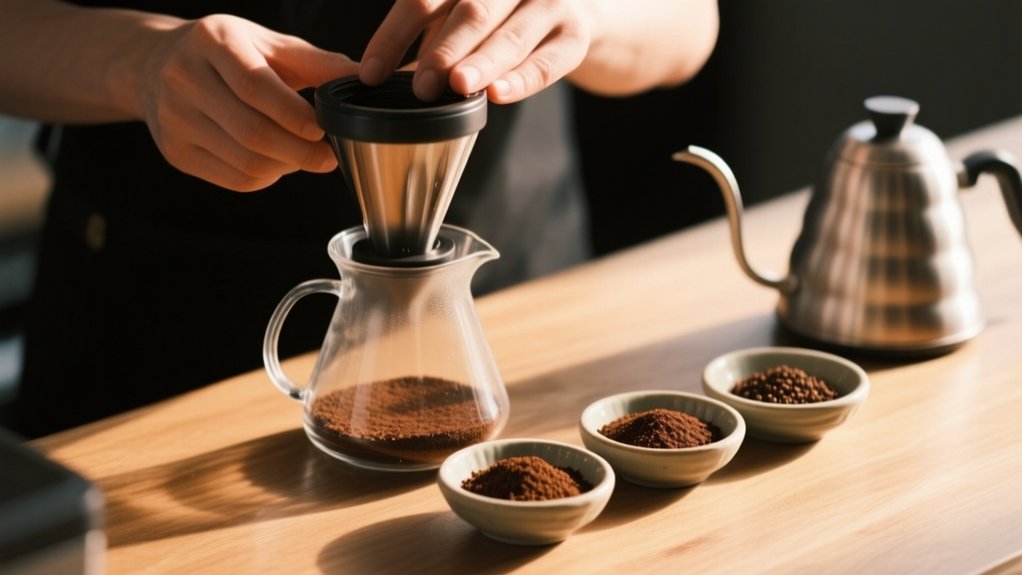
For pour-over coffee, you want a medium to medium-coarse grind to achieve balanced extraction and ideal flavor. Different drippers need slight tweaks. Hario V60 prefers medium to medium-coarse, Kalita Wave favors medium grind, and Chemex works best with a coarser grind like sea salt.
Use a burr grinder for consistency. Adjust grind finer if your coffee tastes sour, coarser if bitter, and aim for a 3–4 minute brew time. Keen to refine your coffee craft?
Why Grind Size Matters for Pour-Over Coffee
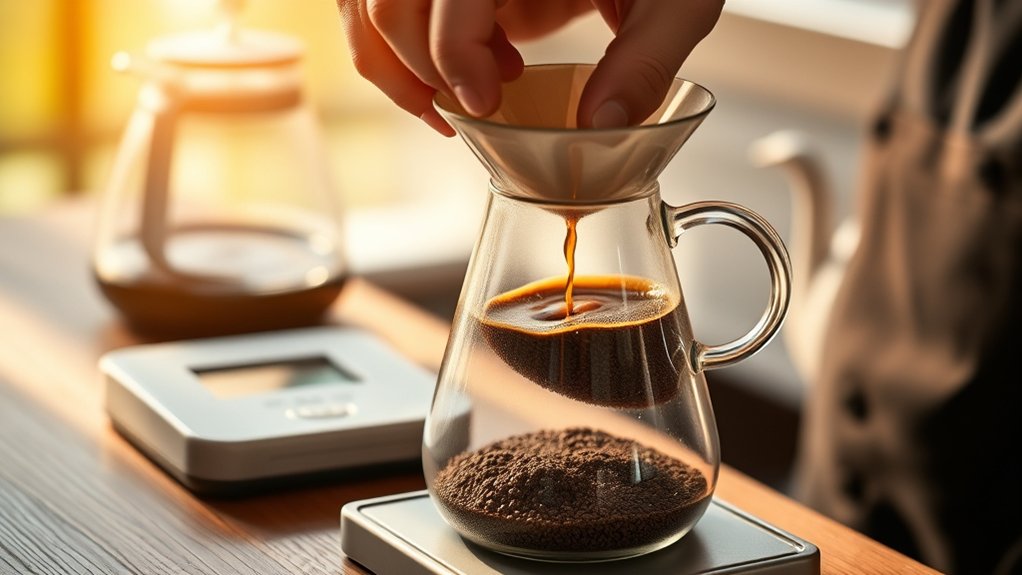
Because grind size directly controls how quickly water extracts flavors from coffee grounds, it plays a crucial role in your pour-over brewing process.
When you use a medium grind size, similar to coarse sand, you set the stage for balanced flavor extraction.
If your grind is too fine, water extracts flavors too quickly, risking bitterness from over-extraction.
Too coarse, and extraction slows, leaving your coffee sour and underdeveloped.
Achieving even extraction means your coffee grinder must produce uniform particles.
Inconsistent grind sizes cause some grounds to over-extract while others under-extract, spoiling the taste.
Adjusting grind size lets you fine-tune flavor extraction to match your taste preferences and the specific pour-over device you use.
Mastering grind size means revealing the full potential of your pour-over coffee.
How Grinder Types Affect Pour-Over Grind Size Consistency
You’ll notice burr grinders give you much more uniform grind sizes, and that’s really key for a balanced pour-over extraction.
Unlike blade grinders, burrs crush the beans consistently, which helps cut down on those unwanted fines and boulders that can mess with your brew.
Burr Grinder Advantages
Three key benefits make burr grinders the preferred choice for pour-over enthusiasts seeking grind size consistency.
First, burr grinders deliver a uniform grind, essential for balanced extraction and enhanced flavor clarity. You’ll notice fewer fines and boulders, typically around 10%, which helps prevent uneven brewing.
Second, unlike blade grinders, burr grinders reduce the risk of over-extraction that leads to bitterness thanks to their controlled grind size distribution.
Finally, burr grinders offer precise adjustments, allowing you to fine-tune grind size for different coffee types and brewing conditions.
The burr geometry, such as conical designs, influences particle shape and taste, giving you more control over your cup’s profile.
For a consistent, clean pour-over, burr grinders are your best bet.
Grind Size Uniformity
Burr grinders stand out because they deliver a more uniform grind size compared to blade grinders, which directly impacts the quality of your pour-over coffee.
Uniform grind size guarantees consistent particle sizes, promoting even extraction and balanced flavor during coffee brewing. In contrast, blade grinders create uneven particle distribution, leading to over-extraction from fines and under-extraction from larger particles.
Here’s how burr grinders enhance grind size uniformity:
- Burr geometry influences particle consistency; conical burrs produce slightly more fines but still maintain balance.
- Proper burr alignment in quality grinders assures stable particle sizes every grind.
- Precise adjustment settings let you tailor grind size for specific pour-over methods and beans.
Choosing burr grinders means you achieve peak extraction through superior grind size uniformity.
Choosing the Right Grind Size for Your Pour-Over Method
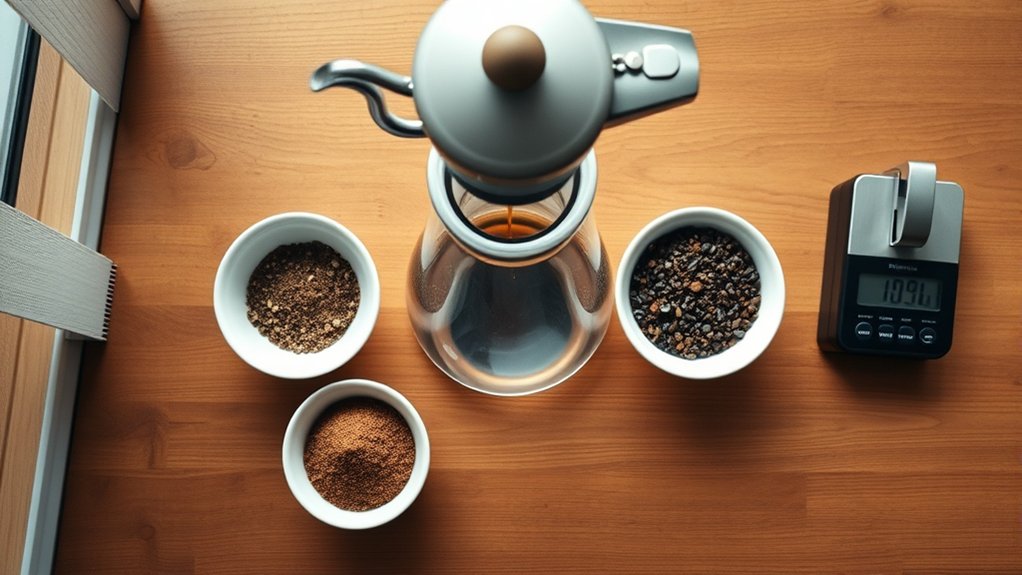
Selecting the right grind size is essential for revealing the full potential of your pour-over coffee. Your brewing method directly influences the ideal grind size, which in turn affects extraction and water flow.
For example, a medium grind suits the Kalita Wave, balancing flavor without muddy brews. Coarse grind works best for Chemex due to its thick filters, preventing bitterness and slow drawdowns.
A medium grind complements the Kalita Wave, while a coarse grind suits Chemex for clean, balanced pours.
Medium to medium-fine grinds optimize extraction in Orea drippers, especially with minimal agitation.
Adjusting grind size fine-tunes your cup’s clarity and body. Finer grinds speed extraction and brighten flavors, while coarser grinds slow water flow, creating heavier tastes.
Understanding these nuances helps you tailor your grind size to your pour-over coffee setup, ensuring consistent, flavorful results every time.
Best Grind Size for Hario V60 Brewers
While you’ve seen how different pour-over methods call for varying grind sizes, the Hario V60 thrives with a medium to medium-coarse grind, similar to coarse sand. This grind size guarantees peak extraction within the ideal brew time of 2.5 to 3.5 minutes, balancing flavor and strength effectively.
To master the best grind size for your Hario V60, consider these tips:
- Adjust grind size to control extraction. Finer grinds boost brightness; coarser ones enhance body and sweetness.
- Avoid too fine a grind to prevent channeling or stalling during brewing.
- Experiment with grind size alongside coffee-to-water ratio and brew time to fine-tune your cup’s flavor profile.
Dialing in these variables helps you reveal your Hario V60’s full potential.
Best Grind Size for Kalita Wave Brewers
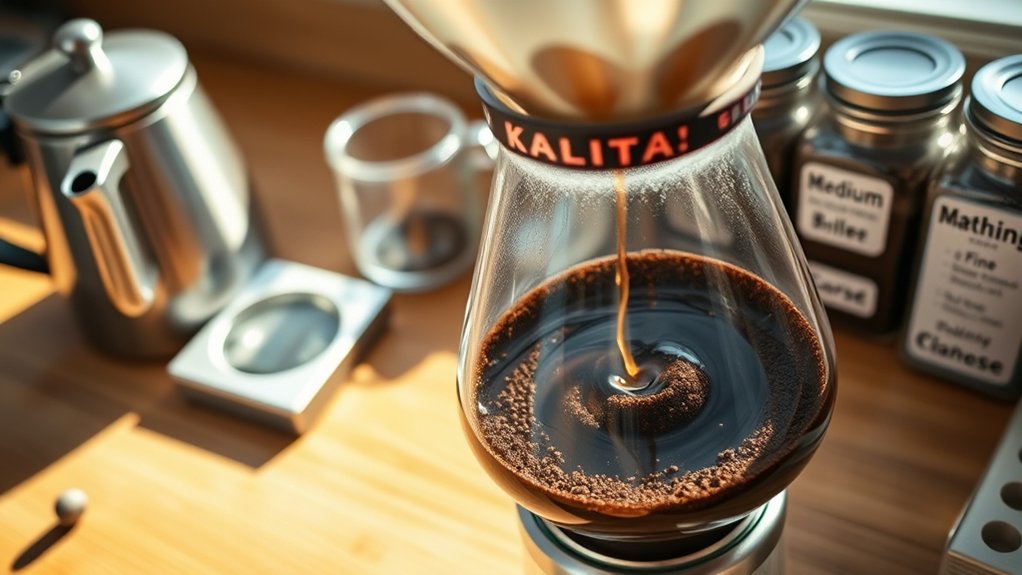
Even though the Kalita Wave shares similarities with other pour-over brewers, it calls for a medium grind size, about the texture of granulated sugar, to release its full potential.
The best grind size for your Kalita Wave is slightly coarser than what you’d use for a Hario V60. This helps prevent heavy, muddy brews and ensures a clean cup.
Its flat-bottom design demands a uniform grind to promote even extraction and minimize channeling.
Don’t hesitate to experiment; adjusting grind size can fine-tune sweetness or clarity depending on your beans and taste.
Finer grinds boost sweetness, while a coarser grind enhances clarity.
Best Grind Size for Chemex Brewers
Grind size plays a critical role in brewing with a Chemex. A coarse texture similar to sea salt guarantees smooth water flow through its thick paper filters. The best grind size for Chemex brewers is a coarse grind that prevents over-extraction and bitterness.
Achieving a uniform particle size is essential to maintain an ideal brew time of 4 to 5 minutes. Here’s what you need to know:
- Use a burr grinder to confirm consistent coarse grind particles for balanced extraction.
- Avoid fine grinds that stall water flow and cause muddy, bitter flavors.
- If your coffee tastes weak, slightly adjust to a finer grind but stay coarse enough to prevent over-extraction.
Mastering this grind size keeps your Chemex brew clear, smooth, and flavorful every time.
How Grind Size Controls Brew Time and Flavor Balance
Because grind size directly affects how quickly water passes through your coffee grounds, it plays an important role in controlling both brew time and flavor balance. A finer grind slows water flow, extending brew time and increasing extraction, which can lead to bitterness.
Conversely, a coarser grind speeds up brew time but risks under-extraction, causing sour notes. For pour-over, a medium-coarse grind typically hits the sweet spot, balancing extraction speed and flavor clarity within the ideal 3 to 4-minute brew time.
Achieving uniform extraction depends on consistent particle size, which is why using a burr grinder is vital.
Fixing Sour or Bitter Coffee by Adjusting Grind Size
If your coffee tastes sour or bitter, adjusting the grind size is often the quickest way to fix the problem.
Sour coffee usually means under-extraction, so you’ll want to use a finer grind size, like moving from medium to medium-fine grind, to improve flavor extraction.
Sour coffee signals under-extraction; try a finer grind, such as medium to medium-fine, for better flavor.
Bitter coffee, on the other hand, often signals over-extraction. Try a coarser grind to slow extraction and balance the taste.
Here’s how to adjust grind effectively:
- If brew time is under two minutes and coffee tastes sour, adjust grind finer.
- If brew time exceeds five minutes with bitter coffee, adjust grind coarser.
- Make small grind size changes and taste after each to find your perfect extraction.
This approach guarantees your pour over brew hits the right flavor balance every time.
Signs Your Grind Size Is Too Fine or Too Coarse
If your coffee tastes bitter or takes forever to brew, your grind is probably too fine. That usually means it’s over-extracting.
But if your brew finishes in under two minutes and ends up kind of flavorless, then your grind is likely too coarse. That leads to under-extraction.
Knowing these signs makes it easier to adjust your grind and nail that perfect pour-over balance.
Over-Extraction Indicators
When your coffee tastes bitter or the brew drags beyond the ideal 3 to 4 minutes, your grind size is likely too fine. Over-extraction happens when water dwells too long, pulling out unwanted compounds from the coffee grounds.
You might notice a heavy mouthfeel or muddy grounds, signs that your fine grind is causing slow extraction and water pooling. Conversely, a sour flavor profile often signals a grind that’s too coarse, but that’s a different issue.
To spot over-extraction, watch for these indicators:
- Extended brew time beyond 4 minutes due to slow water flow through fine grind.
- Bitter taste from excessive extraction of compounds.
- Muddy or sludgy coffee grounds suggesting fines clogging the coffee bed.
Adjust grind size to balance extraction and brew time for peak flavor.
Under-Extraction Symptoms
Recognizing under-extraction symptoms is key to refining your pour over technique, especially after understanding the pitfalls of over-extraction. When your coffee grind is too coarse, water flows too quickly, shortening brew time and resulting in sour, acidic flavors.
Conversely, too fine a grind can cause bitterness due to over-extraction. Monitoring brew time alongside flavor extraction helps you dial in the ideal grind size.
| Symptom | Possible Cause |
|---|---|
| Sour or acidic | Grind too coarse |
| Short brew time | Rapid water flow |
| Weak flavors | Insufficient extraction |
| Bitter taste | Grind too fine |
| Muddy texture | Over-extraction effects |
Adjust your coffee grind to balance brew time and flavor for the best results across pour over brew methods.
How to Dial In Your Grinder for Consistent Pour-Over Results
Although dialing in your grinder may seem challenging at first, mastering this step is essential for consistent pour-over results. Start with a medium grind using a quality burr grinder to achieve uniformity, which directly impacts extraction.
Mastering grinder settings is key to consistent pour-over coffee and uniform extraction.
Keep your coffee-to-water ratio around 1:16 and focus on brew time, aiming for 3 to 4 minutes. If the brew is off, don’t hesitate to experiment by adjusting the grind size.
Here’s how to dial in your grinder effectively:
- Begin with a medium grind resembling coarse sand.
- Taste your coffee; if sour, go finer, if bitter, go coarser.
- Monitor brew time and tweak grind size to hit that sweet spot.
This method guarantees balanced extraction every time.
Frequently Asked Questions
How Does Water Temperature Affect Pour-Over Extraction With Different Grind Sizes?
You’ll notice brew temperature directly impacts extraction time and coffee solubility, especially with different grind sizes.
Finer grinds need precise temperature control to avoid over-extraction and bitterness, while coarser grinds require higher temps to extract flavors fully.
Maintaining grind uniformity and consistent brewing techniques guarantees flavor balance.
Also, don’t overlook water quality; it influences extraction too.
Adjusting temperature based on grind size helps you craft the perfect pour-over every time.
Can Grind Size Impact the Clarity and Texture of Pour-Over Coffee?
Think of grind size as the conductor of your coffee’s symphony. It directly shapes clarity and texture.
When you nail grind uniformity, you control extraction time and brew duration, letting your coffee’s flavor profile and tasting notes shine.
Different brew methods and coffee origins demand specific grinds, so adjusting size fine-tunes your cup’s balance.
Too fine, and bitterness overpowers. Too coarse, and the brew feels thin.
You’re crafting clarity with every tweak.
How Often Should I Clean My Grinder to Maintain Grind Size Consistency?
You should clean your grinder every few weeks to keep grind size consistent and avoid coffee oils buildup that impacts flavor.
For burr grinders, follow grinder maintenance tips like disassembling and brushing burrs to remove residue.
Blade grinders need more frequent attention. Clean after each use by grinding rice, then wiping thoroughly.
This balance in cleaning frequency recommendations prevents grind retention effects, ensuring ideal extraction and a fresh, vibrant pour-over every time.
Is It Better to Grind Coffee Fresh Before Each Pour-Over Brew?
Yes, you should grind fresh beans before each pour-over brew to maximize your coffee aroma and flavor profile.
Fresh grinding guarantees grind uniformity, which directly impacts extraction time and the overall brewing technique. This precision prevents over or under-extraction, letting you enjoy a balanced taste.
Plus, grinding fresh allows you to experiment with different grind sizes easily, helping you fine-tune your cup and elevate your pour-over experience every time.
How Does Altitude Influence the Ideal Grind Size for Pour-Over Coffee?
Altitude plays a big role in your grind consistency because coffee density changes with brewing altitude.
Higher altitudes pack beans tighter, so you’ll want a coarser grind to balance extraction time and avoid bitterness.
Lower altitudes call for finer grinds to highlight regional differences and brighten the flavor profile.
Conclusion
You control your pour-over’s flavor by controlling your grind size. You adjust your grind to balance brew time, fix sour notes, and tame bitterness.
You choose your grinder to guarantee consistency, select your grind size to match your brewer, and dial in your settings to perfect each cup.
Mastering grind size means mastering your coffee because every great pour-over starts with the right grind.