How Much Caffeine Is In 5 Shots Of Espresso – Total Caffeine Explained
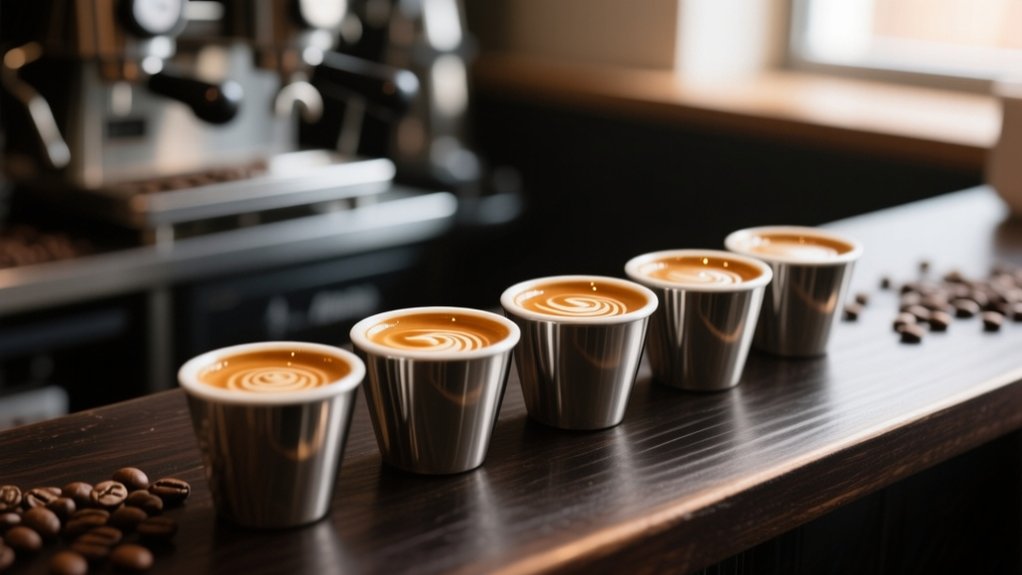
If you have five shots of espresso, you’re looking at about 315 to 375 mg of caffeine total, which is much higher than a single cup of drip coffee. Each shot typically contains 63 to 75 mg, but factors like bean type, roast level, and brewing method can shift this amount.
Whether you choose Arabica or Robusta beans also changes the caffeine kick you get. Keep exploring to uncover how these details influence your espresso experience.
How Much Caffeine Is in a Single Shot of Espresso?
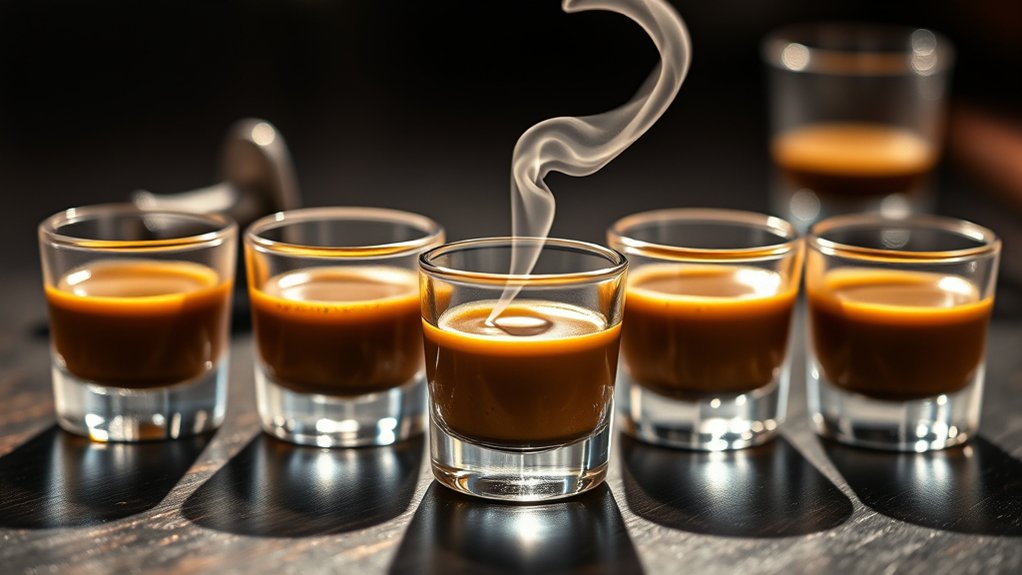
How much caffeine does a single shot of espresso pack? Typically, an espresso shot contains about 63 to 75 milligrams of caffeine. This amount can vary depending on factors like the coffee bean variety and the brand you choose.
A single espresso shot usually packs 63 to 75 milligrams of caffeine, varying by bean and brand.
According to the U.S. Department of Agriculture, the caffeine content in a single shot ranges from 47 to 65 milligrams, showing some natural variation.
Since espresso shots are served in a small 1-ounce size, they deliver a more concentrated dose of caffeine compared to regular brewed coffee.
Specialty brands like Starbucks report that their espresso shots contain approximately 75 milligrams of caffeine, often on the higher end.
Knowing these milligrams helps you understand just how much caffeine you’re getting in each shot.
Why Does Espresso’s Caffeine Content Vary?
Espresso’s caffeine content can change quite a bit depending on several factors you mightn’t immediately consider.
When you’re sipping on your espresso shots, keep in mind these key reasons for variation:
- Grind Size and Brew Ratio: Finer grinds and a higher coffee-to-water ratio extract more caffeine, boosting the caffeine content in each shot.
- Brewing Methods and Equipment: Different machines and techniques pull caffeine differently, so your espresso’s strength can shift from one cafe to another.
- Roasting Level: Lighter roasts retain slightly more caffeine than darker ones, affecting the final caffeine punch.
These factors combine to make the caffeine content in your espresso shots less predictable than you might think, even when shot sizes look the same.
How Coffee Beans Affect Espresso’s Caffeine Levels
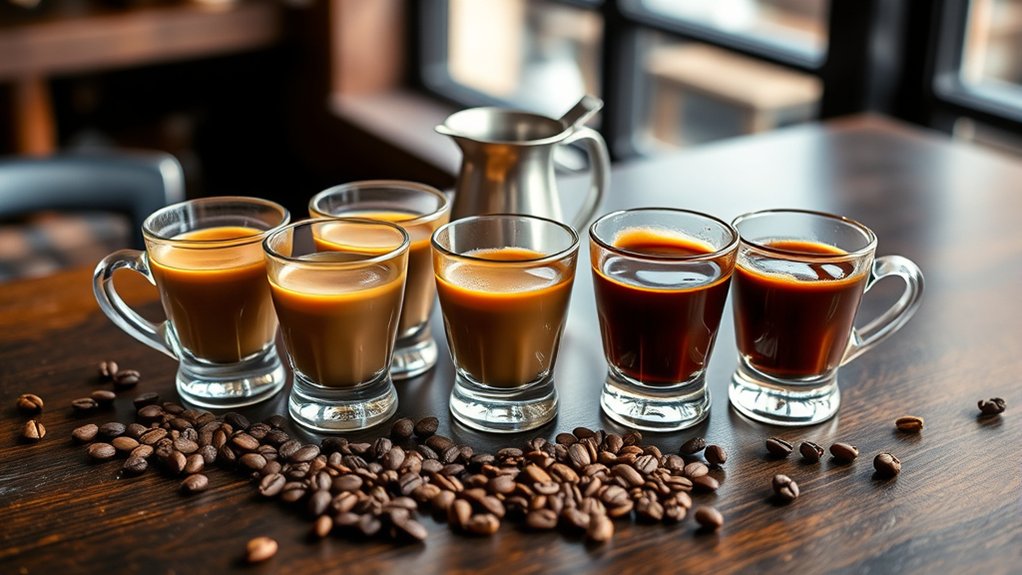
You’ll notice that choosing between Arabica and Robusta beans makes a big difference in your espresso’s caffeine kick.
Robusta packs nearly twice the punch compared to Arabica. The roast profile also plays a role here—lighter roasts usually keep more caffeine than darker ones.
And on top of that, where your beans come from can subtly influence both the flavor and caffeine content you get in each shot.
Arabica Vs Robusta
Two main coffee bean types, Arabica and Robusta, dramatically influence the caffeine content and flavor of your espresso. Arabica beans contain about 63-70 mg of caffeine per shot, while Robusta beans pack nearly double, around 140 mg per shot. Choosing between them affects more than just caffeine content.
Arabica beans deliver a smoother, sweeter taste with complex acidity. Robusta beans offer a stronger, bitter flavor and higher caffeine kick. The aroma and overall espresso profile shift depending on your bean choice.
If you want a mellow, flavorful espresso, Arabica is your go-to. But if you need that bold caffeine jolt, Robusta beans won’t disappoint.
Understanding these differences helps you tailor your espresso to exactly how much caffeine and flavor you want.
Roast Profile Impact
Beyond choosing between Arabica and Robusta beans, how those beans are roasted plays a major role in how much caffeine ends up in your espresso.
The roast profile affects caffeine content in espresso because lighter roasts retain more caffeine; darker roasts undergo more chemical breakdown, reducing caffeine levels.
For instance, lighter roasted Arabica beans can deliver about 122.5 mg of caffeine per 100 ml, while darker roasts drop to around 87.3 mg per 100 ml.
Since espresso uses a fine grind and high pressure, it extracts caffeine efficiently regardless of roast.
Whether you use Arabica or Robusta, which naturally differ in caffeine, the roast profile can greatly influence your espresso’s caffeine punch.
Bean Origin Influence
Although many factors influence your espresso’s caffeine content, the type of coffee bean you choose plays a crucial role. Bean origin affects not only flavor but also caffeine levels, as coffee beans from different regions contain unique chemical compositions.
For example, Robusta beans pack almost double the caffeine content compared to Arabica beans. When selecting your beans, keep these points in mind:
- Robusta beans (originating mostly from Africa and Indonesia) average about 198.7 mg caffeine per shot.
- Arabica beans (primarily from Latin America) contain roughly 109.95 mg caffeine per shot.
- Beans grown at higher altitudes tend to have slightly lower caffeine content.
Understanding how bean origin influences caffeine content helps you tailor your espresso’s strength to your preference.
The Role of Roast Profile in Espresso Caffeine
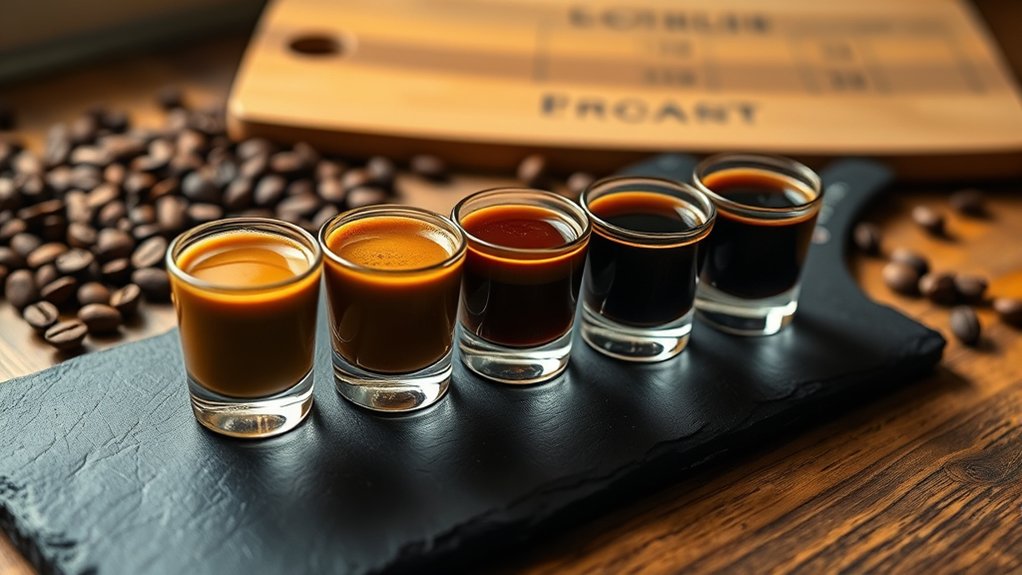
You might think darker roasts pack less caffeine, but the difference is usually pretty small. That’s because caffeine stays fairly stable during roasting.
Light roasts tend to hold onto a bit more caffeine, while dark roasts bring out those bolder, richer flavors.
Light vs Dark Roasts
While many assume dark roasts pack more caffeine, light roasts actually retain slightly more due to less degradation during roasting.
When you compare caffeine content, light roasts have about 122.5 mg per 100 ml, whereas dark roasts contain around 87.3 mg.
Still, the difference is minimal, so don’t expect a huge caffeine boost just by choosing one roast over the other.
Here’s what you should keep in mind:
- Light roasts preserve caffeine better because they’re roasted for a shorter time.
- Dark roasts develop deeper flavors and lower acidity but slightly less caffeine.
- The caffeine difference between light roasts and dark roasts is often negligible in espresso.
Caffeine Stability During Roasting
Understanding how caffeine behaves during roasting sheds more light on why light and dark roasts differ in caffeine content. You’ll find that caffeine remains stable throughout roasting, so the caffeine content changes little.
However, light roasts usually contain slightly more caffeine than darker roasts because they spend less time exposed to heat.
Here’s a quick comparison for Arabica beans:
| Roast Level | Caffeine Content (mg/100 ml) | Roast Time & Temperature |
|---|---|---|
| Light Roast | 122.5 | Shorter time, lower temperature |
| Medium Roast | ~105 (approximate) | Moderate time & temperature |
| Dark Roast | 87.3 | Longer time, higher temperature |
Roast Impact On Flavor
Because the roast profile shapes both flavor and caffeine levels, it plays an essential role in your espresso experience. When you choose your roast, keep these in mind:
- Lighter roasts retain slightly more caffeine content since they undergo less degradation, offering a subtle, brighter flavor.
- Arabica beans, common in espresso, provide a smoother taste but contain less caffeine compared to Robusta, influencing your overall caffeine intake.
- Dark roasts deliver bold, rich flavors with reduced acidity, though their caffeine content is only marginally lower than lighter roasts.
Your roast profile also affects grind size and brewing temperature, optimizing extraction and crema.
Understanding these factors helps you tailor your espresso for both flavor and caffeine punch.
Comparing Espresso’s Caffeine to Drip Coffee
If you’re comparing caffeine content, five shots of espresso pack a much bigger punch than a single cup of drip coffee. Each shot of espresso contains about 63 to 75 mg of caffeine, totaling 315 to 375 mg for five shots.
In contrast, an 8-ounce cup of drip coffee usually has around 95 mg of caffeine. This means those five espresso shots deliver caffeine equivalent to roughly three or more cups of drip coffee.
Espresso’s caffeine concentration per ounce is much higher, about 63-75 mg compared to drip coffee’s 12 mg.
Keep in mind, factors like bean type and brewing method can affect caffeine levels.
You’ll also notice espresso’s caffeine hits you faster due to quicker absorption, unlike the slower effect from drip coffee.
How Espresso-Based Drinks Affect Your Caffeine Intake
While espresso shots pack a strong caffeine punch on their own, espresso-based drinks like lattes and cappuccinos can quickly add up your daily intake without you realizing it. Each espresso drink usually contains two shots, meaning your caffeine intake rises fast.
For example, a grande latte or cappuccino often delivers about 150 mg of caffeine.
Keep in mind:
- Five shots of espresso alone can total 315-375 mg of caffeine, nearing the FDA’s daily limit.
- Flavored syrups in espresso drinks may disguise caffeine’s effects, making you drink more.
- Total caffeine content varies by preparation and brand, so always check to avoid excess.
Calculating Caffeine in Five Shots of Espresso
When you down five shots of espresso, you’re consuming roughly 315 to 375 mg of caffeine. This depends on the beans and brewing method. Each shot typically contains 63 to 75 mg of caffeine, but factors like bean type and grind size can shift this number.
Robusta beans, for example, pack nearly double the caffeine compared to Arabica. Since caffeine content varies, knowing the range helps you make informed choices about your intake.
| Factor | Caffeine per Shot (mg) |
|---|---|
| Arabica Beans | 63 – 70 |
| Robusta Beans | 70 – 75 |
| Finer Grind | Higher extraction |
| Coarser Grind | Lower extraction |
Understanding Caffeine Content in Decaf Espresso
Although decaffeination considerably reduces caffeine, decaf espresso still contains a small amount, typically between 3 to 15 mg per shot, depending on the brand and preparation.
When you choose decaf espresso, you’re opting for much lower caffeine content compared to a regular espresso shot, which averages about 63 mg.
Choosing decaf espresso means enjoying espresso flavor with significantly less caffeine than a regular shot.
Keep in mind:
- Some decaf espresso brands contain as little as 0.3 mg caffeine per shot.
- Others may have up to 7 mg caffeine per espresso shot.
- The decaffeination process lowers caffeine but preserves flavor and aroma.
If you’re sensitive to caffeine but love espresso’s taste, decaf espresso offers a balanced option.
Just remember, even decaf espresso contributes some caffeine to your daily intake.
What Are Safe Daily Caffeine Limits for Espresso?
You should try to keep your daily espresso caffeine intake within the recommended limits to avoid any health risks.
For most adults, that usually means no more than about six shots a day.
But remember, if you’re pregnant or have high blood pressure, that number should be lower.
It’s important to pay attention to how your body reacts and adjust how much you’re drinking to stay safe.
Recommended Daily Intake
Since caffeine affects everyone differently, it’s important to know the safe daily limits for espresso consumption. The FDA suggests a daily caffeine limit of 400 mg for most healthy adults, which equals about 6 shots of espresso.
However, your ideal caffeine per day can vary depending on your situation. Here’s a quick guide:
- If you’re pregnant, keep your intake under 200 mg, or roughly 2 shots of espresso.
- Breastfeeding? Aim for no more than 300 mg, about 4 shots.
- If you have hypertension, limit yourself to 300 mg daily, around 3 shots.
Knowing your daily caffeine limit helps you enjoy espresso safely without overdoing it.
Health Risks And Moderation
While enjoying espresso can boost your energy and focus, it’s important to keep your caffeine intake within safe daily limits to avoid health risks. The FDA suggests a maximum of 400 mg of caffeine daily for healthy adults, about 6 shots of espresso.
Pregnant women should limit themselves to under 200 mg, or roughly 3 shots, to reduce potential risks. If you have hypertension, aim for no more than 300 mg, around 4-5 shots, depending on your tolerance.
Drinking espresso in moderation is generally safe, but individual sensitivity varies. Some may experience negative effects even at lower doses.
Common Myths About Espresso and Caffeine Debunked
How much caffeine does espresso really pack? You might think espresso is the strongest caffeine source, but several myths need busting. For example, espresso doesn’t have more caffeine than an 8-ounce drip coffee cup.
Here are three common espresso and caffeine myths debunked:
- Dark roasts contain more caffeine than light roasts — false; light roasts hold slightly more caffeine.
- The crema has the highest caffeine concentration — incorrect; caffeine is evenly distributed in the shot.
- Decaf espresso is caffeine-free — not true; it still contains 3 to 15 mg of caffeine per shot.
Understanding these espresso and caffeine myths helps you make smarter choices about how much caffeine you consume without overestimating or underestimating its effects.
Frequently Asked Questions
How Does Caffeine in Espresso Affect Sleep Quality?
Caffeine in espresso can seriously disrupt your sleep quality by increasing the time it takes to fall asleep and reducing deep sleep stages.
Its effects last around 4 to 6 hours, so if you drink espresso later in the day, it can interfere with your relaxation and sleep patterns.
To counteract this, you should try relaxation techniques before bed and avoid caffeine close to bedtime to improve your overall caffeine sleep experience.
Can Caffeine Tolerance Reduce Espresso’s Effects Over Time?
Think of caffeine tolerance as a fading sunrise. You wake up expecting brilliance, but the light dims over time.
Yes, caffeine tolerance can reduce espresso effects, especially with long-term consumption. Your brain adapts, making those five shots less jolting than before.
What Are the Symptoms of Caffeine Overdose From Espresso?
If you experience caffeine sensitivity symptoms like rapid heartbeat, anxiety, restlessness, or upset stomach, you might be overdosing on espresso.
Exceeding safe caffeine limits can also cause sleep disturbances and dizziness.
To avoid these issues, follow espresso consumption guidelines carefully and stay within recommended safe caffeine limits.
Listen to your body and reduce intake if you notice any adverse effects, ensuring you enjoy espresso without risking your health.
Does Adding Milk Alter the Caffeine Absorption Rate?
Think of your digestive system like a busy highway. Adding milk types, like whole or skim, is like adding a few speed bumps.
While milk doesn’t change caffeine content, it can slightly slow absorption rates because fats affect digestion’s pace.
How Quickly Does Caffeine From Espresso Metabolize in the Body?
Caffeine metabolism varies, but on average, your body takes about 5 hours for the espresso half-life, meaning it eliminates half the caffeine in that time.
However, individual variability plays a big role. Your genetics, age, and liver function can speed up or slow down this process.
Conclusion
Now that you know how much caffeine is packed into five shots of espresso, you’re armed to make smarter choices without riding the jittery rollercoaster. Remember, caffeine content isn’t a fixed number; it dances with your beans and roast.
Keep your daily limits in mind, and don’t let myths cloud your judgment. Whether you’re chasing a quick buzz or savoring decaf, understanding caffeine helps you sip smarter and feel better.