Can You Make Espresso In A French Press – Step By Step Guide
You can make a strong, espresso-like coffee in your French press by using medium-fine grounds, heating water to about 200°F, and steeping for 4 minutes before pressing the plunger slowly. While it won’t create the true espresso’s rich crema or intense pressure-extracted flavor, you’ll get a bold, concentrated brew.
Adjusting the coffee-to-water ratio helps control strength and caffeine. Keep exploring to discover tips, common pitfalls, and alternative espresso methods you might enjoy.
What Is Espresso and How Does It Differ From French Press Coffee?
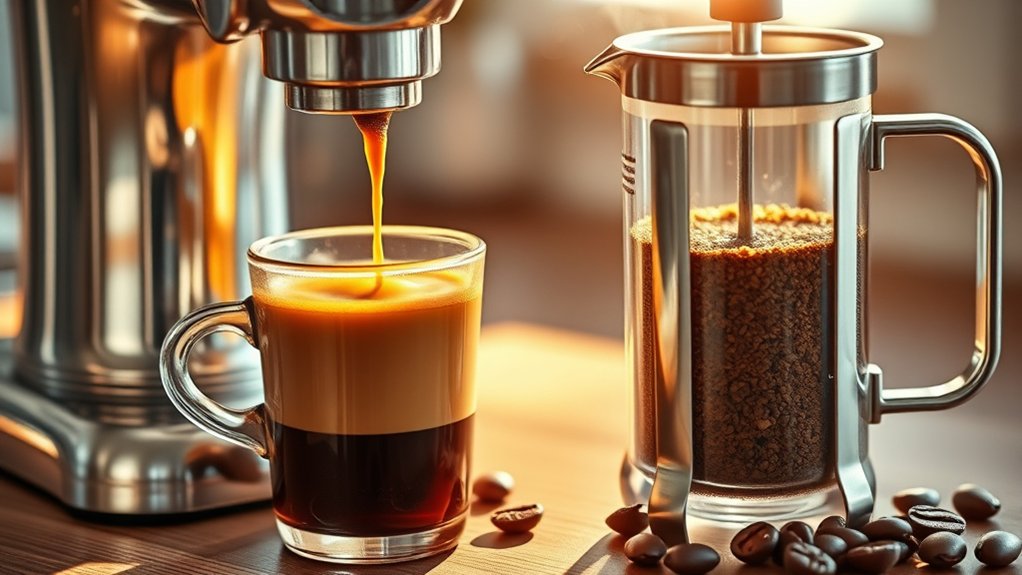
Espresso and French press coffee offer distinct experiences because they use different brewing methods and grind sizes.
When you make espresso, you force hot water through finely ground coffee under high pressure. This extracts bold flavors and a creamy texture quickly.
Hot water under high pressure extracts bold flavors and creamy texture from finely ground coffee.
In contrast, French press brewing involves steeping coarsely ground coffee in hot water for several minutes. This lets the flavors develop through immersion and gravity.
The grind size plays an essential role: espresso demands a very fine grind to guarantee fast extraction, while French press needs coarser grounds to avoid bitterness and cloudiness.
Espresso typically packs a stronger, more concentrated punch, whereas French press coffee feels richer with a thicker body but milder intensity.
Understanding these differences helps you appreciate each method’s unique qualities.
Can You Really Make Espresso With a French Press?
How close can a French press get to making espresso? While it won’t replicate espresso’s high-pressure extraction, your French press can brew a strong, concentrated coffee that resembles espresso.
Start with coarsely ground coffee beans, ideally a dark roast, to avoid bitterness. Use a coffee-to-water ratio of about 1 ounce of coffee per 4 ounces of water, then pour water heated to around 200°F (93°C) over the grounds.
Let it steep for 4-5 minutes to extract peak flavor. This steeping time and ratio produce a richer, thicker brew than regular coffee but still lack espresso’s creamy texture and intensity.
Which Coffee Beans and Grind Size Work Best for French Press Espresso?
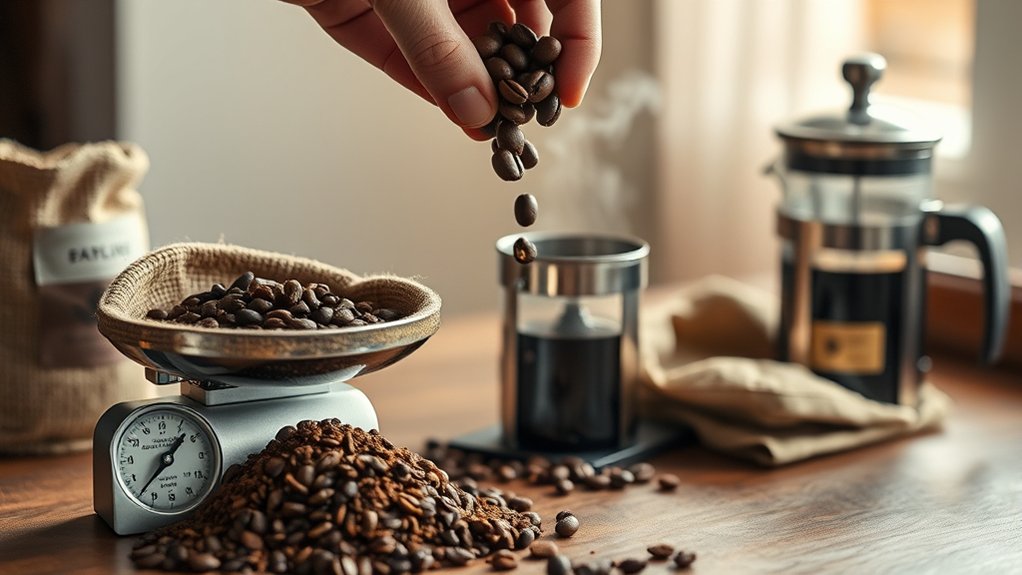
To get the best espresso flavor from your French press, go for bold, dark roast beans that really pack a rich punch.
You want something with a deep, intense flavor to stand up to the brewing method.
As for the grind size, aim for medium to medium-fine—kind of like breadcrumbs.
This helps balance the flavor extraction without ending up with too much sediment in your cup.
And don’t forget, freshly grinding your beans right before brewing makes a big difference.
It helps bring out the full aroma and taste, so your espresso tastes as fresh and vibrant as possible.
Ideal Bean Selection
When you choose bold, dark roast coffee beans, you’ll bring out the rich flavors essential for a French Press espresso. Selecting the right coffee beans and grind size sets the foundation for a great brew.
For your French Press espresso:
- Pick bold, dark roast coffee beans to highlight deep, robust flavors.
- Use a coarse grind size, similar to sea salt, to avoid over-extraction and bitterness.
- Always grind fresh right before brewing to maximize aroma and intensity.
Avoid fine grounds, as they can slip through the French Press filter, causing cloudiness and an unpleasant texture.
Optimal Grind Size
Choosing the right grind size plays an essential role in crafting a rich French Press espresso. You want a medium to medium-fine grind, slightly coarser than traditional espresso but finer than typical French press grounds, resembling breadcrumbs.
This grind size balances extraction, avoiding bitterness from over-extraction or weakness from under-extraction. Start with bold, dark roast coffee beans to capture that deep, intense flavor espresso lovers crave.
Always grind your coffee beans freshly just before brewing to preserve aroma and taste. Keep your coffee-to-water ratio around 1 ounce of coffee per 4 ounces of water for a concentrated, robust brew.
Mastering these elements guarantees your French Press espresso delivers rich flavor with the perfect body every time.
How Hot Should Your Water Be for French Press Espresso?
How hot should your water be to get the best espresso-style coffee from a French press? The ideal water temperature is about 200°F (93°C), which guarantees optimal extraction without burning the grounds.
For the best espresso-style French press coffee, use water at about 200°F (93°C) for optimal extraction.
Boiling water can scorch your coffee, causing bitterness that masks the espresso’s rich flavors.
To nail the water temperature, follow these steps:
- Boil your water and let it sit for about 30 seconds to cool slightly.
- Use a thermometer to check accuracy, especially since espresso brewing methods require precision.
- Maintain consistent water temperature throughout brewing to achieve balanced flavor and strength.
Controlling water temperature is vital when making espresso in a French press, as it directly impacts how well the coffee extracts and ultimately tastes.
Step-by-Step: Brewing Espresso in a French Press
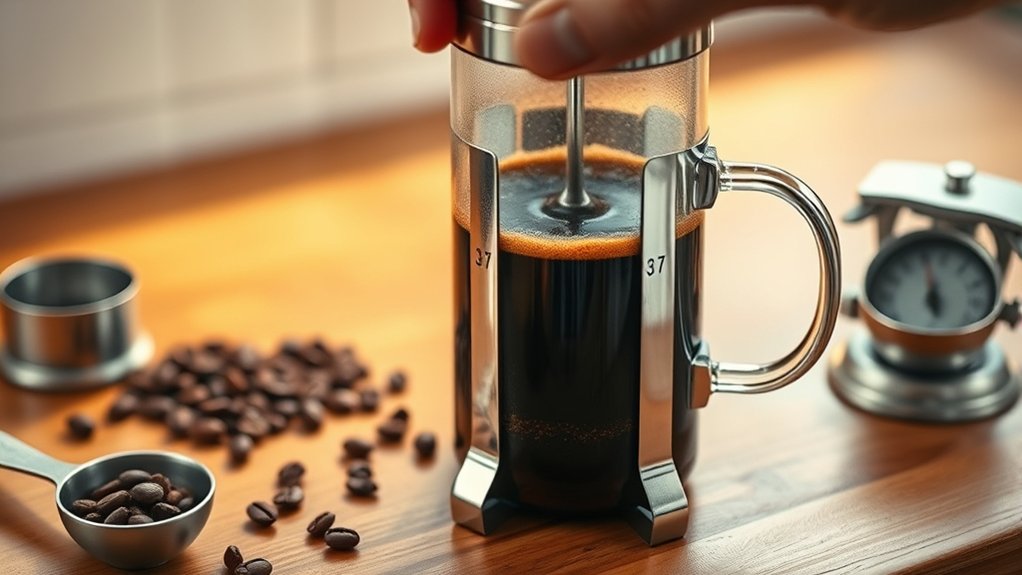
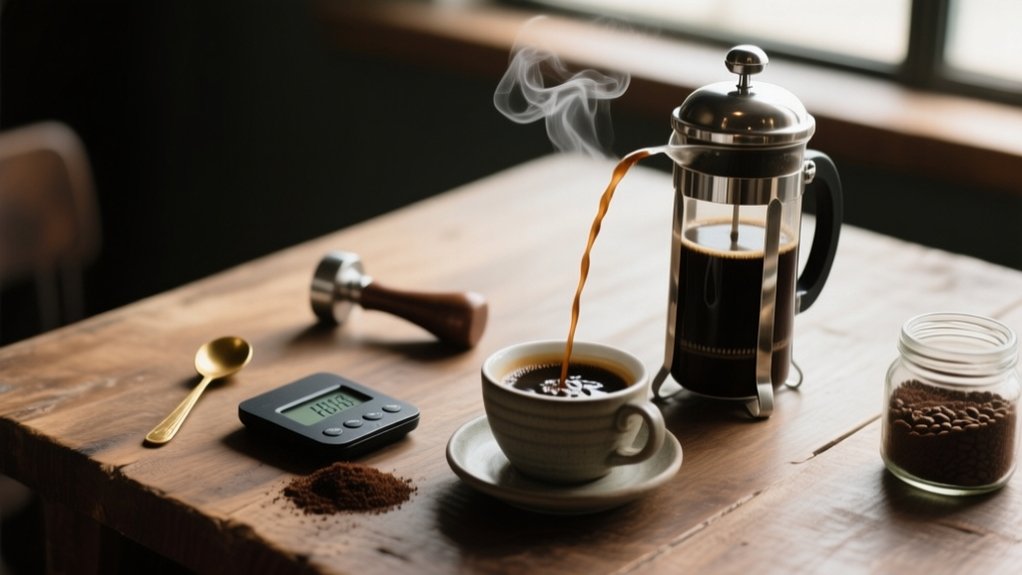
Brewing espresso in a French press takes just a few simple steps, but precision is key to capturing that rich, bold flavor.
Start by using a medium-fine grind of coffee grounds, about ½ cup works best.
Heat your water to 200-205°F, then pour it over the grounds in the French press. Stir gently to make sure all the coffee grounds are fully saturated.
Let the coffee steep for exactly four minutes to extract maximum flavor.
When time’s up, slowly press the plunger down to separate the grounds from the espresso-like liquid.
Serve your French press espresso immediately to enjoy its full richness, as letting it sit can lead to bitterness.
Follow these steps, and you’ll have a strong, satisfying espresso without an espresso machine.
How to Press and Pour for the Smoothest French Press Espresso
You’ll want to press the plunger down slowly to keep sediment out of your espresso.
Then, when you pour, go ahead and do it right away—but pour steadily. This helps lock in that rich aroma and smooth flavor you’re aiming for.
Let’s dive into the best techniques to help you master your press and pour for the perfect cup.
Plunger Technique Tips
Although pressing the plunger might seem straightforward, mastering a gentle, steady motion is key to preventing sediment from mixing into your espresso. Your plunger technique sets the foundation for a smooth pour and clean cup.
Before you press on the plunger, verify it’s fully seated to create a tight seal and avoid leaks. Then, gently press down with consistent pressure. Don’t force it or rush. Keep the French press upright to keep grounds submerged and minimize bitterness.
Follow these steps for a flawless press:
- Confirm the plunger is fully seated before pressing.
- Gently press the plunger down steadily without forcing.
- Pour slowly and smoothly immediately after pressing.
This approach delivers a clean, sediment-free espresso every time.
Pouring Methods Explained
Once you’ve mastered the plunger technique, focusing on how you press and pour can make all the difference in achieving the smoothest French press espresso.
Begin by pressing the plunger down slowly and evenly, using gentle pressure to separate the grounds from the liquid without forcing sediment through the mesh filter.
Before plunging, gently stir the grounds to confirm even extraction.
When you pour, tilt the French press slightly to control the flow, allowing for a smooth pour that minimizes grounds escaping into your cup.
Use a pre-warmed mug to keep your espresso hot.
After pouring most of the coffee, let the remaining liquid settle before pouring the last bit to avoid sediment contamination.
These steps guarantee a clean, smooth French press espresso every time.
How to Adjust Coffee-to-Water Ratios for Your Perfect Espresso
How much coffee you use compared to water can completely change your espresso-style French press brew. To get it just right, focus on the coffee-to-water ratio and use coarsely ground coffee for smooth extraction.
The coffee-to-water ratio is key for perfect espresso-style French press with smooth, balanced flavor.
Here’s a quick guide:
- For a strong espresso-style brew, use a 1:4 ratio, which means 1 ounce of coffee to 4 ounces of water.
- Prefer something milder? Try a 1:6 ratio for a lighter taste.
- Brewing two servings? Use ¼ cup (2 ounces) of coarsely ground coffee with 1 cup (8 ounces) of hot water.
Don’t forget, you can always adjust the steeping time to fine-tune strength.
Experiment with ratios like 1:5 until you discover your perfect balance.
Common Mistakes to Avoid When Making Espresso in a French Press
If you want a smooth, flavorful espresso-style coffee from your French press, you need to avoid some common mistakes that can ruin the brew.
First, always use a coarse grind. Fine grounds can slip through the mesh filter, causing cloudiness and bitterness.
Next, stick to the proper coffee-to-water ratio, typically 2 tablespoons of coffee per cup of water, to keep flavors balanced.
Pay close attention to steeping time; 4 minutes is ideal. Steeping too long leads to over-extraction and bitterness.
Also, avoid overfilling your French press. Leave enough room for the plunger to press without forcing grounds into your cup.
Finally, use hot water just below boiling to extract the best taste without burning the coffee.
Avoiding these errors guarantees a great espresso-style brew every time.
How Much Caffeine Does French Press Espresso Have Compared to Machine Espresso?
You’ll find that French press espresso usually packs a caffeine punch pretty close to machine espresso.
The brewing method does make a bit of a difference, though. Since French press uses immersion instead of pressure, the caffeine concentration might be a little lower per volume.
But really, the total caffeine you get depends on how long you steep it and the type of coffee you use.
Caffeine Content Comparison
Although French press espresso typically contains slightly less caffeine than machine espresso, the difference isn’t dramatic. You’ll find that caffeine content depends on several factors unique to the French press method.
Here’s what influences it most:
- The coffee-to-water ratio: a higher ratio means more caffeine extraction.
- Using coarsely ground coffee: this prevents over-extraction, maintaining balanced caffeine levels without bitterness.
- Steeping time: longer steeping allows more caffeine to dissolve, but still usually less than a concentrated machine espresso shot.
Machine espresso delivers about 30 to 50 mg of caffeine per shot, while French press espresso falls just below that range due to its gentler brew.
Brewing Method Influence
How does the brewing method affect the caffeine content in your espresso? When you use a French press, the brewing method plays a key role in caffeine content.
French press espresso usually contains slightly less caffeine than machine espresso because its longer steeping time can lower extraction efficiency.
You use coarsely ground coffee in the French press, which helps prevent over-extraction and influences caffeine levels differently than the finely ground coffee in espresso machines.
Adjusting the coffee-to-water ratio in your French press lets you boost caffeine concentration, making it closer to traditional espresso.
Ultimately, the caffeine content difference is minimal and depends more on your coffee bean and roast than the brewing method itself, but your brewing choices still shape the final caffeine kick.
Concentration Versus Volume
Understanding the difference in caffeine concentration and volume between French press espresso and machine espresso helps you gauge their true strength.
While espresso from a machine boasts 30 to 50 mg of caffeine per shot, French press coffee usually contains slightly less caffeine due to its longer steeping time and different brewing method.
The grind size in a French press impacts caffeine extraction, potentially altering the experience despite similar caffeine levels.
Consider these points:
- Espresso’s high-pressure brewing method creates a concentrated shot with intense caffeine concentration.
- French press coffee, though less concentrated, can have more caffeine by volume due to larger serving sizes.
- The grind size and steep time in a French press influence caffeine release, making its caffeine profile unique.
You’ll find espresso stronger overall, but French press offers a milder, fuller volume.
Other Ways to Brew Espresso Without an Espresso Machine
If you don’t have an espresso machine, you can still enjoy espresso-like coffee using several alternative methods. The French press, for example, offers a simple way to brew a concentrated coffee by using coarsely ground coffee and a shorter steeping time. Though it won’t produce true espresso, it’s a handy option.
The AeroPress combines immersion and pressure to create a richer brew that mimics espresso well.
The AeroPress uses immersion and pressure to craft a rich, espresso-like coffee experience.
The Moka pot, known as a stovetop espresso maker, forces boiling water through grounds to deliver a strong, espresso-like coffee. You might also try a siphon coffee maker, which uses vacuum pressure for a unique brew.
Finally, cold brew steeped for hours yields a concentrated coffee that works great for espresso-style drinks and cocktails.
Frequently Asked Questions
Can I Use Flavored Coffee Beans for French Press Espresso?
Yes, you can use flavored beans for French press espresso, but you’ll want to pay attention to brewing techniques.
Because flavored beans often have added oils, they affect taste profiles and coffee strength, so experiment with grind size and steeping time.
Always use fresh bean freshness for the best aroma and flavor.
Adjust the coffee-to-water ratio to balance intensity, and monitor your brew closely to get the perfect cup every time.
How Do I Clean My French Press After Making Espresso?
Coincidentally, cleaning your French press right after brewing espresso makes maintenance easier.
You’ll want to disassemble the plunger and filter, then rinse off any espresso residue with warm water.
Use gentle cleaning tools like a soft brush to scrub the mesh filter and carafe.
Maintain a regular cleaning frequency to avoid buildup and preserve flavor.
Once clean, dry thoroughly before storing to keep your French press in top shape for every brew.
Can I Froth Milk for Lattes With French Press Espresso?
Yes, you can froth milk for lattes with French press espresso. Use milk frothing techniques by heating milk to about 150°F.
Follow the milk temperature guide to avoid burning.
Fill your French press halfway, then pump the plunger vigorously for froth.
Adjust your coffee to water ratio and brewing time for a stronger shot. This helps you create creamy milk perfect for latte art tips, enhancing your homemade latte experience.
How Long Can I Store French Press Espresso Before It Tastes Bad?
Like a fading sunset, your French press espresso’s flavor starts to slip after about 30 minutes.
For ideal flavor preservation, aim to enjoy it fresh, as storage beyond this leads to noticeable taste deterioration.
If you must store it, use an airtight container at room temperature for up to 1-2 hours.
Refrigeration can extend freshness to 3-4 days, but brewing techniques matter most.
Fresh coffee always wins for peak coffee freshness.
Is French Press Espresso Suitable for Iced Coffee Drinks?
Yes, French Press espresso is perfect for iced coffee drinks. You can experiment with iced coffee recipes by using brewing techniques that emphasize a strong, bold flavor, ensuring coffee dilution from ice doesn’t weaken the taste.
Try different flavor combinations like vanilla or caramel syrups to enhance your drink.
For serving suggestions, brew with a coarse grind, steep longer, then cool before adding ice or milk. This method keeps your iced coffee rich and satisfying.
Conclusion
Think of making espresso in a French press like painting with a new brush—different, but full of creative potential. Just like a barista perfecting their craft, you’ll learn the nuances of grind size, water temperature, and timing.
Remember, even without a machine, you can brew a bold, rich espresso that wakes you up like a lightning bolt, proving great coffee isn’t about the tool but the passion behind each cup you make.