How Many Shots Of Espresso In A Latte – Standard Ratios Explained
You’ll typically use two shots of espresso, about 2 ounces total, in a standard 16-ounce latte to strike the perfect balance between flavor and strength. This double shot, extracted using roughly 18-20 grams of coffee grounds at a 1:2 brew ratio, brings out rich sweetness while minimizing bitterness.
Measuring shots by weight helps guarantee consistency. Adjusting grind, tamp, and milk texture lets you customize your cup. Keep exploring to master the exact ratios and techniques behind the ideal latte.
How Many Shots Of Espresso Are In A Standard Latte?

How many shots of espresso do you find in a standard latte? Typically, it contains two shots of espresso, totaling about 2 ounces. This standard guarantees a balanced flavor when combined with roughly 12 ounces of steamed milk in a 16-ounce latte.
Each shot usually involves 18 grams of coffee grounds for a double shot extraction. Understanding brew ratios helps clarify this: the common ratio is 1:2, meaning one gram of coffee grounds produces about two grams of espresso.
A double shot uses 18 grams of coffee grounds with a 1:2 brew ratio for optimal espresso yield.
This precise balance between coffee and milk creates the classic latte profile you expect.
While you can tweak the number of shots to suit your taste, sticking to two shots of espresso aligns best with traditional brew ratios and flavor harmony.
Why A Double Shot Is Ideal For Latte Flavor And Balance
The double shot of espresso delivers the perfect balance of flavor and strength that a latte demands.
When you use about 18-20 grams of coffee for espresso extraction, you get roughly 36-40 grams of espresso at a 1:2 brew ratio.
This precise extraction enhances the espresso’s natural sweetness and minimizes bitterness, making it ideal for blending with milk.
A double shot guarantees the coffee flavor stands out without overpowering the creamy texture of the milk.
It also creates a richer, more satisfying mouthfeel that defines a classic latte.
By sticking to this standard, you enjoy consistent flavor every time, whether at home or your favorite café.
This balance is why a double shot is the go-to for latte lovers.
What Espresso Brew Ratios Mean For Your Latte’s Flavor

Understanding brew ratios is a great way to get a handle on how strong or flavorful your latte turns out. It’s all about how much espresso you pull from your coffee grounds.
Things like how long you extract and the grind size really play a role in the taste, so finding the right balance is super important.
Once you get the hang of your brew ratio, you can tweak your latte’s intensity just the way you like it.
Brew Ratio Basics
Because brew ratios directly shape your espresso’s flavor, knowing their basics helps you craft the perfect latte. Brew ratios refer to the weight relationship between the coffee grounds and the espresso shot extracted, influencing taste and strength. Here’s what you need to know:
- A standard espresso shot uses a 1:2 brew ratio. That means 20 grams of coffee yields about 40 grams of espresso, balancing richness and extraction.
- A ristretto shot, with a tighter 1:1 to 1:1.5 ratio, delivers a sweeter, less bitter flavor. It’s ideal for sweeter latte profiles.
- A lungo shot stretches to a 1:3 ratio, producing a lighter, more diluted espresso shot that subtly alters your latte’s flavor.
Mastering these ratios guarantees consistent, precise espresso shots that elevate your latte’s taste every time.
Flavor Impact Factors
When you adjust espresso brew ratios, you directly shape the flavor intensity and balance of your latte. Using around 20 grams of coffee for a double shot, the brew ratio determines whether your espresso base is robust or balanced.
For example, a 1:1.5 ratio yields a stronger, more concentrated flavor, while a 1:2 ratio offers a smoother, balanced taste. Choosing between ristretto, normale, or lungo shots further influences concentration and flavor nuances.
To guarantee consistent, ideal flavor, you need to measure both grams of coffee and espresso output precisely with a scale. This attention to detail helps you avoid bitterness from over-extraction and ensures that every latte you make highlights the espresso’s true character.
Balancing Extraction Strength
A careful balance of espresso brew ratios plays a key role in shaping your latte’s overall flavor profile. Understanding how extraction strength affects taste helps you craft the perfect cup. Here’s what to take into account:
- A 1:1.5 brew ratio yields a bold, robust espresso, giving your latte a strong, intense flavor.
- A 1:2 ratio offers a balanced taste, ideal for most lattes with two shots and about 230-240 grams of steamed milk.
- For a sweeter, less bitter experience, try a ristretto shot brewed at 1:1, which concentrates flavor without harshness.
Consistently measuring your espresso and brew ratio guarantees you replicate your preferred taste every time.
Balancing extraction strength is essential for a harmonious latte.
How To Measure Espresso Shots By Weight, Not Volume
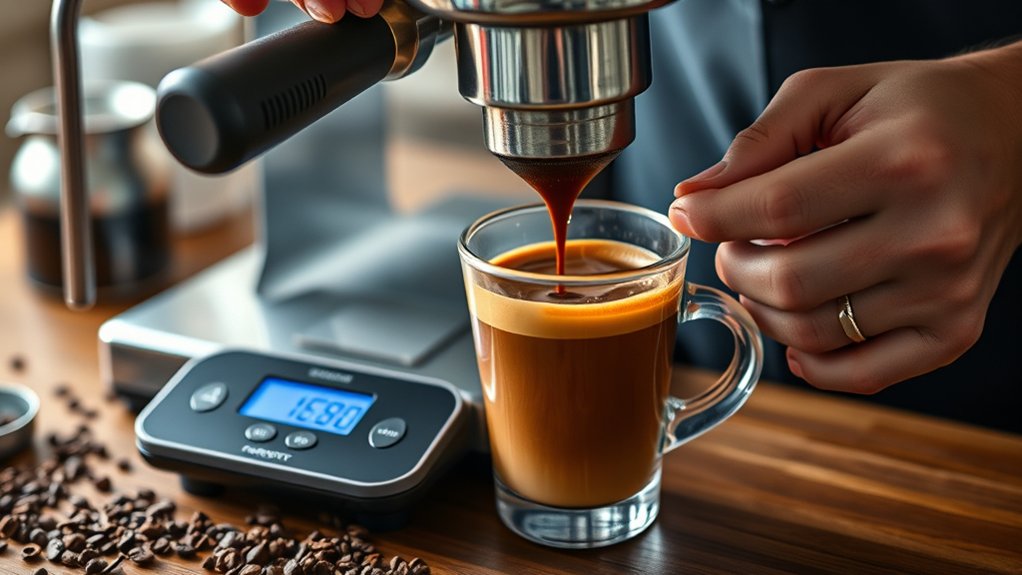
How exactly do you guarantee each espresso shot hits the perfect balance every time? The answer lies in measuring espresso shots by weight, not volume.
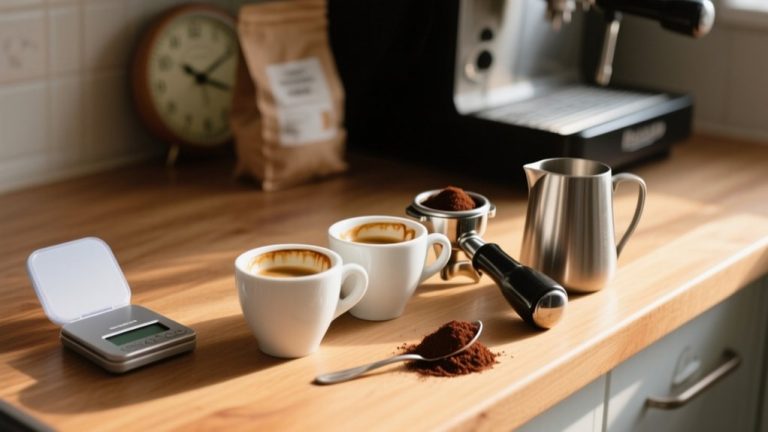
By using a scale, you can precisely control the grams of coffee used and the espresso yield, ensuring consistent brew ratios and flavor profiles. For instance, a standard double shot involves 20 grams of coffee producing about 40 grams of espresso, following a 1:2 brew ratio.
Using a scale ensures precise coffee dosing and consistent espresso yield for perfect flavor every time.
Measuring by weight accounts for coffee ground density and moisture variations that volume measurements miss, making your extraction more reliable and repeatable.
This method eliminates guesswork, allowing you to craft lattes with perfectly balanced espresso every time, enhancing your coffee’s taste and consistency.
Tips For Dialing In Your Espresso Shot For The Perfect Latte
To nail the perfect latte, start by dialing in your espresso. Play around with the grind size—that’s key to controlling how long the shot extracts and really brings out those flavors.
Next, keep an eye on your brew ratio. Measuring it carefully helps you get a balanced yield that shows off the coffee’s richness just right.
And hey, don’t overlook tamping pressure. Keeping it consistent makes sure the water flows evenly, giving you a smooth, balanced shot every single time.
Adjusting Grind Size
Three key factors determine the perfect espresso shot for your latte, with grind size being the most critical. Using 20 grams of coffee, you want to dial in your grind size to hit a brew ratio of 1:2, yielding about 40 grams of espresso in 25-30 seconds.
Here’s how to adjust:
- If extraction is under 23 seconds, grind finer to slow the flow and boost flavor concentration.
- If it takes longer than 45 seconds, coarsen the grind to avoid over-extraction and bitterness.
- Regularly taste your shots to balance acidity, sweetness, and body precisely.
Fine-tuning grind size directly impacts extraction time and flavor, helping you craft the ideal espresso shot for your latte every time.
Measuring Brew Ratio
Achieving the perfect espresso shot for your latte hinges on accurately measuring the brew ratio. Aim for a 1:2 brew ratio, meaning if you use 20 grams of coffee, your espresso yield should be about 40 grams.
Use a scale to measure the output precisely. This consistency is key to extracting superior flavors every time. Adjust your grind size if your shot pulls too quickly or slowly, targeting an extraction time between 23 and 45 seconds.
Employ a double basket holding 16-18 grams of coffee for a richer flavor. Evenly distribute the grounds in the portafilter to avoid channeling, which compromises extraction quality.
Mastering these steps guarantees your latte’s espresso component hits the perfect balance every time.
Consistent Tamping Pressure
Although dialing in the perfect espresso shot involves multiple factors, consistent tamping pressure plays an essential role in ensuring even extraction. Applying around 30 pounds of pressure creates a compact puck that prevents channeling and promotes balanced flavor.
You should focus on these key steps:
- Use a tamper that fits snugly in your portafilter to apply uniform pressure across the grams of ground coffee.
- Tamp level to avoid uneven water flow, which can cause under- or over-extraction.
- Regularly observe extraction time and adjust grind size or coffee dose if shots pull too quickly or slowly.
Mastering consistent tamping pressure helps you achieve a smooth, well-extracted espresso, crucial for a perfect latte every time.
Milk Volume And Texture’s Role In Latte Balance
A 16-ounce latte usually combines two shots of espresso with about 12 ounces of steamed milk, creating a delicate balance between bold coffee and creamy texture.
The milk volume in espresso drinks directly influences this harmony, as the typical 5:1 milk-to-espresso ratio softens the espresso’s intensity without dulling its flavor.
The ideal 5:1 milk-to-espresso ratio balances boldness and smoothness without losing flavor.
But it’s not just about quantity. Milk texture plays an essential role too. Properly frothed milk forms microfoam, enhancing the mouthfeel and making each sip smoother and more enjoyable.
Trying different milk types like oat or almond can subtly shift both texture and taste, allowing you to customize your latte’s balance.
Understanding milk volume and texture guarantees your latte consistently hits that perfect blend of richness and strength.
How Different Shot Sizes Affect Your Latte’s Strength
Two shots of espresso typically form the foundation of a classic latte, providing a balanced strength that complements the milk. The size and type of espresso shots you choose directly influence your latte’s flavor and intensity.
Here’s how different shot sizes affect your drink:
- A single shot (about 1 ounce) delivers a milder, lighter espresso flavor, making your latte smoother and less intense.
- A double shot (around 2 ounces) offers a richer, fuller espresso presence, perfectly balancing with steamed milk.
- Using ristretto shots, with a 1:1 brew ratio, concentrates the espresso’s sweetness and reduces bitterness, giving your latte a more robust yet sweeter profile.
Understanding these variations helps you appreciate how shots shape your latte’s strength and flavor.
How To Adjust Espresso Shots For Your Perfect Latte
You can easily tailor your latte by adjusting the number of espresso shots to suit your taste and how strong you like it.
Try to keep the brew ratio around 1:2 to maintain a good balance, but don’t be afraid to tweak it as you experiment.
Just pay attention to the shot volume and your personal preference, and you’ll be crafting the perfect cup every time.
Shot Volume Adjustments
Many espresso lovers find that adjusting shot volume is key to crafting their perfect latte.
While a standard latte uses two shots (about 2 ounces) of espresso, you can tweak this to suit your taste.
Here’s how to adjust shot volume effectively:
- For a bolder flavor, increase to three shots while keeping total espresso volume near 2 ounces to maintain balance.
- If you prefer a lighter latte, reduce to one shot (1 ounce) and add more milk to keep the drink size consistent.
- Use a scale to measure espresso precisely, ensuring consistent shot volume and flavor every time.
Brew Ratio Selection
Selecting the right brew ratio plays a crucial role in shaping the flavor and strength of your latte. By adjusting the brew ratio, you control how concentrated each shot of espresso tastes.
A standard latte uses a 1:2 brew ratio, meaning 20 grams of coffee yield about 40 grams of espresso with two shots. If you want a bolder flavor, try a 1:1.5 ratio for the same coffee amount but a stronger espresso.
Increasing shots of espresso intensifies the latte’s profile, so balance it with your milk volume for the perfect cup.
| Brew Ratio | Coffee Used | Espresso Yield |
|---|---|---|
| 1:2 | 20g | 40g |
| 1:1.5 | 20g | 30g |
| 1:2 | 30g | 60g |
| 1:1.5 | 30g | 45g |
Personal Taste Preferences
How do you find the perfect balance between espresso strength and milk creaminess in your latte? It all comes down to adjusting the number of shots and the coffee’s intensity to suit your taste. Here’s how you can personalize your latte:
- Opt for two shots if you want the classic balance of coffee and milk.
- Increase to three shots for a bolder, more robust coffee flavor.
- Choose a single shot to enjoy a creamier, milder latte with a lighter coffee presence.
Additionally, experimenting with different coffee bean types and roast levels can further refine your latte’s profile.
Adjusting your brew ratio, like a 1:1.5 espresso to water ratio, can also enhance the flavor, making your perfect latte truly your own.
How A Scale Helps You Nail Espresso And Milk Every Time
When you use a scale, you gain precise control over both your coffee and milk measurements, ensuring every latte you craft hits the perfect balance.
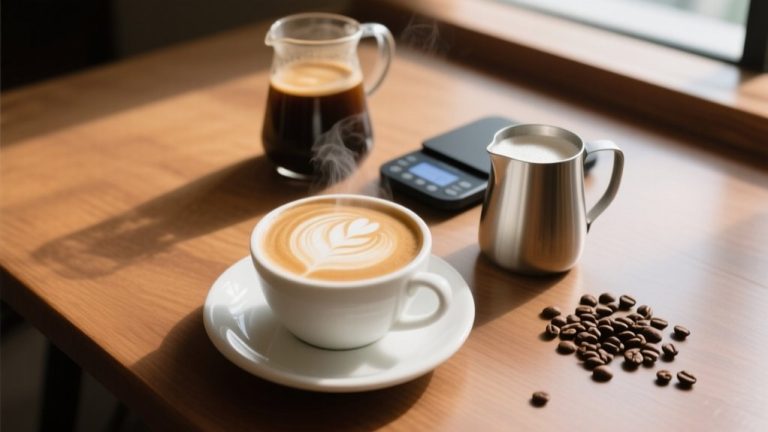
Measuring your coffee grounds to exactly 20 grams helps you pull about 40 grams of espresso, which you can track in real-time with a reliable scale like the Acaia Lunar.
It’s waterproof and designed specifically for espresso prep, making accuracy effortless.
Next, by weighing your milk in grams of liquid, you can maintain the ideal espresso-to-milk ratio, typically 1:12 for a standard latte.
This method eliminates guesswork and inconsistency, letting you replicate your favorite flavor and texture every single time.
Using a scale transforms latte-making into a precise science, elevating your craft with every cup.
Common Misconceptions About Espresso Shot Sizes And Strengths
Why do so many people get confused about espresso shot sizes and strengths? It mainly comes down to misunderstandings around espresso shot sizes and brew ratio.
Here are three key points to clarify:
- Espresso shot sizes aren’t fixed by volume; they vary depending on the coffee weight and brew ratio used.
- Double shots internationally can use different coffee amounts, typically 16-20 grams, not a single standard.
- Strength depends more on brew ratio than shot size. For example, a ristretto at a 1:1 ratio is stronger than a normale at 1:2.
Frequently Asked Questions
Can I Use Single-Origin Espresso for My Latte?
Yes, you can definitely use single-origin espresso for your latte. The origin impact plays a big role in shaping the espresso flavor, giving your latte unique fruity, floral, or even spicy notes depending on the beans.
Just remember, the pronounced flavor might mean you’ll want to adjust your milk volume to keep the balance just right.
Experimenting with different origins lets you tailor each latte to your taste perfectly.
How Does Water Temperature Affect Espresso Shots?
Water temperature directly influences your espresso extraction by controlling how flavors dissolve during brewing.
If the water’s too cool, under-extraction makes your shot taste sour or weak. Too hot, and you get bitterness from over-extraction.
Consistent water temperature, ideally between 90°C and 96°C, guarantees balanced flavors.
Don’t forget, water quality also plays a key role. Impurities can alter taste and interfere with proper extraction, so use clean, filtered water for the best espresso shots.
What Grind Size Is Best for Latte Espresso?
You’ll want a fine espresso grind for your latte espresso, similar to the texture of table salt. This grind size guarantees ideal extraction by controlling water flow during brewing methods like espresso machines.
Using a consistent grind helps balance flavor, avoiding under or over-extraction.
Remember, darker roasts might need a slightly coarser grind to prevent bitterness.
Investing in a burr grinder will keep your espresso grind uniform and your latte tasting great every time.
How Long Should I Steam Milk for a Latte?
You should steam your milk for about 30-40 seconds because who doesn’t want perfectly textured milk that’s not too hot to cause a meltdown?
Nail the steaming technique by aiming for 150-155°F to release that silky milk texture and natural sweetness.
Use a whirlpool motion to create smooth microfoam.
Can I Make a Latte With Decaf Espresso?
Yes, you can definitely make a latte with decaf espresso. Decaf options use the same brewing methods, so you’ll get similar flavor profiles to regular espresso, just without the caffeine.
Pay attention to your grind size and extraction time to guarantee the taste stays rich and balanced.
This way, your decaf latte will still have that smooth, bold character you expect from a classic latte, perfect any time of day.
Conclusion
Now that you know how many shots of espresso go into a standard latte, you can balance flavor, strength, and texture with confidence. You’ll measure shots by weight, dial in your brew, and adjust ratios to suit your taste.
You’ll experiment with shot sizes, refine your technique, and use a scale to perfect every cup. By mastering these elements, you’ll craft lattes that are bold, smooth, and utterly satisfying every single time.