How Much Caffeine In Mcdonalds Iced Coffee – Nutrition Facts Guide
You’ll find McDonald’s iced coffee caffeine ranges from about 133 mg in a small (12 oz) to up to 260 mg in a large (21-24 oz). Calorie counts rise with size and additions like cream or sugar but don’t affect caffeine levels.
Decaf choices offer just 10-15 mg caffeine, and customizations let you adjust sweetness and creaminess. If you want to understand ingredients, allergens, and how this fits your daily intake, there’s more useful info ahead.
How Much Caffeine Is in Each Size of McDonald’s Iced Coffee?
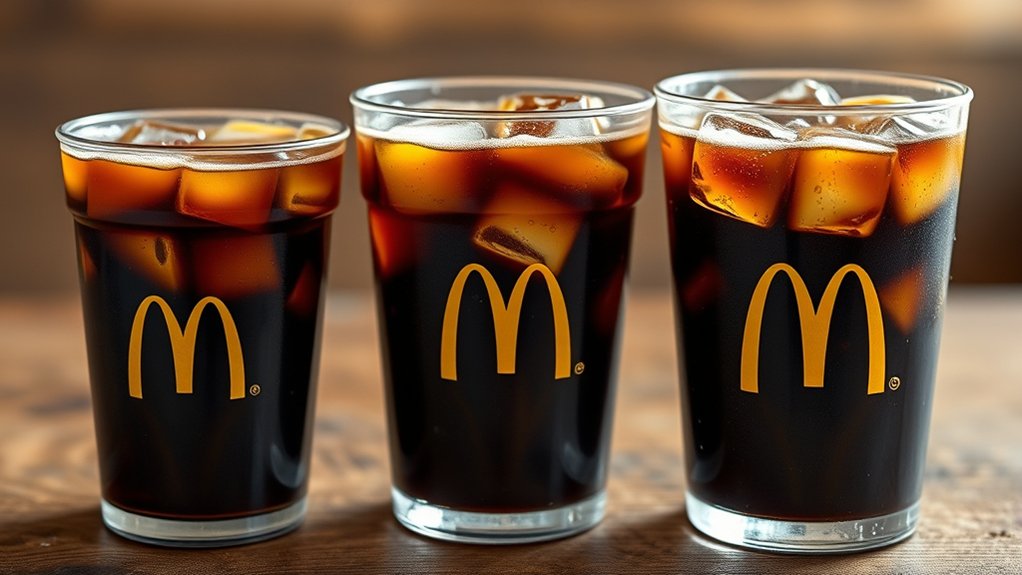
Although caffeine content can vary slightly by location and preparation, McDonald’s Iced Coffee offers a clear caffeine increase with each size. You get about 133 mg of caffeine in a small (12 oz), around 200 mg in a medium (16 oz), and between 235-260 mg in a large (21-24 oz).
McDonald’s Iced Coffee caffeine content rises clearly with size, from 133 mg in small to up to 260 mg in large.
This proportional rise means you can choose your caffeine boost precisely.
McDonald’s also spices up your experience with seasonal variations and unique flavor combinations, which might subtly influence preparation but don’t drastically alter caffeine levels.
Whether you prefer classic or seasonal flavors, understanding these caffeine amounts helps you customize your drink to fit your energy needs without surprises.
This transparency ensures you enjoy your iced coffee while managing caffeine intake effectively.
What Are the Calorie Counts for McDonald’s Iced Coffee Sizes?
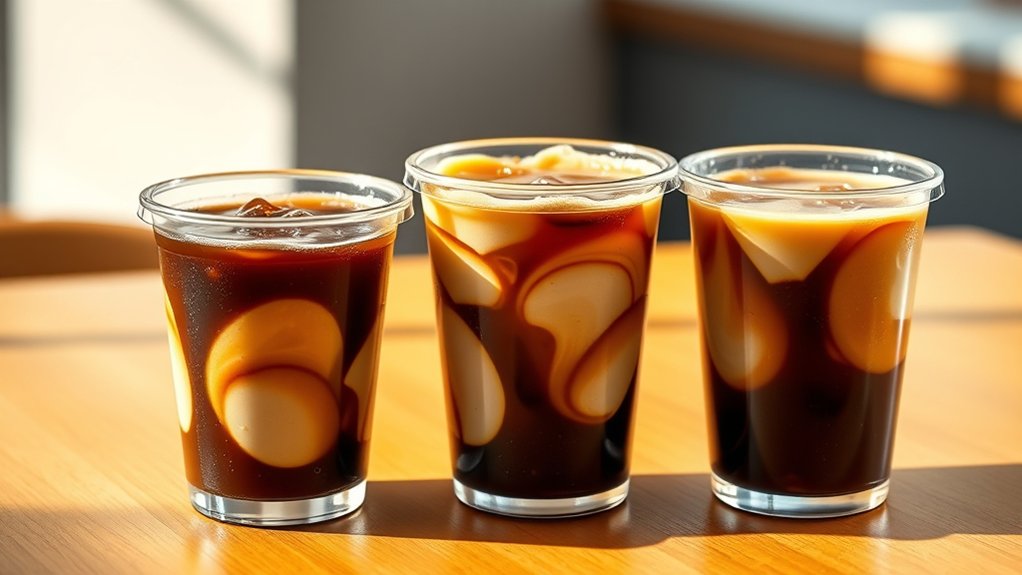
When you order a McDonald’s Iced Coffee, the calorie content goes up with each size, so you can manage your intake based on what you prefer. A small has about 140 calories, a medium around 180, and a large roughly 260 calories.
These numbers are based on standard ice levels; if you skip the ice, the calorie count might be a bit higher.
Keep in mind that regional differences in how they make the coffee and any customizations can change these calorie amounts. McDonald’s flavor options and seasonal drinks can also affect how many calories you’re getting.
So, it’s a good idea to check the nutritional info for the specific variety you want.
Which Ingredients Affect McDonald’s Iced Coffee Nutrition?
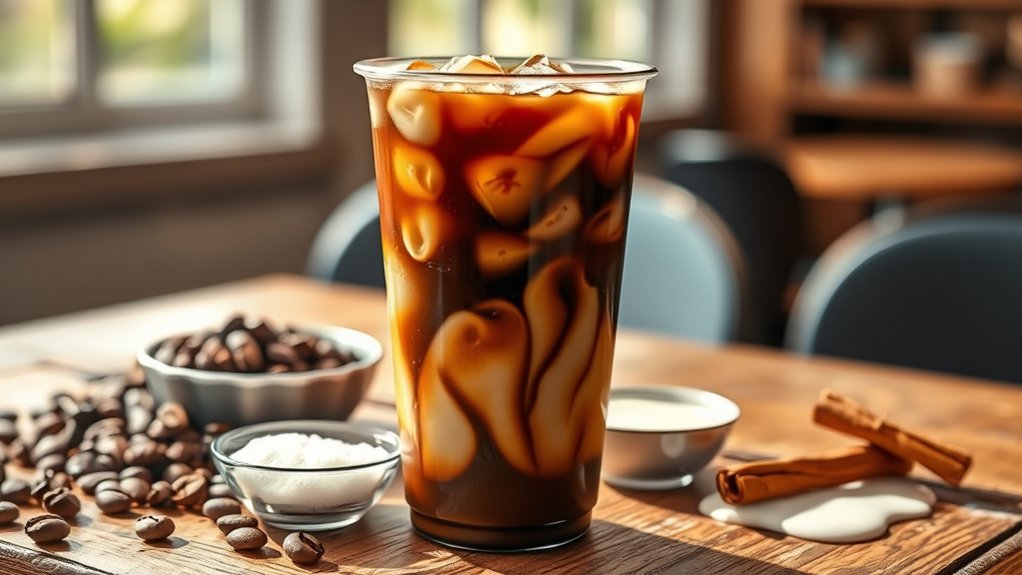
Since the caffeine in McDonald’s Iced Coffee comes solely from the brewed 100% Arabica coffee beans, ingredients like light cream, liquid sugar, or flavor syrups don’t affect its caffeine content.
Caffeine in McDonald’s Iced Coffee comes only from 100% Arabica coffee beans, unaffected by added ingredients.
What does impact nutrition, however, are the ingredient interactions involving these additions.
While cream and sugar won’t change caffeine levels, they do add calories and sugars, which alters the drink’s nutritional profile.
Coffee brewing plays a vital role since the type and amount of coffee used directly determine caffeine amounts in each size.
Customizing your order, such as choosing black or unsweetened iced coffee, keeps caffeine constant but reduces calories and sugar.
What Allergens Are in McDonald’s Iced Coffee and Related Products?
If you have allergies, it’s important to know that McDonald’s Iced Coffee contains milk and cream, which are common allergens found in the Light Cream ingredient. Dairy ingredient details reveal that milk proteins could trigger reactions in sensitive individuals.
Also, nut allergy concerns come up because McDonald’s prepares iced coffee in shared kitchens. This increases the risk of cross-contact with nuts and soy.
To stay safe, consider these points: McDonald’s lists nine major allergens, including dairy, nuts, soy, eggs, wheat, fish, shellfish, peanuts, and sesame. Milk and cream are the primary dairy allergens in iced coffee.
Cross-contact risks exist due to shared equipment.
Make sure to check McDonald’s official allergen information before ordering. Always review ingredient details and talk to your healthcare provider if you have food allergies.
How Do Cream and Sugar Affect McDonald’s Iced Coffee Calories?
Understanding the allergen content in McDonald’s Iced Coffee is important, but it’s equally helpful to know how cream and sugar impact the drink’s calorie count.
When you add cream and sugar, the calories rise considerably. For example, the black version has about 5 calories, but a small size with standard additions has roughly 150 calories.
Cream adds fat and calories, while liquid sugar contributes carbohydrates and extra calories. These flavor variations don’t affect caffeine content but do influence nutritional labeling, showing a higher calorie count.
If you opt for no cream and no sugar, the calorie count drops nearly to zero.
Keep in mind, the actual calorie increase depends on the amount of cream and sugar you choose to add. Typically, they add 100 to 140 calories per serving.
Can You Customize Sweetness and Cream Levels in McDonald’s Iced Coffee?
Although McDonald’s iced coffee comes with a default blend of liquid sugar and light cream, you can easily tailor the sweetness and cream levels to suit your taste or dietary needs. Sweetness customization and cream level adjustments are straightforward whether you order in-store, via kiosk, or through the mobile app.
McDonald’s iced coffee lets you easily customize sweetness and cream levels to fit your taste or dietary needs.
You can reduce or omit sugar and cream without impacting caffeine content, making it ideal for lower-calorie or specific diet plans. Plus, sugar-free syrup options, like Sugar-Free French Vanilla, provide flavorful alternatives.
- Request less or no liquid sugar
- Choose sugar-free syrup flavors
- Adjust or remove light cream entirely
- Personalize sweetness and cream levels on all ordering platforms
These options guarantee your iced coffee matches your preferences perfectly.
How Does McDonald’s Iced Coffee Compare to Starbucks and Dunkin’?
How does McDonald’s iced coffee stack up against popular competitors like Starbucks and Dunkin’? In terms of caffeine, a small McDonald’s iced coffee packs about 133 mg, which is pretty close to Starbucks’ Tall size at 135 mg. But it’s significantly less than Dunkin’s Small, which hits 196 mg.
Dunkin’ consistently offers higher caffeine levels, especially in larger sizes.
Flavor profiles differ too. McDonald’s iced coffee tends to deliver a balanced, approachable taste, while Starbucks often highlights richer, bolder notes with seasonal variations adding unique twists.
Dunkin’ focuses on a straightforward, robust flavor.
Seasonal variations at Starbucks and McDonald’s introduce variety, but Starbucks’ offerings tend to be more pronounced.
Does McDonald’s Offer Decaf or Low-Caffeine Iced Coffee Options?
You can order decaf iced coffee at McDonald’s, but keep in mind that availability might vary depending on the location.
If you’re looking to cut back on caffeine, just ask for a decaf or low-caffeine option. These usually have about 5-10 mg of caffeine, which is a lot less than the regular brew’s 130-145 mg.
Or, if you prefer, McDonald’s also has other drinks that naturally contain less or no caffeine at all.
Decaf Iced Coffee Availability
Where can you find decaffeinated iced coffee at McDonald’s? Decaf availability for iced coffee options is quite limited. McDonald’s doesn’t typically offer decaf iced coffee as a regular menu item.
While some locations may have decaf brewed coffee, it’s not consistently available for iced coffee preparation. The default iced coffee contains about 95-200 mg of caffeine, so it’s definitely caffeinated.
Here’s what you should know about decaf iced coffee at McDonald’s:
- Decaf iced coffee isn’t listed on the official McDonald’s menu.
- Some stores might brew decaf coffee on request.
- Decaf iced coffee availability varies by location.
- It’s best to ask staff if they can prepare iced coffee with decaf brewed coffee.
If you want decaf iced coffee, it’s a good idea to check with your local McDonald’s first.
Low-Caffeine Customizations
Although McDonald’s doesn’t offer decaffeinated or low-caffeine iced coffee options on their standard menu, you can still manage your caffeine intake through certain customizations.
Flavor variations mainly affect taste, but they don’t impact caffeine levels since the ingredient sourcing remains consistent across iced coffee options.
To reduce caffeine, you can opt for a smaller size or choose black iced coffee, which contains less caffeine than versions with cream or sweeteners.
Some locations occasionally offer specialty or seasonal drinks with reduced caffeine, but these aren’t standard menu items.
Keep in mind, customizing sugar levels won’t affect caffeine content.
Understanding these factors helps you better control your caffeine intake without compromising the flavor variations you enjoy from McDonald’s iced coffee.
Alternative Beverage Choices
Managing caffeine intake at McDonald’s doesn’t stop at size and preparation choices. You can also consider decaffeinated or low-caffeine iced coffee options. McDonald’s offers decaf iced coffee, though it may not be available at every location.
The decaf brew contains about 10-15 mg of caffeine, which is considerably less than the standard 95-200 mg, depending on size. Since decaf options aren’t always clearly marked, it’s best to ask staff directly.
You can also customize your beverage by selecting decaf or requesting no added coffee.
McDonald’s prioritizes ingredient sourcing and flavor variations to maintain a satisfying taste even in low-caffeine choices. So, don’t hesitate to explore these options if you’re looking to cut back on caffeine.
- Ask for decaf iced coffee availability
- Customize with decaf or no coffee
- Enjoy flavor variations with less caffeine
- Confirm ingredient sourcing for quality
How Does McDonald’s Iced Coffee Fit Into Your Daily Caffeine Intake?
Because caffeine affects everyone differently, understanding how McDonald’s Iced Coffee fits into your daily caffeine intake helps you make informed choices.
A small size contains about 95-110 mg of caffeine, which suits most adults well. The medium packs 130-145 mg, adding considerably to your daily total.
The largest size can reach 200 mg, which might be too much if you’re sensitive or pregnant.
When considering flavor variations, remember that caffeine content remains relatively stable. So, your choice won’t drastically affect your intake.
Also, caffeine timing matters. Avoid drinking large amounts late in the day to prevent sleep disruption.
What Preservatives and Additives Are in McDonald’s Iced Coffee?
You’ll find that McDonald’s Iced Coffee contains preservatives like potassium sorbate in the liquid sugar to keep it fresh.
The light cream has additives such as sodium phosphate, Datem, and carrageenan, which help stabilize and emulsify the mixture.
All these ingredients work together to maintain the coffee’s texture and shelf life.
Common Preservatives Used
Although McDonald’s Iced Coffee tastes fresh and smooth, it contains several preservatives and additives to maintain its quality. These packaging preservatives help extend shelf life and preserve flavor, ensuring you get a consistent taste every time.
Potassium sorbate is a key preservative used to prevent microbial growth.
Alongside that, flavor enhancers and stabilizers improve texture and maintain product stability. Common preservatives include potassium sorbate, which extends shelf life, sodium citrate to enhance texture, magnesium oxide to stabilize the product, and carrageenan to maintain consistency.
These ingredients are standard in many coffee beverages. They make sure the iced coffee stays fresh from production to your cup without compromising taste or quality.
Additives In Light Cream
When you enjoy McDonald’s Iced Coffee, the light cream added contains several additives that enhance its quality and stability. This cream includes stabilizers and emulsifiers like sodium phosphate, sodium stearoyl lactylate, and DATEM, which improve texture and consistency.
Carrageenan, derived from seaweed, acts as a thickening agent.
Preservatives such as magnesium oxide and sodium citrate help maintain freshness and prevent spoilage. Being aware of ingredient sourcing is important, especially since these additives come from both natural and synthetic origins.
If you’re concerned about additive health, note that these components are widely used in the food industry to guarantee product stability and shelf life.
However, those with dairy sensitivities should be cautious, as the cream contains milk-based ingredients.
Liquid Sugar Ingredients
Beyond the light cream, another key component that shapes McDonald’s Iced Coffee flavor is the liquid sugar. This syrup combines liquid sweeteners and additives designed for both taste and preservation.
The liquid sugar contains sugar, water, vegetable glycerin, fructose, and potassium sorbate.
Potassium sorbate plays an essential role by providing preservative effects that prevent mold and yeast growth, which helps extend the shelf life.
Vegetable glycerin adds viscosity and helps retain moisture, ensuring the syrup’s smooth texture.
Together, these ingredients create a consistent, sweet syrup that maintains stability and freshness in your iced coffee.
Key components in McDonald’s liquid sugar include:
- Sugar and fructose as primary liquid sweeteners
- Water creating a syrup base
- Vegetable glycerin for texture and moisture retention
- Potassium sorbate for preservative effects
Which Ingredients Enhance the Texture and Flavor of McDonald’s Iced Coffee?
Because McDonald’s Iced Coffee relies on a carefully balanced combination of ingredients, you get a smooth and flavorful drink every time. Key to this flavor enhancement and texture improvement is Light Cream, which contains stabilizers like carrageenan and emulsifiers such as sodium stearoyl lactylate. These ingredients guarantee the coffee has a creamy, consistent texture.
Additionally, liquid sugar adds sweetness and moisture, boosting the overall flavor profile and mouthfeel.
Other components like sodium citrate and magnesium oxide help stabilize the beverage, keeping its creamy texture intact during storage and serving. Sodium phosphate and Datem also act as emulsifiers, preventing separation and blending the cream smoothly with coffee.
Together, these ingredients create the rich, creamy experience that defines McDonald’s Iced Coffee. It’s this careful mix that makes every sip just right.
How Does McDonald’s Iced Coffee Caffeine Compare to Hot Coffee and Frappés?
Although McDonald’s iced coffee offers a refreshing twist on a classic beverage, it also packs a pretty solid caffeine punch compared to their hot coffee and Frappés. The flavor differences and brewing methods play a big role in this. Iced coffee is often brewed stronger to keep its taste when chilled.
Here’s how the caffeine content compares:
- Small hot coffee (12 oz): about 100 mg caffeine
- Small iced coffee (12 oz): slightly less or about the same caffeine
- Larger iced coffee sizes: can have up to 200 mg caffeine, almost double the hot coffee
- Frappés (12 oz): 75–100 mg caffeine, less than iced coffee
So, if you’re looking for a stronger caffeine kick, McDonald’s iced coffee is the way to go.
But if you want something milder, hot coffee and Frappés offer different flavors and a gentler boost.
Frequently Asked Questions
What Is the Best Time of Day to Drink Mcdonald’s Iced Coffee?
The best time for ideal consumption of McDonald’s Iced Coffee is in the morning. You’ll get a morning boost that enhances alertness without risking sleep disruption later in the day.
Just make sure you avoid drinking it too late. That way, you can enjoy the energy lift without messing up your sleep schedule. It’s a simple tip that makes a big difference!
How Long Does Mcdonald’s Iced Coffee Stay Fresh After Purchase?
You can’t let McDonald’s iced coffee linger forever. Coffee preservation is key! For the best freshness, drink it within 24 hours.
If you need to keep it longer, store it sealed in the fridge for up to 48 hours. After that, the flavor and texture start to suffer. So, it’s really best to enjoy it sooner rather than later!
Are There Any Seasonal Mcdonald’s Iced Coffee Flavors Available?
Yes, McDonald’s offers limited edition seasonal flavors for their iced coffee, usually in fall or winter. You’ll find options like pumpkin or holiday spice, which include added syrups. But availability varies by location and year.
Can Mcdonald’s Iced Coffee Be Used as a Mixer in Cocktails?
Looking to boost your coffee cocktails? McDonald’s Iced Coffee works great as a mixer, adding rich flavor enhancement and a creamy, sweet touch.
You’ll enjoy the energizing kick it brings to your drinks, too! It’s an easy way to make your cocktails more exciting and flavorful. Give it a try and see how it changes up your usual recipe!
What Is the Environmental Impact of Mcdonald’s Iced Coffee Packaging?
You should know McDonald’s iced coffee packaging creates significant packaging waste due to plastic-lined cups that limit recyclable materials use.
Though they’re improving sustainability, the current impact still contributes to landfill buildup and environmental strain. It’s a step in the right direction, but there’s definitely more work to be done to reduce the footprint.
Conclusion
You might be surprised to learn that a large McDonald’s Iced Coffee packs about 165 mg of caffeine, which is almost half the daily recommended limit for most adults. This means you can enjoy a revitalizing boost without overdoing it.
By understanding the caffeine content and how cream and sugar add calories, you can make smarter choices that fit your lifestyle. Staying informed helps you enjoy your coffee while managing your daily intake effectively.