What Is A Coffee Pour Over – Complete Brewing Guide
A coffee pour-over is a manual brewing method where you carefully pour hot water over coffee grounds, controlling flow, temperature (195°F to 205°F), and extraction time (around 3 to 4 minutes) to reveal nuanced flavors.
You’ll use specific gear like a gooseneck kettle, precise scales, and filters, adjusting grind size and ratios (1:14 to 1:20) for balance. Pre-wetting grounds and timing bloom phases optimize extraction.
Understanding these steps lets you refine your technique and elevate your coffee experience.
What Is Pour-Over Coffee and Why Try It?
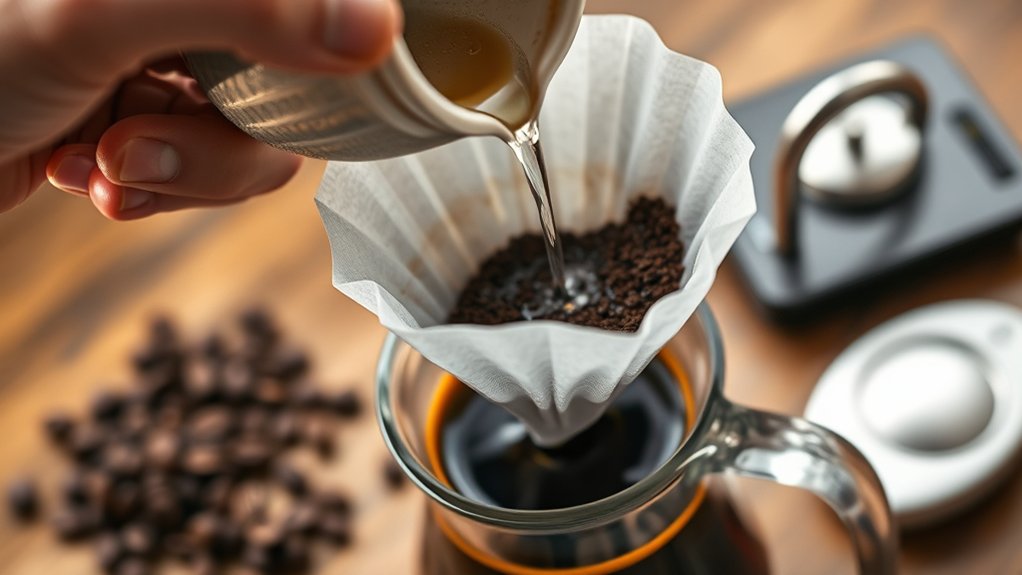
What makes pour-over coffee distinct is the manual process of pouring hot water over coffee grounds, giving you precise control over factors like water flow, temperature, and extraction time. This control lets you tailor the brewing variables to extract the ideal flavor profile from your coffee.
Pour-over coffee minimizes waste by allowing you to brew fresh servings without relying on machines, making it a preferred method for quality-focused enthusiasts. Devices like the Hario V60, Chemex, and Kalita Wave each impart unique characteristics, enhancing clarity and consistency in your cup.
Using a coffee-to-water ratio between 1:14 and 1:20, with 1:17 as a balanced starting point, and aiming for a brew time of 3 to 4 minutes, you can fine-tune your technique for precise, personalized results.
Essential Gear: Brewers, Filters, Scales, and Timers
Three essential tools form the foundation of precise pour-over brewing: the brewer, the filter, and the scale. Popular brewers like the Hario V60, Chemex, and Kalita Wave each influence extraction dynamics through their unique design.
Using high-quality paper or metal filters is critical to prevent sediment and guarantee clarity in your cup. You’ll want to preheat your brewer and rinse the filter with hot water to maintain temperature stability and eliminate any papery flavors.
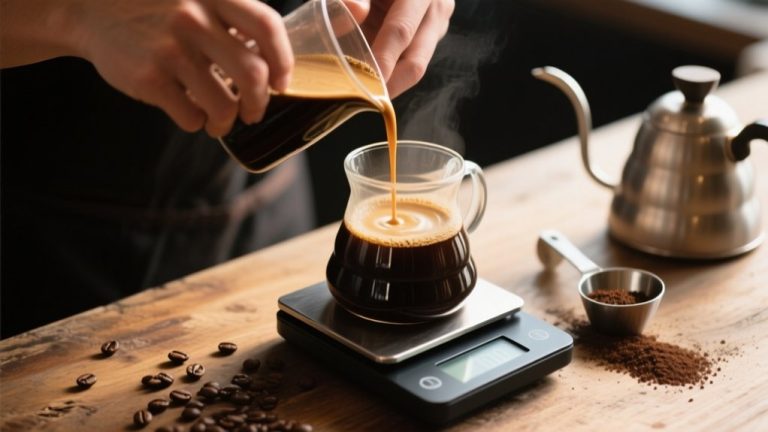
A digital scale lets you measure coffee and water accurately, adhering to a coffee-to-water ratio between 1:14 and 1:20 for consistency.
Finally, a timer tracks your brew time, ideally between 2:45 and 4 minutes, to optimize flavor extraction and avoid under- or over-extraction.
How to Choose the Right Pour-Over Brewer for You
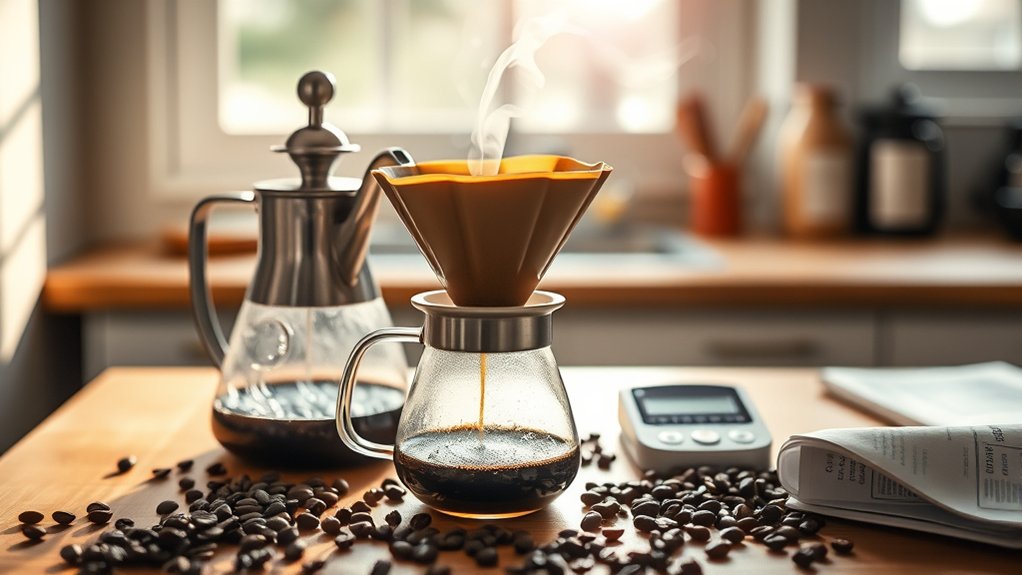
How do you select the perfect pour-over brewer to match your brewing style and taste preferences? Start by evaluating brewer types. Flat-bottomed brewers like the Kalita Wave deliver consistent extraction, which is ideal for ease of use.
Meanwhile, conical brewers such as the Hario V60 and Chemex emphasize flavor clarity and complexity.
Next, consider materials. Glass and ceramic models retain heat better and offer visual appeal. On the other hand, plastic brewers provide durability and affordability.
Think about your brewing capacity needs as well. Chemex suits larger batches, perfect for sharing, while smaller brewers handle single servings efficiently.
If you’re new to pour-over, a straightforward design like the Melitta can simplify technique without sacrificing taste.
Ultimately, experiment with different brewer types to find which accentuates your preferred coffee flavor profiles and aroma nuances.
Why You Need a Gooseneck Kettle for Pour-Over Coffee
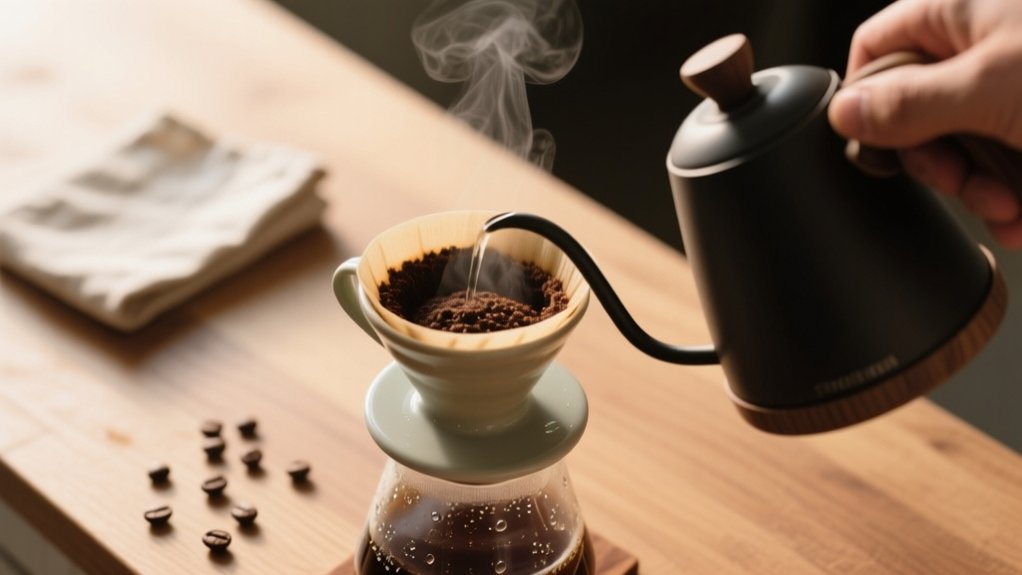
Choosing the right pour-over brewer sets the foundation, but controlling water flow during brewing refines the extraction process. A gooseneck kettle, with its long, narrow spout, gives you precise control over water flow and direction, which is vital for even extraction.
Precise water flow control with a gooseneck kettle is key to achieving even extraction in pour-over brewing.
You can pour in a deliberate circular motion, saturating coffee grounds uniformly and avoiding uneven extraction that compromises flavor clarity.
Most gooseneck kettles maintain consistent water temperature between 195°F and 205°F, which is essential for ideal brewing. Many models feature built-in temperature controls, letting you tailor heat for different coffee types.
By timing your pours accurately, dividing into blooming and final stages, you enhance brew consistency and taste.
Using a gooseneck kettle is indispensable for mastering the pour-over technique with precision and repeatability.
How to Grind Coffee for the Perfect Pour-Over
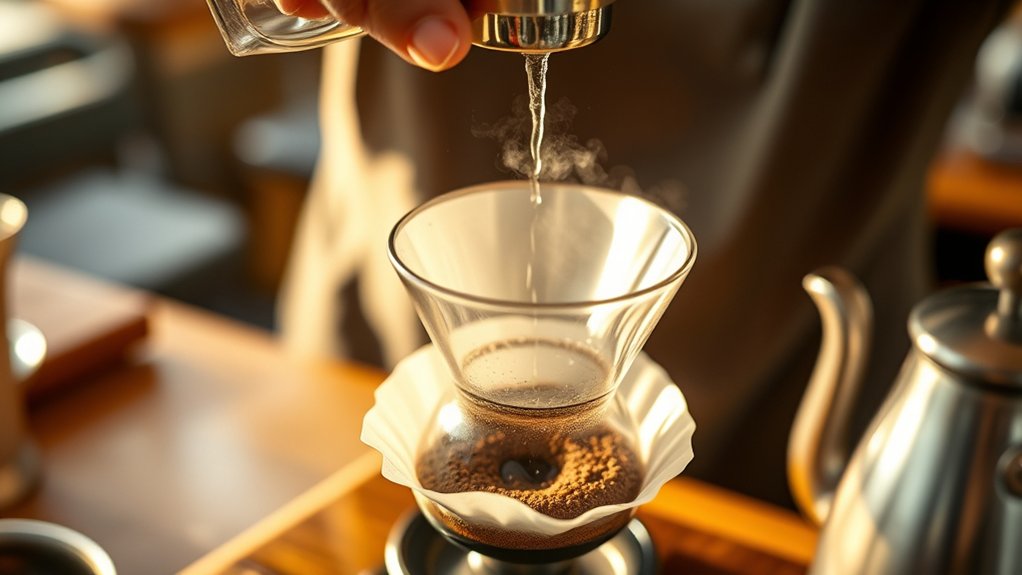
Why does grind size matter so much in pour-over brewing? Because it directly impacts extraction rate and flavor balance.
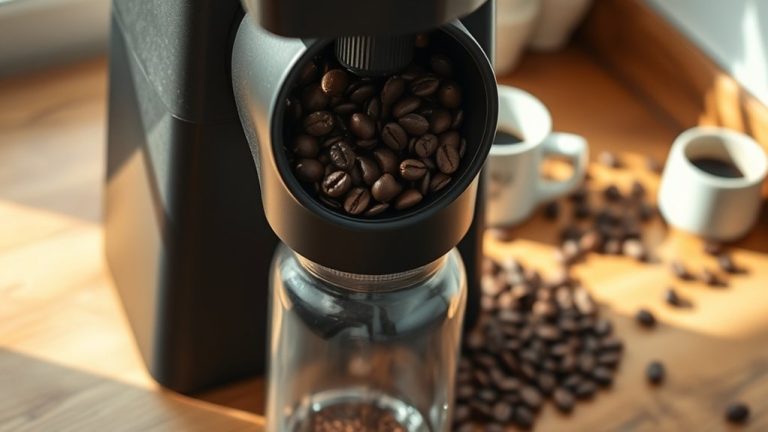
For a perfect pour-over, grind coffee to a medium or medium-fine consistency using a quality burr grinder. This guarantees uniform particle size, preventing uneven extraction.
Finer grinds speed up extraction, risking bitterness, while coarser grinds slow it down, possibly causing sourness.
Start with 20 grams of coffee ground to medium-fine, paired with 300-320 grams of water at a 1:16 ratio.
Adjust grind size based on taste: if your coffee tastes sour, grind finer; if bitter, coarser.
Precise control over grind coffee size lets you dial in a balanced, nuanced cup every time.
Step-by-Step Guide to Brewing Pour-Over Coffee
Now that you’ve dialed in the grind size for balanced extraction, it’s time to focus on the brewing process itself.
Start by preheating your pour-over coffee device and rinsing the filter with hot water to eliminate papery flavors. Discard the rinse water.
Weigh 20g of medium-fine ground coffee and distribute it evenly in the filter for uniform extraction.
Begin brewing by pouring 60g of water to bloom the grounds for 45 seconds. This releases trapped gases and enhances flavor.
Then, pour an additional 260g in two circular motions, 130g each, over 2 to 3 minutes.
When dripping slows, remove the filter and grounds.
Let your pour-over coffee rest briefly before serving to fully develop its nuanced profile.
Should You Rinse Your Pour-Over Filter?
How does rinsing your pour-over filter impact the final cup? Rinsing the filter removes residual paper fibers that cause a papery taste, ensuring a cleaner, purer coffee flavor.
For devices like the Chemex and V60, it’s essential to rinse with hot water before adding grounds. This step also preheats the brewer and server, stabilizing the brewing temperature and promoting ideal extraction.
Use the same water you plan to brew with to maintain temperature consistency throughout the process. Skipping rinsing the filter risks introducing undesirable flavors and aromas that detract from the overall experience.
How to Adjust Brew Time and Grind Size for Better Flavor
Although adjusting grind size and brew time may seem subtle, these factors critically influence your pour-over’s flavor extraction. You’ll want to maintain a brew time between 3 to 4 minutes for ideal balance.
If your brew time dips below 2 minutes, your grind is likely too coarse, producing under-extracted coffee. Conversely, a brew time exceeding 5 minutes suggests an overly fine grind, risking over-extraction and bitterness.
Follow this numeric guide to refine your brew:
- Start with a medium to medium-fine grind to promote balanced extraction.
- Adjust grind size incrementally to target a brew time of 2:45 to 3:30 minutes.
- Use a water-to-coffee ratio of 1:14 to 1:20, modifying grind size and brew time for desired taste intensity.
Precision in these variables guarantees a cleaner, richer cup.
Tips for Serving and Tasting Your Pour-Over Coffee
When you serve your pour-over coffee, try to use a pre-warmed cup or carafe. This helps keep the coffee at the perfect temperature, which means those delicate aromas and flavors stay just right.
After brewing, it’s a good idea to let the coffee rest for a little bit. This pause lets the flavors settle and really come together, so you get a better sense of what the coffee has to offer.
When it’s time to taste, start with the coffee on its own—no cream or sugar. Try sipping it at different temperatures, too. This way, you can pick up on the unique flavor notes that each bean brings out.
It’s all about paying attention and enjoying the subtle differences in every cup.
Serving Temperature Tips
Why does serving temperature matter when enjoying your pour-over coffee? Serving temperature directly impacts flavor perception and mouthfeel, affecting your overall experience.
For ideal enjoyment, aim for a serving temperature between 130°F and 160°F.
Here’s how to manage it precisely:
- Let the coffee cool slightly after brewing. This allows delicate flavor notes to emerge, which high temperatures can mask.
- Pre-warm your mug with hot water. This helps maintain the serving temperature longer, preventing rapid cooling.
- Taste your coffee without additives initially. Sugar or cream can alter the perceived temperature and flavor balance, masking the coffee’s true characteristics.
Tasting Flavor Notes
When tasting your pour-over coffee, start by inhaling its aroma deeply. This initial sensory input reveals intricate flavor notes that enhance your overall experience.
Focus on the coffee’s acidity; a balanced brightness without excessive sourness indicates proper extraction, often achieved by adjusting grind size.
Next, slurp gently to aerate the coffee across your palate. This helps you identify distinct flavor nuances like fruity, nutty, or chocolaty.
Serving your pour-over at 140-160°F prevents heat from masking subtle profiles and allows clearer detection of these nuances.
Keep a tasting journal to document your impressions and preferences. This lets you refine your technique and select beans that align with your desired flavor profile.
This methodical approach sharpens your skill in appreciating pour-over coffee’s complex tasting flavor notes.
How to Experiment and Improve Your Pour-Over Technique
A systematic approach to experimenting with your pour-over technique can considerably enhance the flavor and consistency of your coffee. Start by adjusting key variables with precision:
- Grind Size & Coffee-to-Water Ratio: Use a finer grind to intensify extraction and reduce sourness; coarser grounds can minimize bitterness. Experiment within a 1:14 to 1:20 ratio, with 1:16 as a balanced baseline.
- Water Temperature: Modify between 195°F and 210°F according to roast level. Higher temps improve extraction for lighter roasts, while darker roasts often require lower temperatures to avoid over-extraction.
- Pouring Technique & Agitation: Employ circular pouring or gentle agitation to promote even extraction and flavor complexity.
Maintain a brewing journal to log these adjustments, enabling you to systematically refine your process and achieve your ideal pour-over profile.
Frequently Asked Questions
Can I Use Tap Water for Pour-Over Coffee?
You can use tap water for pour-over coffee, but its quality matters greatly.
Water quality impacts extraction and flavor, so make certain your tap water is free from chlorine, heavy metals, and off-flavors.
If your tap water tastes or smells odd, consider filtering it to improve purity and consistency.
Using clean, neutral water with balanced mineral content will help you achieve the best extraction and a well-balanced, flavorful cup every time.
How Do Altitude and Water Temperature Affect Brewing?
Altitude affects brewing variables by lowering water’s boiling point. This means you’ll need higher water temperatures or longer brew times to extract flavors properly.
Water temperature is essential; too hot, and you risk over-extraction. Too cold, and under-extraction happens. You should precisely control temperature between 195°F and 205°F, adjusting for altitude.
These variables directly influence extraction rate, flavor balance, and overall coffee quality in your pour-over process.
What Is the Ideal Coffee-To-Water Ratio for Pour-Over?
Think of the coffee-to-water ratio as the blueprint for your flavor masterpiece.
For precise brewing techniques, use a 1:16 ratio, which means one gram of coffee to sixteen grams of water. This balance extracts ideal solubles, ensuring clarity and brightness.
Adjust slightly between 1:15 and 1:17 depending on roast and grind size, but 1:16 remains the gold standard.
Measuring accurately with a scale guarantees consistent, repeatable results every pour-over you brew.
How Do I Clean and Maintain My Pour-Over Equipment?
You clean your pour-over equipment by rinsing all parts with hot water immediately after use to prevent residue buildup.
For thorough equipment care, disassemble the dripper and wash with mild detergent weekly. Scrub gently with a soft brush to avoid scratches.
Regularly descale using a vinegar solution or specialized cleaner to remove mineral deposits.
Dry all components completely before reassembling to maintain peak performance and extend your equipment’s lifespan.
Can Pour-Over Coffee Be Made With Flavored or Decaf Beans?
Yes, you can make pour-over coffee with flavored or decaf beans.
Keep in mind that the pour-over method highlights subtle nuances in flavor profiles, so flavored beans may release added essences more intensely.
Decaf beans often have a milder, less complex profile, but pour-over brewing can enhance their clarity and brightness.
Adjust grind size and water temperature precisely to optimize extraction, ensuring you preserve the desired flavor profiles of your chosen beans.
Conclusion
Don’t worry if pour-over coffee seems complicated at first. It’s actually more manageable than it looks. With the right gear and precise control over grind size, water temperature, and brew time, you can consistently craft a cup tailored to your taste.
This method reveals nuanced flavors often missed by other brews. Give it a try, adjust your technique as you go, and you’ll soon appreciate the precision and quality that make pour-over coffee worth the effort.