How Many Tablespoons Coffee For 8 Cups – Coffee Ratio Guide
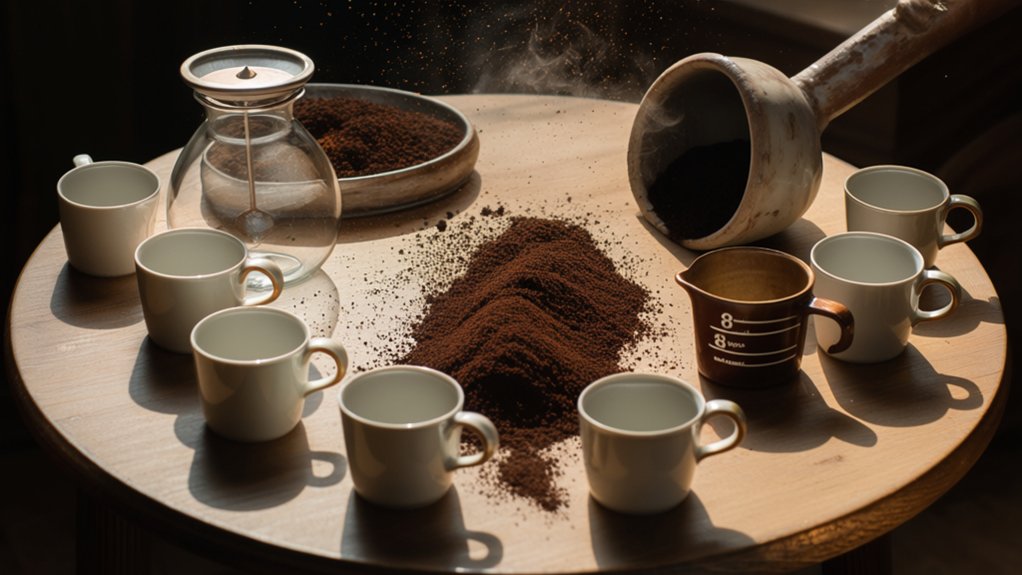
For 8 cups of coffee, you’ll typically use 8 to 16 tablespoons of grounds, depending on how strong you like your brew. The standard ratio is 2 tablespoons per 6 ounces, totaling 16 tablespoons for 8 cups, while a milder cup calls for 1 tablespoon per 6 ounces (8 tablespoons).
Measuring by weight offers precision, but tablespoons work fine if you’re consistent. Adjust gradually to find your perfect strength, and understanding grind size and brewing methods will further enhance your coffee experience.
How Much Coffee Grounds for 8 Cups
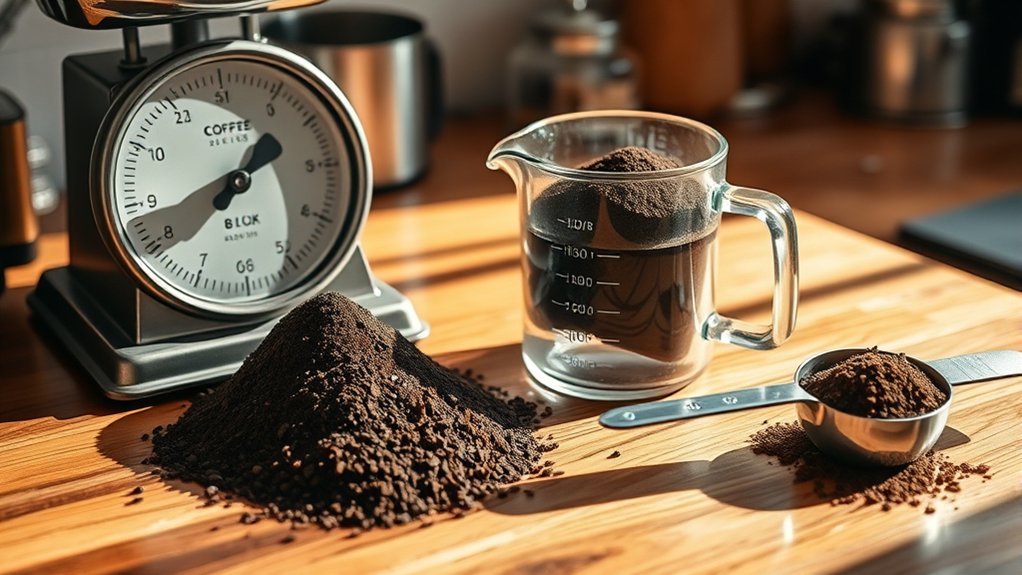
When brewing 8 cups of coffee, which is about 48 ounces of water, you’ll want to use between 8 and 16 tablespoons of coffee grounds depending on how strong you like it.
The standard recommendation is 2 tablespoons of coffee grounds per 6 ounces of water, which equals 16 tablespoons for 48 ounces.
If you prefer a milder flavor, reduce this to 1 tablespoon per 6 ounces, totaling 8 tablespoons for 8 cups.
It’s crucial to measure coffee accurately to maintain consistency and control the coffee-to-water ratio.
Adjusting this ratio directly affects the flavor of your brew, so experiment within this range to find your ideal strength.
Using tablespoons as your measurement tool helps guarantee repeatable, precise results every time you brew.
Picking the Best Coffee-to-Water Ratio
Finding the right coffee-to-water ratio is key to brewing a cup that suits your taste perfectly. The ideal ratio depends on your brew method and desired strength and flavor.
For drip coffee, a 1:16 coffee-to-water ratio works well, translating to 12–16 tablespoons for 8 cups. If you prefer a milder cup, use fewer tablespoons; for stronger coffee, increase them.
Different methods like the French press often call for a 1:15 ratio to enhance flavor extraction.
- Use 1 tablespoon per 6 ounces for a mild brew (8 tablespoons for 8 cups)
- Double that for a stronger brew (16 tablespoons)
- Adjust based on your preferred strength and brew method
- Consistency is key for perfect coffee. Experiment to find your ideal ratio.
Measuring Coffee: Tablespoons vs. Grams
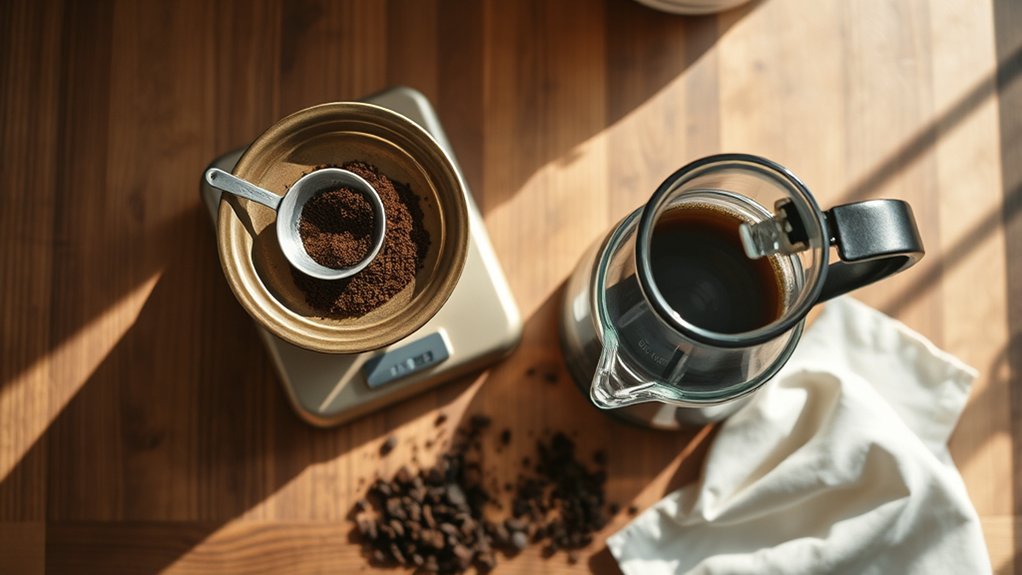
Two common ways to measure coffee for your brew are tablespoons and grams, each offering distinct advantages. Using tablespoons is convenient. One tablespoon roughly equals 5 grams of coffee, which makes it practical for home brewing, especially when following a coffee-to-water ratio for an 8-cup pot.
For example, 8 to 16 tablespoons suit different strengths across 48 ounces of water. However, grams of coffee measured with a digital scale provide precision that’s essential for replicating exact ratios like 1:17.
Your brewing method influences which measurement works best. Tablespoons allow quick tweaks, while grams guarantee consistency.
Whichever you choose, stick to one method for measuring coffee to maintain the flavor profile you want. This balance between convenience and accuracy helps you brew the perfect cup every time.
How to Adjust Coffee Strength to Your Taste
You can easily adjust your coffee’s strength by tweaking the amount of grounds you use. For a strong brew, start with 16 tablespoons. If you prefer something milder, try 8 tablespoons instead.
From there, just add or subtract one tablespoon at a time until you find the perfect balance that suits your taste.
Keep in mind, grind size and brewing method also play a big role in the flavor, so feel free to personalize your ratios accordingly.
Strength Variation Tips
Although the standard coffee-to-water ratio of 1:16 provides a balanced cup, adjusting the amount of coffee grounds per 6 ounces of water allows you to tailor the strength to your preference.
Start with the standard ratio, 1 tablespoon of coffee per 6 ounces for a milder brew, and experiment by increasing or decreasing grounds to match your personal preferences.
Remember, the coffee-to-water ratio is your key to consistency and control.
- Use 1 tablespoon of coffee per 6 ounces for a lighter, smoother cup.
- Increase to 2 tablespoons per 6 ounces for a stronger, bolder flavor.
- Experiment with grind size and extraction time to refine strength.
- Adjust gradually to find the perfect tablespoons of coffee per your taste without overcomplicating your routine.
Personalizing Coffee Ratios
When tailoring your coffee strength, adjusting the coffee-to-water ratio is essential to match your taste preferences. For brewing 8 cups (48 ounces), start with a baseline of 16 tablespoons for a robust flavor or 8 tablespoons for a lighter brew.
Personalizing your coffee ratio means experimenting within this range. Add a tablespoon or two if you want a bolder taste, or reduce it for a milder cup. Each adjustment directly influences the coffee’s flavor intensity, so make changes gradually.
Keep track of the amounts you use and how they affect your cup. By fine-tuning your coffee ratio, you guarantee every brew suits your unique palate perfectly, enhancing your overall coffee experience with consistent, satisfying results.
How Brewing Methods Affect Coffee Grounds and Flavor
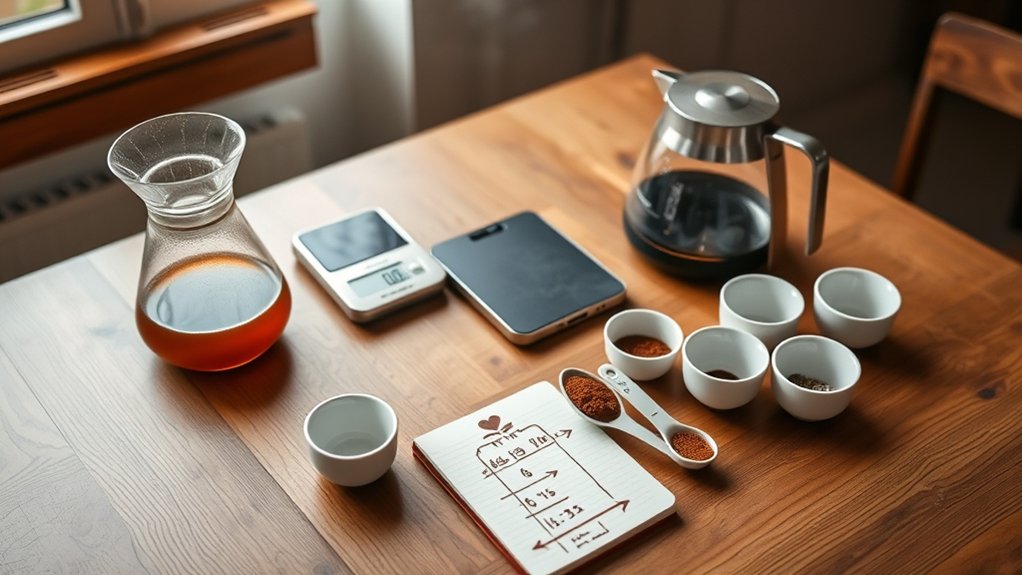
Since brewing methods vary widely, understanding how they affect coffee grounds and flavor is essential for crafting the perfect cup. Each brew method demands a specific grind size and coffee-to-water ratio to optimize extraction and taste.
For example, a French press uses a coarse grind and a stronger ratio (1:15), enhancing richness, while drip coffee makers prefer a medium grind and a balanced 1:17 ratio for smoothness. The contact time between grounds and water also shapes flavor profiles.
French press uses coarse grind and 1:15 ratio for richness; drip brews prefer medium grind and 1:17 for smoothness.
French press retains oils, offering a fuller body through immersion. Drip methods filter oils, delivering cleaner flavors. Pour-over emphasizes clarity with precise grind size control.
Adjust ratios depending on your chosen brew method for best results.
Common Measurement Mistakes for 8 Cups
You might be overestimating the amount of coffee needed for 8 cups, which can lead to bitterness or waste. It’s a common mistake, but easy to fix once you get a feel for the right amount.
Also, don’t overlook grind size. Ignoring it can really affect extraction and flavor, so make sure you match the grind to your brewing method.
And remember, always use accurate measurements. This helps keep things consistent and gets you closer to that perfect balance every time.
Overestimating Coffee Amounts
Although aiming for a strong brew might seem tempting, using 2 tablespoons of coffee per 6 ounces without adjusting for 8 cups (48 ounces) often leads to an overpowering, bitter taste. Overestimating coffee amounts disrupts the ideal coffee-to-water ratio, causing excessive extraction of bitter compounds.
For 8 cups, 16 tablespoons usually suffice, but personal preference may call for as little as 8 tablespoons.
To avoid such pitfalls in the coffee-making process, keep these tips in mind:
Stick to the recommended coffee-to-water ratio of 1:16 for balanced flavor.
Measure tablespoons per cup carefully; don’t rely solely on scoops.
Adjust the amount of coffee based on your taste preference.
Avoid adding too many grounds to prevent bitterness and harshness.
Precise measurement guarantees a smooth, enjoyable cup every time.
Ignoring Grind Size
When grind size doesn’t match your brewing method, your coffee’s flavor can suffer considerably. Using a medium grind is typically best for drip coffee makers, but coarser or finer grinds suit other methods like French press or espresso.
Ignoring grind size disrupts ideal extraction, causing over-extraction that yields bitterness or under-extraction that results in weak flavor. A consistent grind size guarantees uniform extraction, preventing uneven bitterness or thinness.
Achieving this consistency is easier with a burr grinder, which produces uniform particles compared to uneven blade grinders.
Pairing the right grind size with the correct coffee-to-water ratio is vital for balancing strength and flavor.
Don’t overlook grind size when measuring coffee; it’s important to master both grind and ratio to brew a perfect pot of 8 cups.
Skipping Accurate Measurements
Accurate measurements play an essential role in brewing a perfect pot of 8 cups of coffee. Skipping them often leads to bitter or weak coffee due to an imbalanced coffee-to-water ratio.
For 48 ounces, you need 8 to 16 tablespoons depending on strength preference.
Don’t rely just on a coffee scoop or visual estimates. They can cause inconsistency. Instead, use a digital scale to measure precisely, knowing that one tablespoon equals about 5 grams.
Avoid these common mistakes:
- Guessing quantities with a coffee scoop
- Ignoring the standard 2 tablespoons per 6 ounces for a stronger cup
- Overlooking the importance of the coffee-to-water ratio
- Skipping the digital scale and using volume measures only
Accurate measurements guarantee consistent, flavorful coffee every time.
Easy Tips to Perfect Your Coffee Brew
Mastering your coffee brew starts with understanding the right coffee-to-water ratio and maintaining consistency in your measurements. For 8 cups, which equals 48 ounces, use between 8 and 16 tablespoons of coffee grounds, adjusting for your taste preferences.
Remember, a standard cup of coffee is 6 ounces, so 1 tablespoon per cup yields a milder brew, while 2 tablespoons create a stronger one. Measure precisely, either with a tablespoon or a digital scale, to avoid bitterness from over-extraction.
A standard 6-ounce cup uses 1 tablespoon for mild or 2 for strong—measure carefully to prevent bitterness.
Use a 1:16 coffee-to-water ratio, meaning 1 gram of coffee for every 16 grams of water. Freshly grind your beans before brewing, as this greatly enhances flavor.
Finally, experiment with your coffee maker and brewing methods like drip or French press to find the perfect extraction that suits your palate.
Frequently Asked Questions
Can I Use Pre-Ground Coffee for 8 Cups?
Yes, you can use pre-ground coffee for 8 cups, but keep in mind the coffee grind affects your flavor profile.
Choose a grind size that suits your brewing method. Medium for drip machines works best.
For measuring accuracy, use 8 to 16 tablespoons depending on strength preference.
To maintain freshness, store your pre-ground coffee in an airtight container and avoid exposure to air and moisture.
Freshly ground beans still deliver the best flavor.
How Long Should I Brew 8 Cups of Coffee?
Think of brewing time as the conductor guiding an orchestra. Too short, and the flavor profile feels incomplete. Too long, and the coffee turns bitter.
For 8 cups, your brewing time depends on the brewing method and grind size. Drip coffee needs about 5 minutes, while French press requires 4 to 5 minutes. Cold brew takes 12 to 24 hours.
Adjust brewing time to balance coffee strength and reveal the best flavor profile.
What Is the Best Water Temperature for Brewing 8 Cups?
The ideal brewing temperature for 8 cups is between 195°F and 205°F. This range guarantees the best coffee extraction time, balancing flavor without bitterness or sourness.
Water quality impacts the taste considerably, so use clean, filtered water.
Remember, brewing method differences affect how temperature influences flavor profile. Drip machines may retain heat better than pour-over.
Always preheat your equipment to maintain this ideal brewing temperature for consistent, rich coffee.
Does Altitude Affect Coffee Brewing for 8 Cups?
Yes, brewing altitude affects coffee extraction when making 8 cups.
At higher altitudes, lower water pressure reduces boiling temperature, which changes extraction dynamics and can extend brewing time. This impacts your coffee’s flavor profile, often making it milder.
To compensate, you might need to adjust brewing time or increase coffee grounds slightly.
Understanding these factors helps you tailor your brew for richer, balanced flavor despite altitude challenges.
How to Store Coffee Grounds for Freshness After Measuring?
To keep coffee grounds fresh after measuring, store them using airtight containers, control humidity, and limit light exposure.
Grinding techniques matter. Grind just before brewing to preserve flavor.
Use dark-colored, airtight containers to block light and air, which degrade freshness. Keep containers in cool, dry places to prevent moisture buildup.
Avoid refrigerators or freezers because condensation harms coffee freshness.
Label containers with dates to track roast freshness effectively.
Conclusion
Brewing 8 cups of coffee is like painting a masterpiece; every tablespoon counts. By mastering the perfect coffee-to-water ratio, you reveal rich, bold flavors that dance on your tongue.
Remember, precision is your brushstroke, whether you use tablespoons or grams. Adjust the strength to your mood and embrace how brewing methods shape taste. Avoid common pitfalls, and soon your kitchen will smell like a café, with every cup a flawless work of art.