Where Is Coffee Grown In The Us – Growing Regions Explained
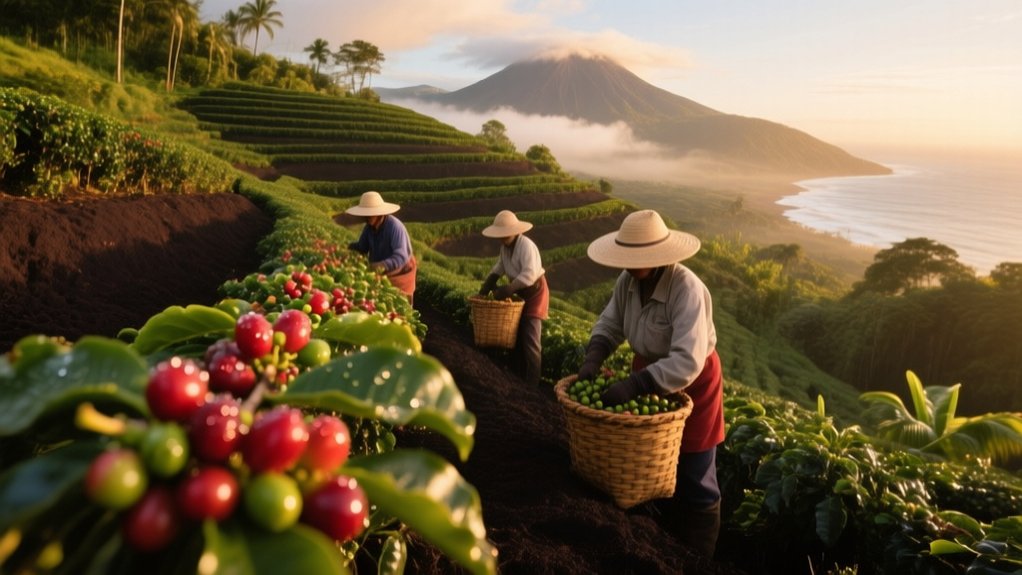
You’ll find coffee grown mainly in Hawaii, Puerto Rico, and California, where unique climates and elevations shape distinct flavors. Hawaii leads with its famous Kona coffee, grown in volcanic soil at ideal elevations.
Puerto Rico’s mountainous regions offer balanced, fruity tastes as the industry recovers. California’s emerging farms experiment with innovative practices in cooler microclimates. Each region’s terroir influences bean quality and flavor.
Explore further to uncover how these factors and challenges affect U.S. coffee production.
Where Is Coffee Grown in the United States?
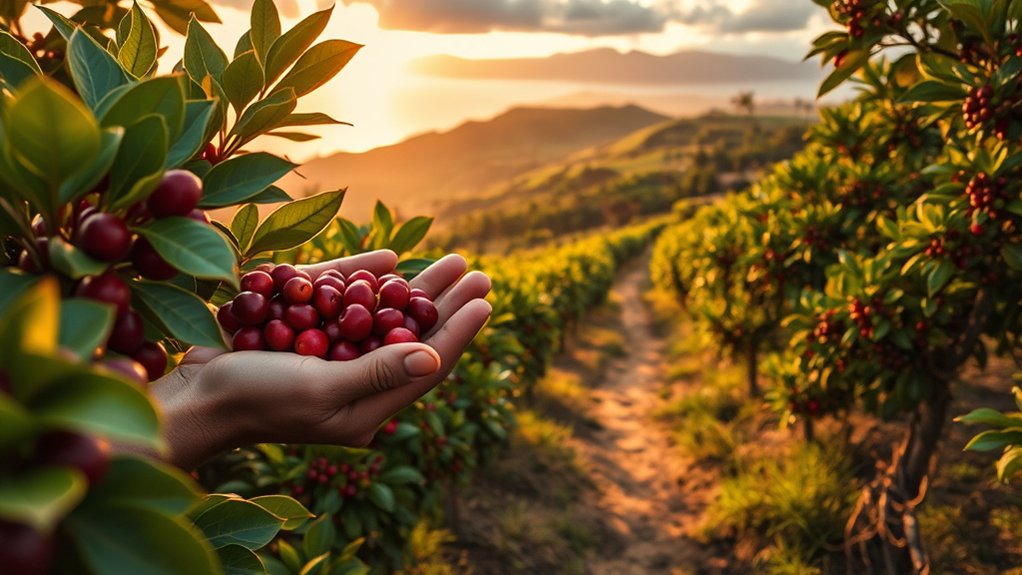
Where exactly is coffee grown in the United States? You’ll find coffee production mainly in Hawaii, Puerto Rico, and California.
Hawaii stands out as the top producer, especially famous for its Kona coffee grown on the Big Island. The island’s volcanic soil and ideal growing conditions, like mild temperatures and consistent humidity, support Arabica plants perfectly.
Puerto Rico’s coffee farms, particularly in Grand Lares and Yauco Selecto, have struggled due to hurricanes but are now revitalizing their production.
California’s coffee scene is still emerging, with experimental efforts like those from Frinj exploring new flavors, though it remains limited in scale.
Because Arabica requires very specific environmental conditions, U.S. coffee-growing regions are scarce, making these areas essential for domestic coffee cultivation.
How Terroir Shapes Coffee Flavor in U.S. Regions
Because terroir includes the unique mix of soil, climate, elevation, and other environmental factors, it directly shapes the flavor profiles of coffee grown in U.S. regions. High altitudes and volcanic or mountainous soils create distinct tastes. Climate variations influence bean development on coffee farms.
Understanding terroir helps you appreciate how each region’s environment impacts flavor complexity, acidity, and aroma.
| Region | Terroir Elements | Flavor Profile |
|---|---|---|
| Hawaii (Kona) | Volcanic soil, microclimate | Smooth, nutty, fruity |
| Puerto Rico | Mountainous terrain | Balanced, acidic, fruity aromas |
| California | Unique soil, climate | Cookie dough, black Twizzlers |
| Elevation | High altitudes, humidity | Complex, nuanced flavors |
| Rainfall | Variable sunlight, rain | Distinct regional characteristics |
Unique Coffee Regions of Hawaii and Their Flavors
You’ll find that Kona coffee really stands out because of its smooth, nutty, and fruity flavors. That unique profile comes from the region’s special microclimate.
And it’s not just Kona—each Hawaiian island offers its own distinctive coffee varieties. These differences are influenced by things like elevation, rainfall, and the volcanic soil conditions.
When you understand how these factors come together, it’s easier to appreciate the rich complexity behind Hawaii’s coffee flavors.
Kona Coffee Profile
Kona Coffee thrives on the Big Island of Hawaii, where volcanic soil and a mild, stable climate create ideal growing conditions. In the Kona region, coffee is grown at elevations between 400 to 2,500 feet, benefiting from rich soil and consistent rainfall.
These ideal conditions produce a specialty coffee known for its smooth flavor profile, featuring nutty and fruity notes that appeal to discerning palates worldwide.
Small family farms meticulously hand-pick and process the beans, ensuring exceptional quality. This attention to detail, combined with the unique volcanic soil, gives Kona Coffee its complex taste and aromatic qualities.
Because of its limited growing area and specific environmental needs, authentic Kona Coffee remains rare and commands premium prices in the market.
Island Microclimates Impact
The diverse microclimates across Hawaii’s islands shape the unique characteristics found in their coffee crops. Coffee grown in the Kona region on the Big Island thrives thanks to unique microclimates created by varying altitudes and trade winds.
These conditions, combined with rich volcanic soil, provide ideal environments for coffee cultivation. The slow maturation of coffee cherries under mild temperatures and ample rainfall leads to complex flavor profiles, often described as smooth nutty with fruity undertones.
Across the Big Island’s slopes, slight changes in elevation and weather produce subtle variations in taste, highlighting microclimate impacts.
Understanding these distinct environments helps you appreciate why Hawaiian coffee stands out, with each region contributing nuanced flavors shaped by the island’s natural diversity.
Distinctive Hawaiian Varieties
Hawaii offers several distinctive coffee-growing regions, each producing beans with unique flavor profiles shaped by local soil, climate, and elevation.
In Hawaii, Kona coffee stands out, cultivated on the Big Island’s volcanic soil, which imparts a smooth, nutty, and fruity distinctive taste. This volcanic soil, combined with ideal climate conditions, supports high-quality coffee cultivation.
Beyond Kona, Kauai’s coffee regions yield rich, smooth beans, while Maui produces coffees with floral and fruity notes. These regions emphasize sustainable farming practices, balancing environmental stewardship with quality.
Although Hawaii contributes about 1% of the U.S. coffee supply, its nearly 7,000 acres dedicated to coffee cultivation produce exceptional varieties prized for their unique flavors and careful production methods.
Revival and Growth: Coffee Production in Puerto Rico
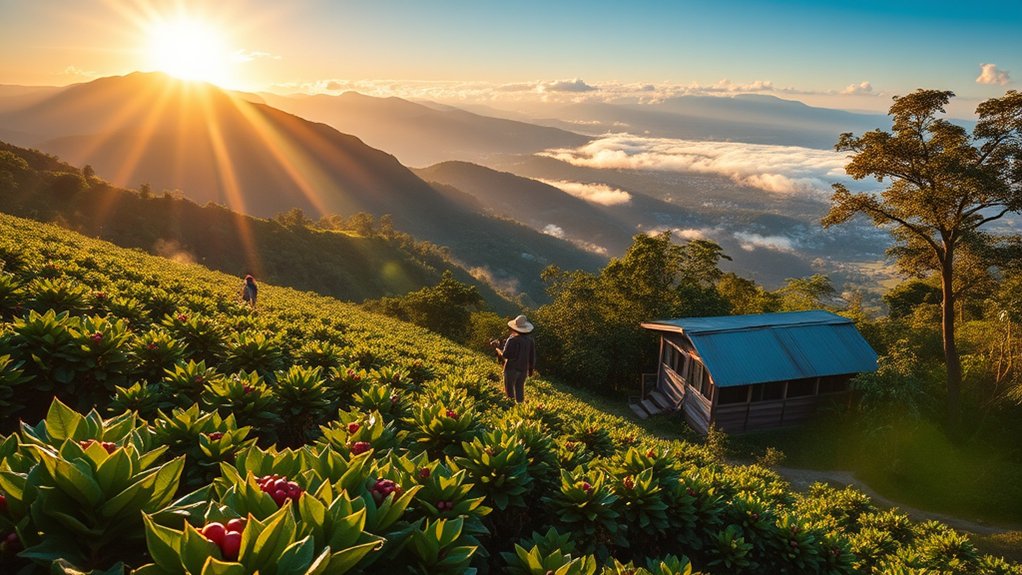
Although Puerto Rico’s coffee industry has faced significant challenges from hurricanes and economic changes, efforts to revive and grow production are gaining momentum, especially in the Grand Lares and Yauco Selecto regions.
Coffee grown in Puerto Rico thrives in its mountainous areas, where the climate and soil contribute to beans with balanced body, pleasant acidity, and a fruity aroma.
The revival focuses on specialty coffee, with farmers adopting modern, sustainable practices to enhance quality and competitiveness. Yauco Selecto, known for its distinctive flavor profiles, plays a central role in this resurgence.
California’s Emerging Coffee Farms and Their Distinctive Tastes
As California’s climate becomes increasingly favorable for coffee cultivation, especially in Santa Barbara and San Diego, you’ll find a growing number of small farms experimenting with unique flavor profiles.
These emerging coffee farms, including notable ones like Frinj, produce specialty coffee with distinctive tasting notes such as cookie dough and black Twizzlers.
California’s mild temperatures and coastal climate create promising conditions, though coffee farming here remains in its infancy.
Many growers emphasize sustainable practices to set their products apart, despite challenges like higher labor costs and irrigation needs.
While yield and quality improvements are ongoing goals, California’s coffee farms offer a fresh take on specialty coffee, reflecting both innovation and the region’s unique environmental factors.
How Climate and Altitude Affect U.S. Coffee Cultivation
You’ve got to know that coffee plants really need steady temperatures, the kind you usually find in tropical climates, to do well.
When it comes to elevation, it actually plays a big role in the quality of the beans. Higher up, the fruit matures more slowly, which helps bring out better acidity and more complex flavors.
What’s interesting is that even within a region, small changes in the microclimate can make a difference.
Take California, for example—there are little pockets where the conditions are just right for growing coffee, despite the bigger area having different overall climate traits.
Temperature Requirements
Because coffee plants require specific temperature and humidity conditions to thrive, cultivation in the U.S. is largely confined to areas with suitable climates, such as Hawaii, Puerto Rico, and parts of California.
When you consider the temperature requirements for Arabica coffee trees, you’ll see why mild climates with high humidity are critical.
Here’s what you need to know:
- Arabica coffee grows best between 60°F and 70°F, making Hawaii’s tropical climate ideal.
- Coffee trees need high humidity, which supports healthy growth and bean development.
- Hawaii, part of the Coffee Belt, offers these perfect conditions, especially in regions like Kona.
- California’s milder climate presents challenges, but some coffee varieties adapt experimentally.
Understanding these factors helps you grasp why U.S. coffee cultivation is so geographically limited.
Elevation Impact
While climate plays a critical role in coffee cultivation, elevation greatly influences the quality and characteristics of coffee grown in the U.S. In key coffee-growing regions like Hawaii’s Kona area, ideal elevation ranges from 1,200 to 2,400 feet, fostering slower fruit maturation that enhances the flavor profile of Hawaiian coffee.
Similarly, Puerto Rican coffee benefits from elevations that provide mild temperatures and high humidity, essential for premium Arabica beans.
California’s experimental coffee farms, reaching up to 1,500 feet, show how varied elevations contribute to unique flavors.
Elevation affects acidity and complexity by controlling growth speed and microclimate conditions.
As climate change alters temperatures, it may expand suitable elevations for coffee cultivation in the U.S., opening new opportunities while maintaining the importance of ideal conditions in these established regions.
Microclimate Variations
Elevation sets the stage for coffee cultivation, but the subtle differences in microclimate across U.S. coffee-growing regions play a defining role in the beans’ final flavor and quality.
You’ll notice how microclimates in Hawaii, Puerto Rico, and California influence temperature, humidity, and rainfall, shaping unique flavor profiles.
Consider these examples:
- Hawaii’s Kona coffee grows between 1,000–2,500 feet, where volcanic soil and mild temperatures create smooth, nutty, and fruity coffee beans.
- Puerto Rico’s mountainous microclimates vary in altitude, producing coffee with balanced body and bright acidity despite hurricane challenges.
- California’s experimental farms exploit diverse microclimates, yielding distinct flavors like cookie dough and black Twizzlers.
- Temperature fluctuations and humidity differences across these regions directly impact bean development and taste complexity.
Challenges to Scaling Coffee Farming in the U.S
Although coffee farming in the U.S. shows promise in regions like Hawaii, Puerto Rico, and California, scaling operations faces significant hurdles. Arabica coffee requires precise climatic conditions, such as mild temperatures and high humidity, that most U.S. regions lack.
While Florida experiments with expanding suitable areas, widespread adaptation remains uncertain. High labor costs further increase expenses, making it tough for you to compete with lower-cost coffee imports.
Florida’s expansion efforts face uncertainty amid rising labor costs and stiff competition from cheaper imports.
These factors combine to challenge the economic viability of larger-scale coffee farming in the U.S. Even in Hawaii, where nearly 7,000 acres cultivate coffee, operational costs remain steep.
As a result, you must carefully weigh these climatic and financial challenges before expanding your coffee farming operations domestically.
Economic and Labor Factors Impacting U.S. Coffee Production
You’ll find that labor costs on U.S. coffee farms, especially in places like Hawaii and California, are much higher than in traditional coffee-growing countries. This directly affects their economic viability.
At the same time, fair wage practices are becoming a big deal since more and more consumers want ethically sourced coffee. This adds extra pressure on producers.
All these economic and labor challenges really shape the competitive landscape and influence how coffee production is evolving in the U.S.
Labor Cost Challenges
When you factor in labor costs, U.S. coffee farming faces significant challenges that affect its competitiveness. Labor cost challenges arise primarily due to the high minimum wage in states like Hawaii and California, which drives up operational costs.
You should consider these key factors:
- Skilled workers are essential for labor-intensive coffee cultivation, but their wages increase production costs.
- Limited growing regions restrict production scale, preventing cost savings through economies of scale.
- Climate change threatens the viability of existing growing areas, potentially altering labor needs and expenses.
- Many small-scale farms struggle to adopt automation as a cost-saving measure due to scale and investment barriers.
Together, these factors make it difficult for U.S. coffee producers to compete with cheaper imported coffee.
Fair Wage Implications
Since fair wage considerations play a crucial role in U.S. coffee production, you need to understand how higher labor costs affect profitability and consumer choices. The high minimum wage in the U.S. raises operational costs for growing coffee, particularly in Hawaii, the primary US producer.
These increased production costs make U.S. coffee more expensive but appeal to consumers seeking ethically sourced products. Balancing fair wages with competitive pricing remains a challenge.
| Factor | US Coffee Production | Traditional Producers (e.g., Brazil) |
|---|---|---|
| Minimum Wage | High | Lower |
| Operational Costs | Elevated | Moderate |
| Consumer Demand | Ethically focused | Price sensitive |
You must weigh these fair wage implications when analyzing U.S. coffee’s market position.
Economic Viability Factors
Balancing fair wages with production costs directly influences the economic viability of U.S. coffee farming. You’ll find that:
- High production costs stem from elevated minimum wages and labor-intensive care for Arabica plants, which need mild temperatures and high humidity.
- Geographic limitations confine coffee production to Hawaii, Puerto Rico, and parts of California, restricting expansion despite demand.
- Historically grown regions face challenges competing with lower-cost countries, pushing U.S. coffee toward premium markets.
- Climate change could open new growing zones, potentially improving economic viability by diversifying suitable areas.
Understanding these factors helps you see why U.S. coffee production remains niche, balancing quality with economic constraints while adapting to evolving environmental and labor conditions.
Comparing Flavor Profiles of U.S. Coffee Varieties
How do the flavor profiles of U.S. coffee varieties differ across regions?
Hawaii’s Kona Coffee, grown in volcanic soil on the Big Island, offers a smooth, slightly nutty taste with fruity undertones.
Puerto Rican coffee, especially from Grand Lares and Yauco Selecto, presents a balanced body with pleasant acidity and bright, fruity aromas.
Production can be vulnerable to hurricanes, though.
California-grown coffee is more experimental, revealing unique tasting notes like cookie dough and black Twizzlers.
This reflects the diverse potential of U.S. coffee.
These flavor profiles stem from distinct local terroir, elevation, and processing methods.
Small-batch roasting further enhances the freshness and complexity of beans from each region, helping U.S. coffee gain recognition for its quality and distinctive characteristics across the country.
Future Prospects for Expanding Coffee Growing Areas in the U.S
The unique flavor profiles found in U.S. coffee regions reflect not only their distinct environments but also the evolving possibilities for cultivation.
Climate change may expand coffee growing beyond Hawaii and Puerto Rico, opening new opportunities.
You should note these key factors shaping future prospects:
- Florida’s research on coffee growing in warm, humid climates shows promising results.
- Coffee producers in California experiment with unique varieties and methods.
- Advances in agricultural techniques help cultivate coffee in previously unsuitable areas.
- Growing demand for specialty coffee and sustainability drives investment in new ventures.
Frequently Asked Questions
What Is the Best Brewing Method for U.S.-Grown Coffee?
The best brewing method for U.S.-grown coffee depends on its origins and flavor profiles. You should adjust grind size and brewing ratios to suit methods like pour-over for smooth, fruity flavors or espresso to concentrate bold notes.
Equipment choices like AeroPress can enhance complexity, while temperature control between 195°F to 205°F guarantees ideal extraction.
Tailoring these brewing techniques lets you highlight the unique qualities of each coffee’s origin for the best cup.
How Does U.S. Coffee Compare in Price Internationally?
You might think U.S. coffee prices should be lower, but price comparison shows they’re often higher than international markets.
That’s due to coffee tariffs, strict import regulations, and increased labor costs.
When you assess quality, U.S. coffee usually scores higher, matching consumer preferences for premium beans.
This economic impact means you pay more, but you get unique, high-quality coffee.
Are There Certifications for Sustainably Grown U.S. Coffee?
Yes, you can find certifications for sustainably grown U.S. coffee like organic certification, fair trade, and Rainforest Alliance.
These labels guarantee sustainable farming practices that reduce environmental impact and promote local sourcing. They also help improve coffee quality and farmer livelihoods.
Can Home Gardeners Grow Coffee Plants Indoors in the U.S.?
Growing coffee indoors is like nurturing a delicate treasure. Your patience pays off as cherries slowly bloom over years.
You can cultivate Arabica coffee varieties at home if you maintain ideal growth conditions: bright, indirect light, rich, well-draining soil, and regular watering without sogginess.
Climate control with humidity and temperature between 60°F-70°F is essential, alongside vigilant pest management.
With careful indoor gardening, you’ll enjoy the unique satisfaction of harvesting your own coffee beans.
What Are the Health Benefits of Drinking U.S.-Grown Coffee?
You’ll enjoy several health benefits from drinking U.S.-grown coffee, thanks to its rich coffee antioxidants. These compounds support heart health and aid digestion, helping your body function smoothly.
Plus, the caffeine boosts brain function, enhancing focus and memory.
Coffee also promotes mood enhancement by stimulating mental alertness, which can help with weight management by increasing metabolism.
Conclusion
As you explore coffee grown in the U.S., you’ll find each region paints its own rich flavor canvas, shaped by unique terroirs and climates. From Hawaii’s volcanic soils to Puerto Rico’s tropical revival, and California’s budding farms, the landscape is as diverse as a well-blended roast.
Though challenges brew on the horizon, the future of American coffee cultivation promises growth, innovation, and a cup full of distinct, homegrown character worth savoring.