Does A Coffee Maker Boil Water – How It Works Explained
Your coffee maker doesn’t boil water; it heats it to an ideal 195°F to 205°F range to guarantee precise extraction and prevent bitterness. This controlled temperature preserves coffee’s flavor without stressing the machine’s components.
Boiling water risks over-extraction and damages internal parts, reducing lifespan and taste quality. Water quality also impacts performance by affecting temperature stability and scaling.
Understanding these mechanics will clarify why brewing temperature and maintenance are critical for the best cup and when alternative devices might suit your needs better.
Do Coffee Makers Actually Boil Water?
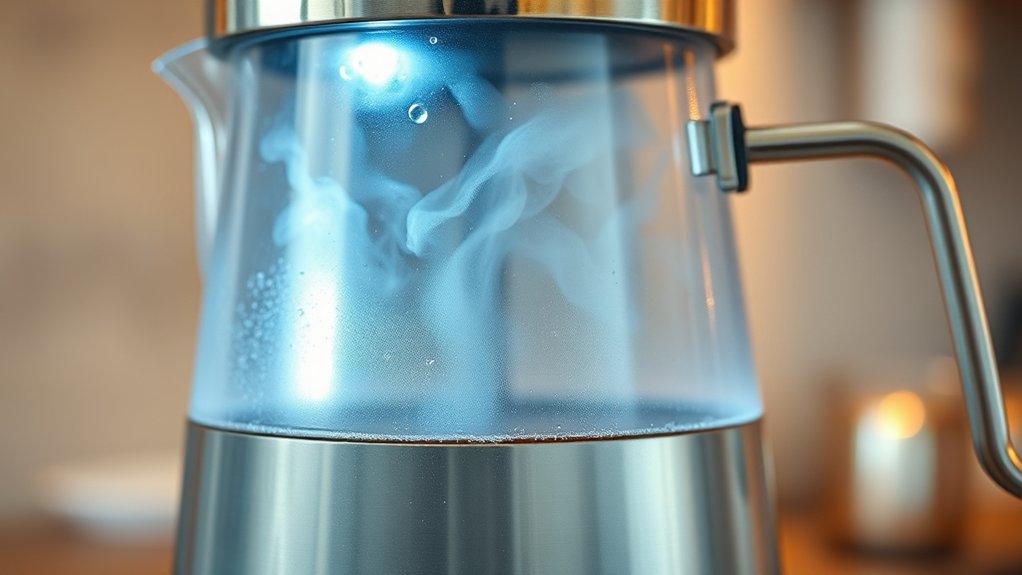
How hot does a coffee maker actually get? Coffee makers use heating elements that warm water to an ideal brewing temperature range between 195°F and 205°F (90°C to 96°C), which is distinctly below boiling.
Coffee makers heat water to 195°F–205°F, ideal for brewing but below boiling point.
So, do coffee makers actually boil water? The answer is no. Instead of boiling, they heat water just enough to extract coffee flavors effectively without causing over-extraction or bitterness.
Boiling water, at 212°F (100°C), is unnecessary for brewing and can degrade coffee quality. While boiling kills bacteria, coffee makers produce hot water, requiring regular cleaning to maintain hygiene and taste.
Understanding this precise temperature control clarifies why coffee makers don’t reach boiling point and how this impacts your brew’s flavor profile and safety.
Why Coffee Makers Use Lower Water Temperatures
Why do coffee makers consistently use water temperatures below boiling? They heat hot water to an ideal range of 195°F to 205°F (90°C to 96°C) rather than reaching boiling point at 212°F (100°C).
This precise control prevents over-extraction of coffee grounds, which can produce bitterness and harsh, burnt flavors. Using hot water just below boiling guarantees balanced extraction, preserving desirable flavor compounds while avoiding the harshness that excessive heat causes.
Meanwhile, water that’s too cool results in weak, under-extracted brews, so maintaining this narrow temperature window is critical.
Coffee makers’ heating elements are engineered to rapidly produce hot water within this range, enhancing extraction efficiency and safety by avoiding the risks associated with boiling.
This temperature management is key to consistent coffee quality without compromising safety or flavor integrity.
How Hot Water Temperature Affects Coffee Flavor
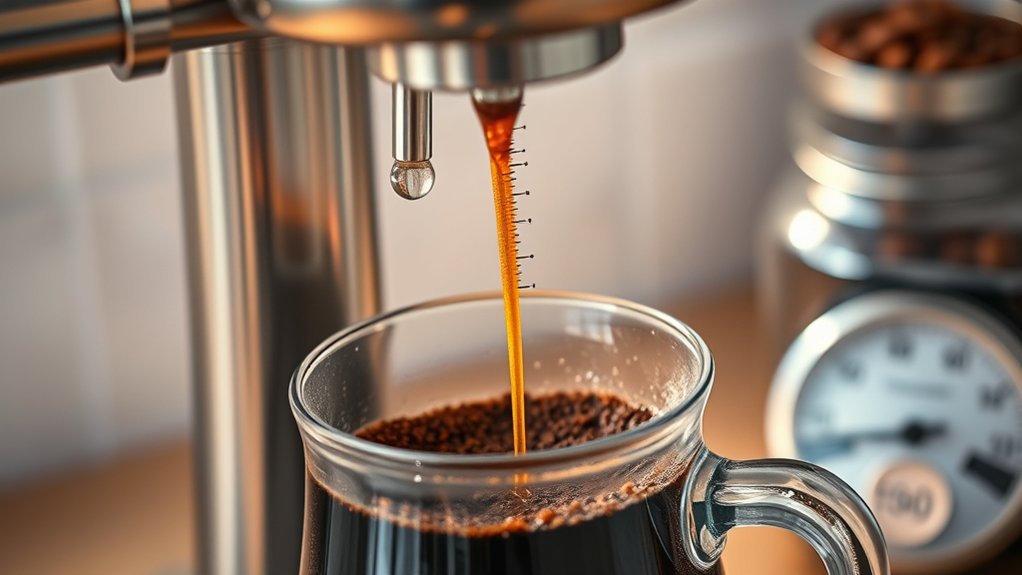
The temperature of the water you use in brewing directly influences the chemical extraction from coffee grounds, shaping the final flavor profile. Water must be heated within the ideal range of 195°F to 205°F (90°C to 96°C) to extract desirable flavors without causing bitterness.
If water exceeds this range, over-extraction occurs, imparting harsh, bitter notes. Conversely, water below this range leads to under-extraction, producing weak, flat coffee lacking complexity.
You must also maintain consistent water temperature throughout brewing, as fluctuations disrupt extraction rates and alter flavor balance.
Starting with room temperature water guarantees gradual heating, promoting uniform extraction. Ultimately, water must reach approximately 200°F (93°C) to achieve an ideal balance, maximizing flavor complexity while minimizing undesirable compounds in your coffee.
Why Boiling Water Isn’t Ideal for Coffee Makers
Although boiling water might seem like a quick solution for brewing coffee, it actually exceeds the ideal temperature range of 195°F to 205°F. This causes over-extraction that produces bitter flavors.
When you use boiling water, coffee grounds release undesirable compounds, which negatively affect flavor and aroma.
Boiling water extracts undesirable compounds from coffee grounds, harming both flavor and aroma.
Moreover, boiling water can damage your coffee maker’s internal components, accelerating wear and reducing its operational lifespan.
Using water at boiling point often results in a flat, unbalanced taste because it surpasses the best extraction temperature.
Maintaining water temperature below boiling guarantees precise flavor development and preserves machine integrity.
Ideal Temperature Range for Brewing Coffee
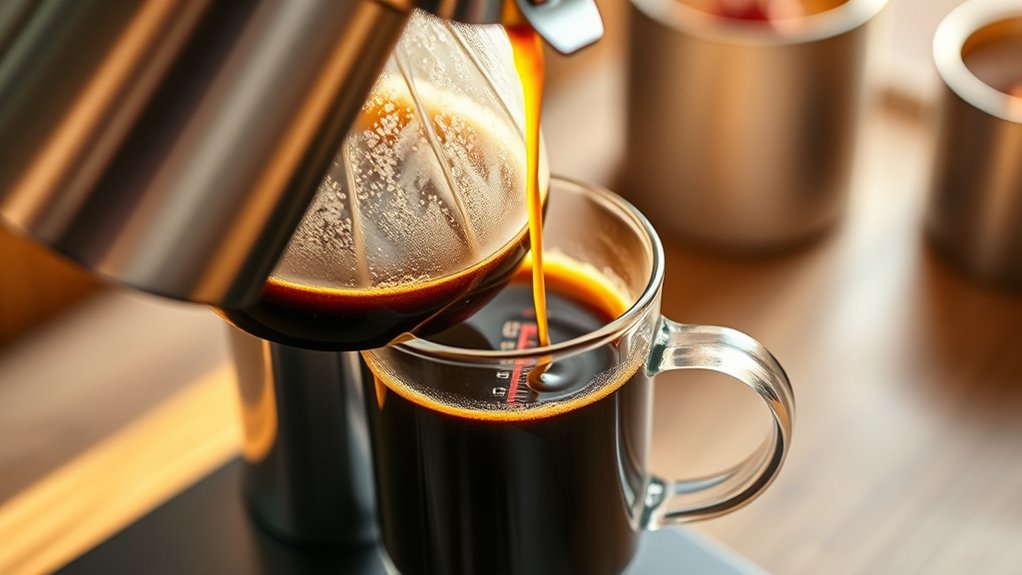
When you brew coffee, you want to keep the water temperature between 195°F and 205°F (90°C to 96°C) to maximize flavor extraction without causing bitterness.
Maintaining this precise brewing temperature guarantees ideal solubility of coffee compounds, balancing acidity and bitterness.
Coffee makers typically heat water to around 200°F (93°C), slightly below boiling, to prevent over-extraction.
If water exceeds this range, it extracts unwanted bitter compounds; if it’s too cool, the brew becomes weak and underdeveloped.
For peak flavor, coffee should be consumed shortly after brewing, ideally around 55°C (130°F).
Key factors to take into account include:
- Accurate brewing temperature range for balanced extraction
- Avoiding overheating to prevent bitterness
- Timely consumption post-brewing to enjoy ideal flavor
How Coffee Makers Heat and Move Water
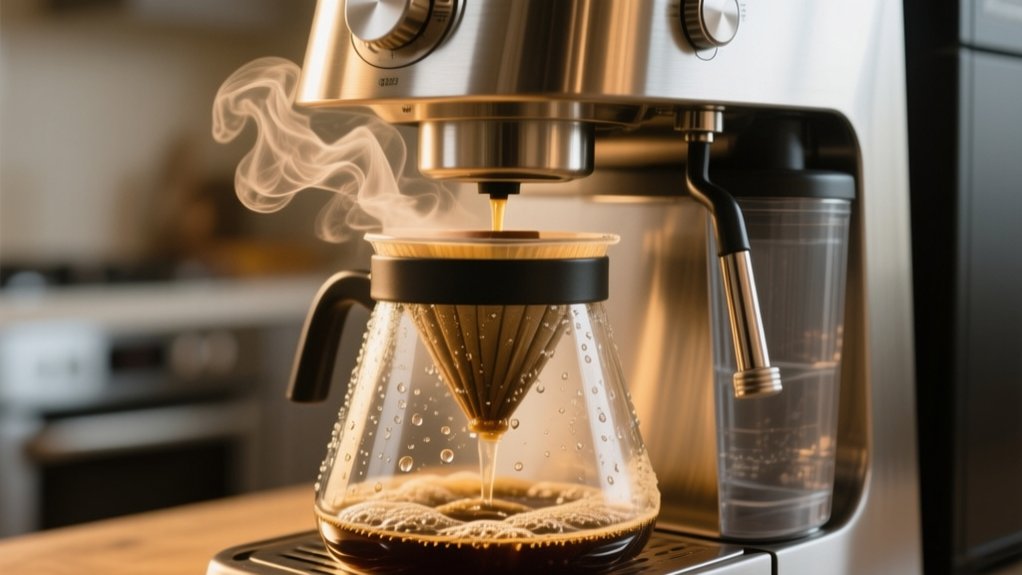
Since precise temperature control directly impacts coffee quality, coffee makers employ a heating element that rapidly warms water to an ideal range between 195°F and 205°F. This temperature window guarantees optimal flavor extraction without causing bitterness or weak brews.
Water is pulled from the reservoir through a dedicated tube system, facilitating consistent movement toward the filter basket containing coffee grounds. The design assures even distribution of hot water over the coffee grounds, promoting uniform extraction and preventing under- or over-extraction.
Any irregularity in heating or water flow can alter the taste profile, so maintaining and cleaning the machine regularly is essential.
Pressure Differences in Coffee Makers vs. Espresso Machines?
You’ll notice that coffee makers operate at around 1.5 bars of pressure and mostly rely on gravity to extract flavors.
On the other hand, espresso machines use about 9 bars to force water through the coffee grounds.
This big difference in pressure really changes how the coffee is extracted. It affects both the concentration and the taste of the final brew.
Pressure Levels Compared
Although both coffee makers and espresso machines aim to brew coffee, they operate under vastly different pressure conditions that greatly influence the extraction process. Coffee makers function at lower pressure levels, roughly 1.5 bars, using steam-generated pressure and gravity to move water through grounds.
In contrast, espresso machines employ a pump to reach about 9 bars, forcing hot water rapidly through compacted coffee. This significant disparity impacts brewing mechanics and coffee concentration.
Key distinctions in pressure levels include:
- Coffee makers rely on steam pressure and gravity at ~1.5 bars.
- Espresso machines utilize mechanical pumps to achieve ~9 bars.
- Higher pressure in espresso machines enables faster, more forceful extraction.
Understanding these pressure levels clarifies how each device brews differently, affecting overall performance and design.
Impact On Coffee Extraction
When you compare coffee makers and espresso machines, the pressure differences greatly influence coffee extraction quality and flavor profile.
Coffee makers operate around 1 bar and heat water to about 95ºC, which limits extraction efficiency during brewing. This lower pressure extracts fewer oils and soluble compounds, often resulting in a milder flavor.
Conversely, espresso machines apply approximately 9 bars of pressure and maintain precise temperature control. This optimizes the brewing process to extract rich, concentrated flavors while minimizing bitterness.
The Moka pot, at roughly 1.5 bars, offers an intermediate extraction intensity.
In coffee makers, inconsistent temperature and pressure control can lead to over-extraction or under-extraction, which affects taste.
Understanding these pressure dynamics helps you grasp how the brewing process impacts coffee’s flavor and texture.
How Water Quality Affects Coffee Maker Performance
Since water serves as the primary solvent in coffee brewing, its quality directly influences both the extraction process and the coffee maker’s operational efficiency.
Poor water quality, particularly hard water, can cause limescale buildup, impairing heating elements and reducing temperature stability. This impacts your machine’s ability to maintain the ideal brewing temperature of 195°F to 205°F, essential for peak extraction.
Using fresh, clean water each brew minimizes bacterial growth and off-flavors, ensuring consistent taste and performance.
Consider these factors regarding water quality:
- Hard water promotes mineral deposits that degrade machine function and coffee flavor.
- Natural bottled mineral water enhances flavor and prevents scale in Moka pots.
- Room temperature water improves extraction by allowing stable heat transfer.
Maintaining Your Coffee Maker for Best Water Quality
You should clean your coffee maker regularly to keep coffee oils and mineral deposits from affecting the water quality and the flavor of your brew.
Descaling is super important because it gets rid of mineral buildup that can slow down your machine and even shorten its lifespan.
Regular Cleaning Importance
Although it may seem routine, cleaning your coffee maker regularly directly impacts water quality and brew flavor. Neglecting to clean allows coffee oils and mineral deposits to build up, which degrades taste and machine efficiency.
You need to clean after each use to prevent residue contamination and bacterial growth. These issues compromise water purity and flavor consistency.
Key points to focus on:
- Clean the water reservoir and filter basket consistently to maintain ideal brewing temperature and extraction.
- Avoid storing water overnight in the machine to prevent microbial growth.
- Use fresh, clean water every brew cycle to guarantee taste integrity.
Descaling For Longevity
When mineral deposits accumulate inside your coffee maker, they compromise both machine performance and coffee flavor. Regular descaling prevents buildup from hard water, maintaining ideal brewing temperatures and extending your machine’s lifespan.
You should descale every three to six months, depending on water hardness and usage frequency. Use a 1:1 mixture of water and white vinegar or a commercial descaling solution for effective limescale removal. After descaling, flush the system with plain water to eliminate residues.
| Frequency | Descaling Agent | Effectiveness |
|---|---|---|
| Every 3 months | Water + White Vinegar | High |
| Every 6 months | Commercial Solution | Very High |
| Rare/None | None | Low (Damage Risk) |
Descaling is critical for consistent water temperature and coffee quality.
Coffee Makers vs. Hot Water Dispensers: Which Fits Your Needs?
How do you determine whether a coffee maker or a hot water dispenser best suits your beverage preparation needs?
Coffee makers heat water to ideal brewing temperatures (195°F to 205°F) for extracting flavors from ground coffee, producing freshly brewed coffee without boiling.
In contrast, hot water dispensers deliver near-boiling water instantly, suitable for various drinks beyond coffee.
Consider these factors:
- Volume: Coffee makers serve single or limited servings; hot water dispensers provide up to 30 liters daily.
- Temperature: Coffee makers enhance flavor extraction; hot water dispensers reach boiling for broader use.
- Maintenance: Both require regular cleaning, but dispensers often feature advanced filtration to reduce odors and limescale.
Choosing depends on whether precise brewing or versatile, high-volume hot water is your priority.
When to Choose a Hot Water Dispenser Instead of a Coffee Maker
Since hot water dispensers deliver water at near-boiling temperatures up to 100ºC, you benefit from ideal extraction for beverages like tea that require higher heat than coffee makers provide.
When you need consistent, near-boiling water on demand, hot water dispensers outperform coffee makers, which typically heat water only to 90-95ºC.
If you frequently prepare multiple hot beverages or require large volumes, hot water dispensers offer greater capacity, up to 30 liters daily, making them more efficient in office or high-use settings.
Furthermore, their advanced filtration systems remove odors and limescale, ensuring superior water quality compared to tap water used in coffee makers.
Choose hot water dispensers when you want versatility, energy efficiency, and precise temperature control beyond what traditional coffee makers can deliver.
Frequently Asked Questions
Can I Use a Coffee Maker to Brew Tea or Other Beverages?
You can use a coffee maker for tea infusion, but it’s not ideal.
The machine heats water below boiling, which may under-extract flavors, especially from delicate teas.
Plus, its water distribution isn’t optimized for even saturation of tea leaves, affecting infusion quality.
For precise temperature control and consistent tea infusion, you’d get better results using a dedicated hot water dispenser that can deliver near-boiling water suited to various tea types.
How Long Does It Take for a Coffee Maker to Heat Water?
Wondering how long it takes for your coffee maker to heat water? Typically, it’s about 5 to 10 minutes, depending on your machine’s heating efficiency.
Higher wattage models or smaller water volumes heat faster, while larger reservoirs take longer.
Maintaining your coffee maker, like regular descaling, guarantees peak heating efficiency, reducing heat time.
Are There Energy-Saving Coffee Makers Available?
Yes, you can find energy-saving coffee makers with eco-friendly options designed to reduce electricity use by up to 30%.
These models often include programmable timers for off-peak brewing, insulated reservoirs to minimize reheating, and thermal carafes that eliminate the need for warming plates.
Does Altitude Affect the Water Temperature in Coffee Makers?
Yes, altitude impacts water temperature in coffee makers considerably.
As altitude increases, atmospheric pressure drops, lowering water’s boiling point. This means your coffee maker can’t heat water to the ideal 195°F–205°F range needed for proper extraction.
You’ll notice your coffee tastes weaker or under-extracted unless you adjust variables like grind size or brew time.
Understanding this helps you enhance brewing despite high-altitude challenges.
Can Mineral Buildup Damage the Heating Element in Coffee Makers?
Yes, mineral buildup can seriously damage your coffee maker’s heating element. The mineral impact, especially from limescale deposits, creates an insulating layer that traps heat.
This causes the element to overheat, reducing efficiency and risking burnout.
You’ll notice inconsistent brewing temperatures and potential device failure if you don’t descale regularly.
To protect the heating element, you need to perform routine maintenance and consider using low-mineral water to minimize buildup.
Conclusion
You might be surprised to learn that most coffee makers heat water to around 195°F–205°F, just below boiling point. This optimizes extraction without scorching the grounds.
This precise temperature control explains why boiling water isn’t ideal. It can degrade flavor by over-extracting bitter compounds.
Understanding this helps you appreciate why maintaining your coffee maker and water quality is essential for the perfect cup. Choosing the right device depends on your specific needs and brewing preferences.