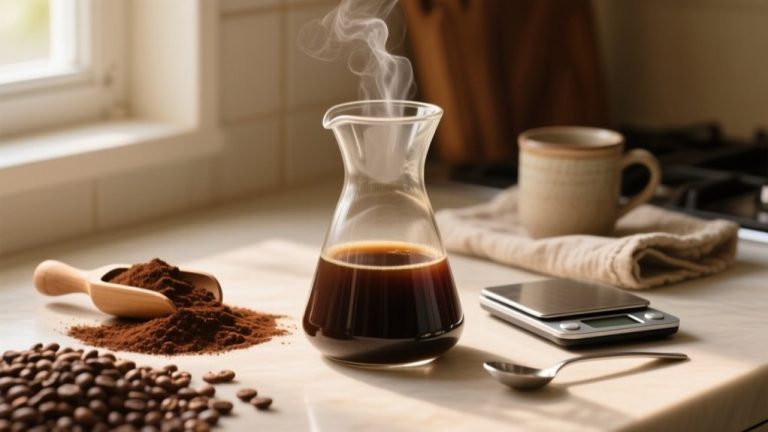
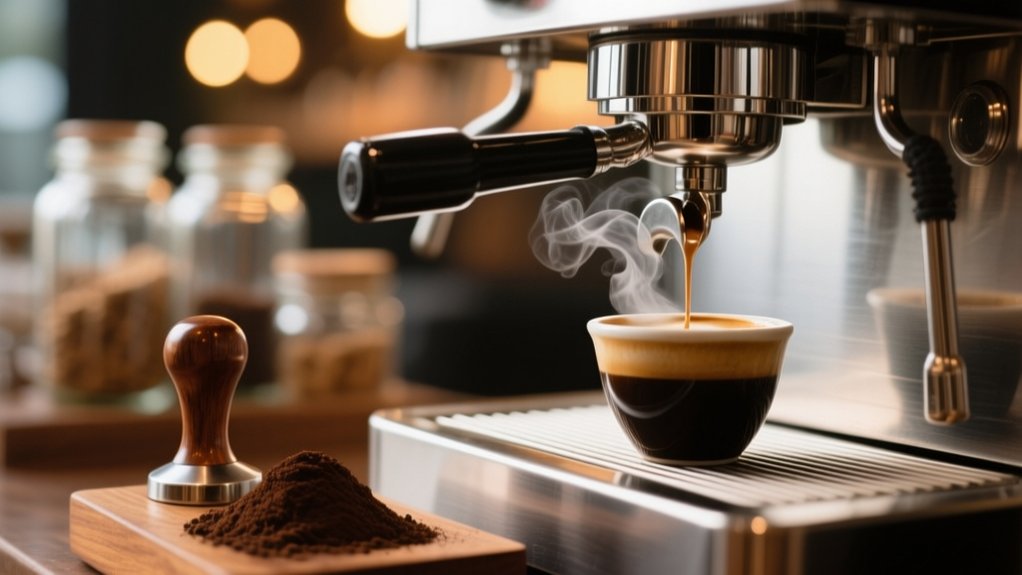
How To Make Espresso With Coffee Maker – Step-By-Step Guide
To make espresso with your coffee maker, start by grinding fresh, high-quality beans to a fine, salt-like texture using a burr grinder. Measure 16-19 grams, evenly distribute, and tamp firmly with about 30 pounds of pressure.
Preheat your machine to 93-95°C, lock in the portafilter, and pull the shot aiming for 36-40 grams in 25-30 seconds. Watch for a thick, syrupy flow, then stop before bitterness.
Fine-tune grind and tamp for balanced flavor. You’ll soon master the nuanced steps behind a perfect shot.
How Espresso Coffee Makers Work
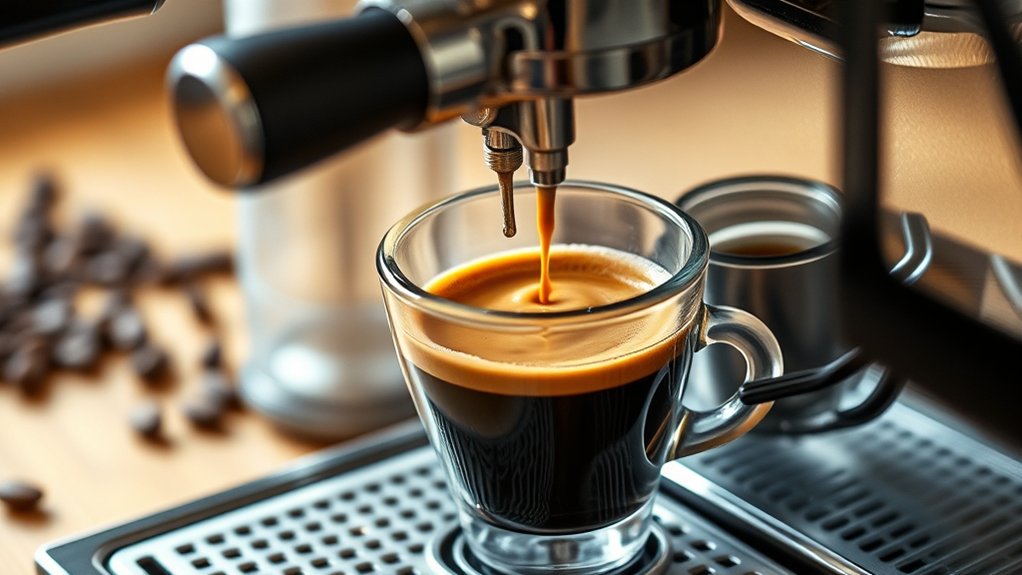
Although espresso coffee makers come in various designs, they all rely on heating water to near boiling and forcing it through finely ground coffee under high pressure, typically around 9 bars, to produce a rich, concentrated shot.
You’ll find key parts like the boiler, pump, group head, and portafilter all work together in this brewing process.
The portafilter holds your coffee grounds, so grind size matters; too coarse or too fine affects extraction. If you use a fully automatic coffee maker, it simplifies this by automating grinding, tamping, and brewing, letting you select settings easily.
Maintaining your machine guarantees consistent temperature and pressure, which is vital for quality espresso every time.
Understanding these fundamentals helps you appreciate the precision behind each shot you pull.
Get Your Espresso Equipment And Ingredients Ready
You’ll want a pump-driven espresso machine, a burr grinder, and a tamper to make sure you get consistent pressure and extraction.
Freshly roasted coffee beans are key—try to use them within 7 to 30 days for the best flavor.
And don’t forget about the water! Using filtered water with balanced hardness really helps bring out the true taste of your espresso.
Also, grind those beans finely to get the most flavor in every shot.
Essential Espresso Equipment
Before you pull your first shot, gathering the right espresso equipment is crucial to crafting a rich, flavorful cup. Start with reliable at-home espresso machines, ideally pump-driven models, to guarantee consistent pressure.
A Burr Grinder is indispensable for achieving uniform grind size, which directly impacts extraction quality. Use freshly roasted coffee, preferably beans roasted 7 to 30 days ago, to capture peak flavor and aroma.
An espresso tamper helps you compress grounds evenly, preventing channeling during brewing.
Don’t overlook a digital scale—it allows precise measurement of coffee, typically 16 to 19 grams for a double shot, assuring consistency shot after shot.
Finally, use filtered water with balanced hardness to enhance extraction, rounding out your essential espresso setup perfectly.
Quality Coffee Selection
When selecting coffee for your espresso, freshness and grind quality make all the difference. Start with freshly roasted coffee beans, ideally used within 7 to 30 days post-roast for peak flavor.
A quality burr grinder guarantees you achieve the perfect grind size, fine like confectionary sugar, for even extraction.
Don’t forget filtered water; it’s essential for a clean, balanced taste. Use an espresso tamper to compress grounds evenly, applying about 30 lbs of pressure to avoid channeling.
These elements combine to reveal your espresso’s full potential.
- Choose freshly roasted coffee beans for peak flavor
- Use a quality burr grinder for consistent grind size
- Prepare filtered water to enhance taste
- Employ an espresso tamper for uniform compression
- Aim for even extraction with precise grind and tamping
Importance Of Fresh Water
Although selecting quality coffee beans is crucial, the water you use plays an equally important role in crafting the perfect espresso. Using fresh, filtered water with a hardness of 50-175 ppm guarantees ideal brewing and superior flavor extraction.
Contaminants and chlorine in water can ruin espresso quality, so always choose clean water. Preheat your machine’s water reservoir to maintain consistent temperatures between 90-96°C (194-205°F) during brewing, as this affects taste dramatically.
| Factor | Recommendation |
|---|---|
| Water Type | Fresh, filtered water |
| Hardness Level | 50-175 ppm |
| Temperature Range | 90-96°C (194-205°F) |
| Preheating | Always preheat reservoir |
Prioritize fresh water for the best espresso experience.
Grind Fresh Espresso Coffee To The Perfect Fineness
You’ll want to grind your coffee fresh just before brewing to lock in those essential oils and flavors that really make espresso shine.
Aim for a fine, consistent grind—something like the texture of table salt. This helps ensure proper extraction and a balanced taste.
If your espresso shots aren’t pulling quite right, don’t hesitate to tweak the grind size a bit.
The goal is a smooth flow rate that leads to the perfect espresso every time.
Importance Of Fresh Grinding
Freshly grinding your espresso beans is vital to releasing the fullest flavor and aroma in every cup. To achieve maximum freshness and ideal espresso extraction, you need to grind your coffee just before brewing.
Using a burr grinder guarantees a consistent grind size, which is essential for balanced flavor and proper water flow. Freshly ground coffee preserves the essential oils that quickly fade after grinding.
Remember, coffee loses its aroma and taste rapidly, so grind only what you need. Keep these in mind:
- Grind your coffee immediately before brewing
- Use a burr grinder for uniform particle size
- Aim for consistent grind size to avoid channeling
- Use coffee within 7 to 30 days post-roast
- Preserve maximum freshness for rich, flavorful espresso
Ideal Grind Size
Grind size plays a critical role in pulling the perfect espresso shot, with the ideal fineness resembling table salt or confectionery sugar.
To achieve this, use a burr coffee grinder, which delivers a consistent grind essential for uniform extraction.
The ideal grind size guarantees your espresso shot extracts evenly, releasing rich and flavorful notes.
Start with 16-19 grams of coffee for a double shot, and focus on adjusting the grind based on taste.
If your espresso tastes sour, make the grind finer. If it’s bitter, try a slightly coarser grind or check coffee freshness.
Mastering the ideal grind size with your coffee grinder is key to crafting the perfect espresso every time, elevating your brewing experience and flavor profile.
Adjusting Grind Consistency
Mastering the grind size you choose is only part of the process. Fine-tuning its consistency will make all the difference in your espresso’s flavor and extraction time.
To get the perfect fine grind, use a burr grinder to guarantee uniform coffee grounds essential for balanced espresso brewing. Adjust your grind based on the shot’s flow: if it pours too fast, make it finer; if too slow, coarser.
Regular calibration helps counteract humidity and bean density changes, maintaining consistency.
- Aim for grind resembling table salt or granulated sugar
- Use a burr grinder for even extraction
- Adjust grind size to control brewing time
- Dose 16–19 grams without overfilling portafilter
- Test and recalibrate grinder regularly for best results
Consistent grind means richer flavor and ideal extraction every time.
Dose And Tamp The Coffee Evenly For Great Extraction
Start by measuring 16 to 19 grams of coffee to match your machine’s requirements and guarantee a snug fit in the portafilter.
Use a quality burr grinder to achieve a fine grind resembling table salt, which is vital for balanced extraction.
Next, employ the WDT (Weiss Distribution Technique) to declump and evenly distribute the coffee grounds. This ensures a uniform coffee bed, preventing channeling and promoting consistent water flow during brewing.
Once leveled, tamp the coffee firmly with about 30 pounds of pressure to create a compact, even puck.
Proper dosing and tamping are essential because they directly affect extraction quality, flavor consistency, and crema formation.
Preheat Your Espresso Machine And Lock The Portafilter
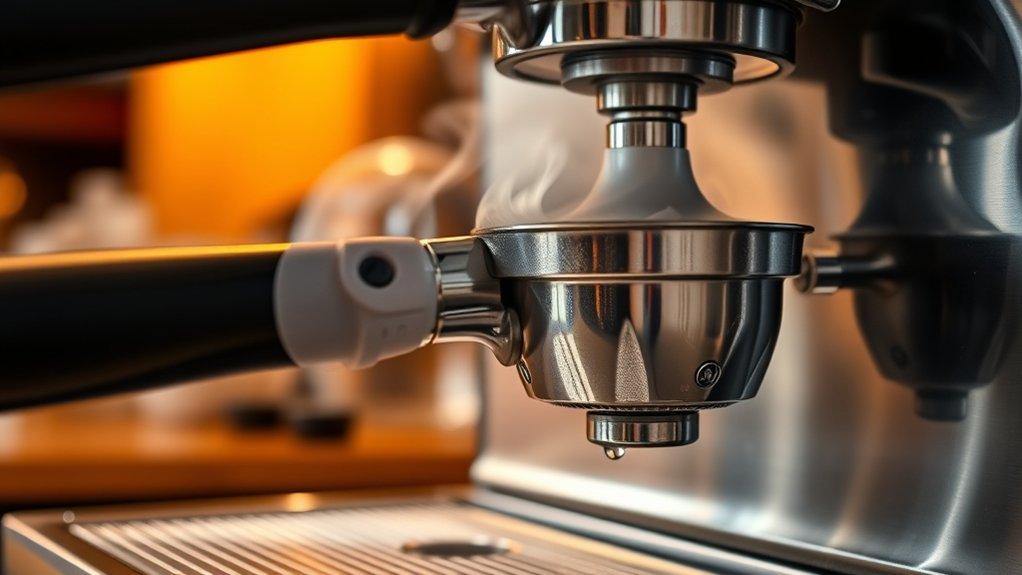
Allow your espresso machine to preheat for 15 to 20 minutes until it reaches the ideal brewing temperature of 93-95°C (199-203°F). This step is essential to guarantee your espresso brewed has the best flavor and consistency.
Once preheated, it’s time to add the correct amount of coffee to the portafilter. Make sure it’s clean and dry to avoid unwanted flavors. After tamping evenly, securely lock the portafilter into place. This guarantees an even extraction by creating a proper seal.
Keep these in mind:
- Preheat your espresso machine fully before brewing
- Use the correct amount of coffee in the portafilter
- Tamp evenly for uniform extraction
- Lock the portafilter gently but firmly
- Check portafilter locks align properly to prevent leaks
Pull Your Espresso Shot And Monitor The Extraction
Begin pulling your espresso shot immediately after locking the portafilter to maintain perfect temperature and pressure for extraction.
If your machine has a preinfusion mode, engage it to saturate the coffee grounds gently before full pressure extraction. This helps enhance flavor complexity.
Aim for an extraction time between 25 and 30 seconds to guarantee a balanced profile.
While pulling your shot, watch the espresso stream closely. It should flow with a thick, syrupy consistency and develop a rich, golden crema. These signs indicate proper extraction.
For a double shot of espresso, target a final yield of 36 to 40 grams.
Monitoring these factors during extraction guarantees your espresso delivers superior taste and texture every time.
Know When To Stop Your Espresso Shot
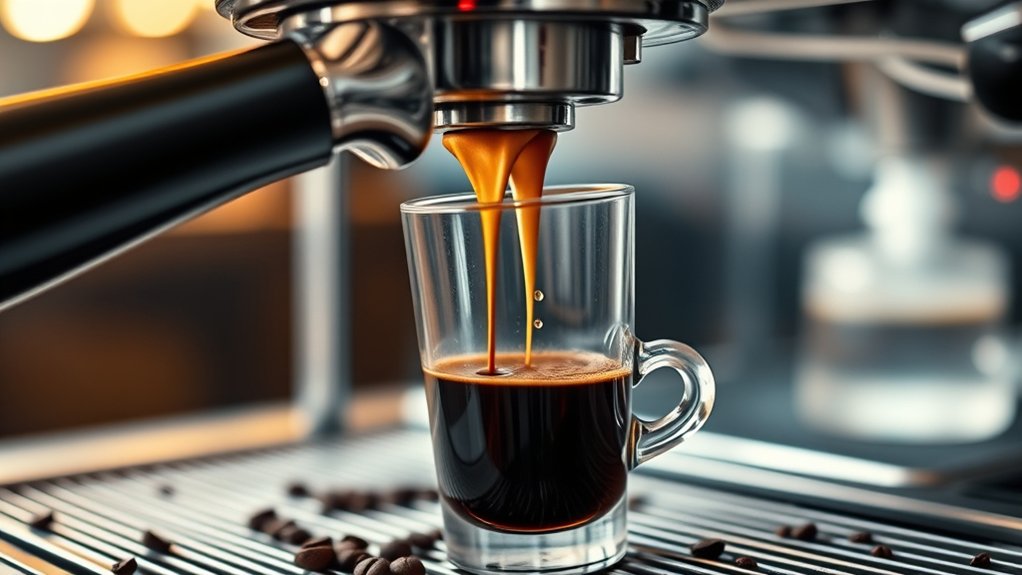
How do you know exactly when to stop your espresso shot? To consistently pull a perfect shot, you need to know when to stop by observing key signs that prevent over-extraction and bitterness. Aim for a double shot weighing 36-40 grams within 30-35 seconds.
Watch for blonding, the moment the espresso stream lightens, signaling extraction is almost done. Stop the shot when the flow becomes thin or watery to avoid a bad, bitter taste.
If shots run too fast or slow, adjust the grind size or tamping pressure to improve consistency.
- Target 36-40 grams in 30-35 seconds
- Look for blonding in the espresso stream
- Stop when flow thins or turns watery
- Taste regularly for signs of over-extraction
- Adjust grind size if shots extract too quickly or slowly
Taste And Adjust Your Espresso For Next Time
Why does your espresso taste the way it does right after brewing? It’s all about extraction and balance. Taste your espresso immediately to identify if it’s too sour, bitter, or just right.
If it’s sour, adjust by making your grind finer; if bitter, coarser. Keep an eye on brewing time. Aim for 25-30 seconds for a double shot to maintain consistency.
Experiment with different coffee beans and roasts, since freshness and type greatly influence flavor.
Use a scale to measure your coffee and water precisely; a typical brew ratio is 18 grams of coffee to 40 grams of water.
Frequently Asked Questions
Can I Use Pre-Ground Coffee for Espresso?
You can use pre-ground coffee for espresso, but it often lacks the ideal grind size and bean freshness needed for rich flavors.
Since grind size affects extraction time, your espresso might end up tasting flat.
Brewing temperature and tamping pressure also play important roles, so it’s best to use coffee labeled specifically for espresso.
For the best results, grind beans fresh to control these variables and bring out the full aroma and crema.
How Often Should I Descale My Espresso Machine?
You should descale your espresso machine every 1 to 3 months, depending on water hardness and usage.
Following the recommended descaling frequency keeps your machine’s brewing efficiency ideal and preserves espresso flavor.
Use descaling solutions made specifically for espresso machines to avoid damage.
Regular machine maintenance prevents mineral buildup that slows brewing and alters taste.
Always rinse thoroughly after descaling to guarantee no residue affects your coffee’s quality.
What Is the Best Water Type for Espresso?
The best water type for espresso balances mineral content, ensuring ideal espresso water quality. Filtered water typically outperforms tap due to reduced impurities, though some tap waters work if balanced.
Bottled water can be handy but check its pH balance and mineral levels.
Temperature impacts extraction, so your water should be between 90-96°C. Avoid overly soft or hard water; balanced minerals help flavor and crema, making each shot consistently excellent.
Can I Make Espresso With Non-Dairy Milk?
Yes, you can make espresso with non-dairy alternatives like oat, almond, or soy milk.
Focus on frothing techniques and choose barista-specific brand recommendations to get stable microfoam.
Keep an eye on the milk temperature, around 150°F, to avoid curdling and preserve flavor.
Experimenting with different options reveals unique tastes and health benefits.
Try what suits your palate and dietary needs best while enhancing your espresso experience.
How Do I Clean the Steam Wand Properly?
Imagine you’re a medieval alchemist, carefully tending your steam wand for perfect milk frothing. For proper steam wand maintenance, purge it right after use to clear milk residue.
Wipe with a damp cloth daily and soak the tip weekly in warm, mild detergent. Always dry it thoroughly and use a needle to clear clogs.
These cleaning techniques and maintenance tips guarantee your equipment care keeps your espresso game strong with consistent cleaning frequency.
Conclusion
So, you’ve mastered the art of espresso, and all it took was grinding beans just right, tamping like a pro, and timing your shot perfectly. No big deal, right? Who knew pulling a tiny cup of coffee could feel like rocket science?
But hey, that’s the charm of espresso: a simple pleasure wrapped in complex steps. Keep experimenting, and soon your espresso will be the only rocket fuel you need to launch your day.