How Long Does It Take To Make Coffee – Brewing Time Guide
Brewing coffee takes anywhere from 25 seconds to 12 minutes, depending on your method and grind size. Espresso is the quickest at about 30 seconds, while drip coffee can take up to 12 minutes.
Your grind size and coffee-to-water ratio shape extraction time and flavor. Finer grinds speed it up but can bring bitterness. Coarser grounds need longer brewing.
Getting your water temperature right and adjusting these factors leads to perfect coffee. Keep exploring to master your ideal brew.
How Long Does It Take To Brew Different Coffee Methods?
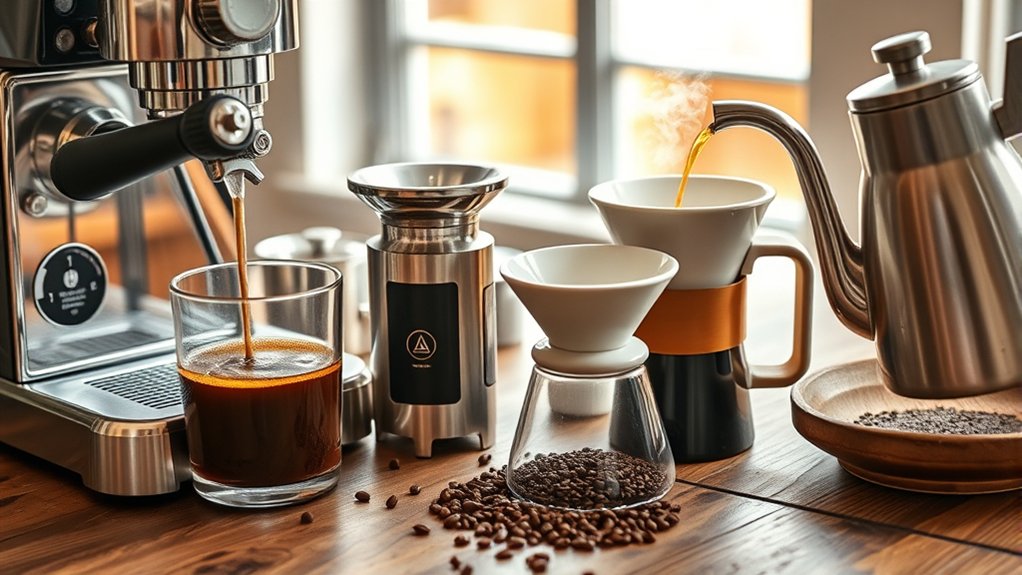
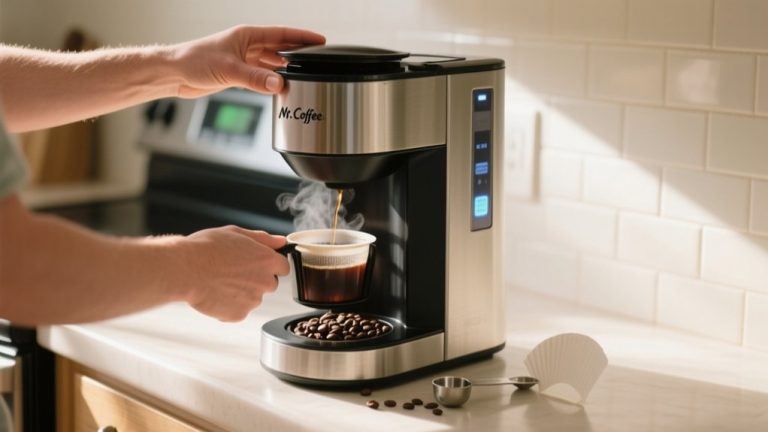
How long does it really take to brew the perfect cup of coffee? It depends on your method. Drip coffee demands a brewing time between 5 to 12 minutes, influenced by machine size and water temperature.
If you prefer a French press, expect a steeping brew time of 4 to 6 minutes to extract ideal flavor.
For a rich, full-bodied cup, steep your French press coffee for 4 to 6 minutes.
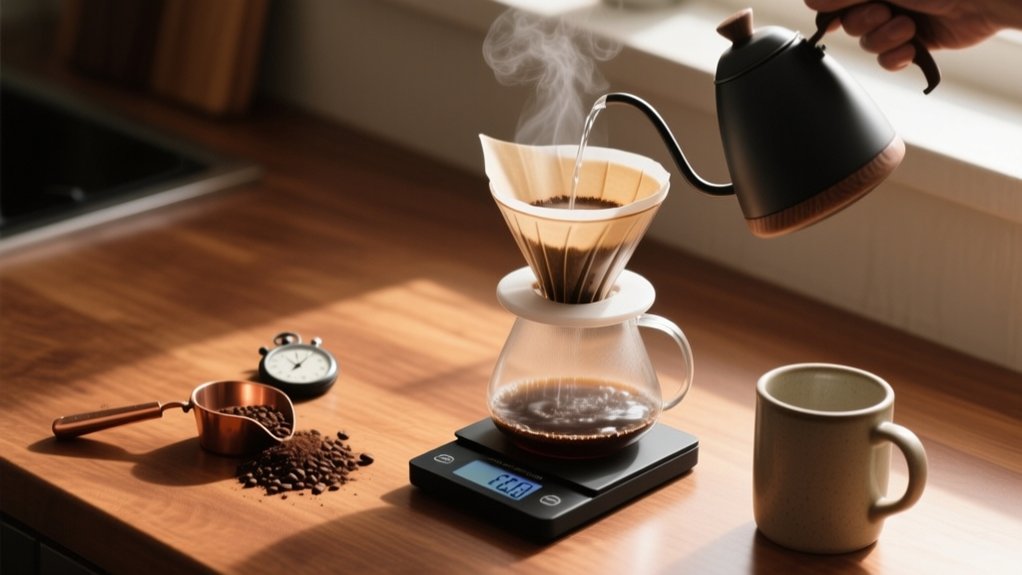
Pour-over coffee requires about 3 to 4 minutes, with careful, circular pouring for even saturation.
The AeroPress is quicker, with a brew time of 1 to 3 minutes, where fine grinds produce an espresso-like intensity.
Speaking of espresso, it’s the fastest, only 25 to 30 seconds under 9 bars of pressure.
Understanding each method’s brewing time helps you tailor your process for the perfect cup every time.
Why Brew Time Matters For Coffee Flavor
Because brew time directly controls extraction, it plays an essential role in shaping your coffee’s flavor profile. When water interacts with coffee grounds for the ideal 5 to 6 minutes, you extract balanced flavors, enhancing your coffee experience.
If you brew too quickly, under 3 minutes, you risk under-extraction, resulting in weak, sour notes. Conversely, brewing too long can over-extract bitter compounds, spoiling the cup.
Each brewing method demands its own ideal brew time, like 4-5 minutes for drip and 4-6 minutes for French press, to highlight distinct taste characteristics.
Pairing the right brew time with proper water temperature (195°F to 205°F) guarantees you reveal your coffee’s full potential, making every sip a deliberate, satisfying moment.
Mastering brew time is key to refining your coffee experience.
How Grind Size Changes Your Coffee Brew Time?
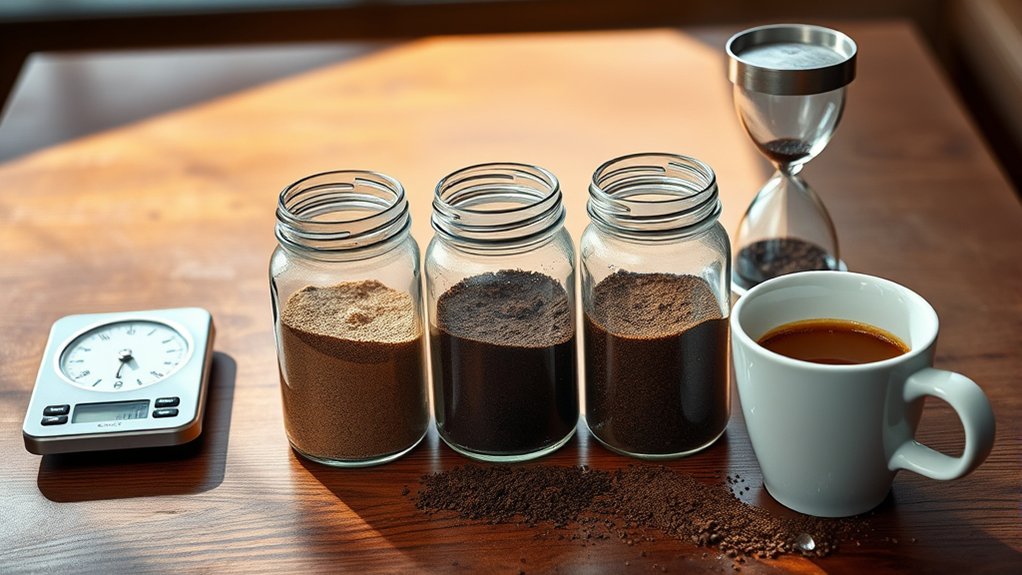
You’ll notice that grind size directly influences how quickly flavors extract from your coffee grounds.
So, you’ll need to adjust your brew time accordingly. Finer grinds speed up extraction, which means if you brew too long, your coffee might end up bitter.
On the other hand, coarser grinds need more time to bring out all their flavors.
Getting this balance right helps you tailor the brew to highlight the unique profile of your beans.
Impact On Extraction Rate
Although many factors affect coffee extraction, grind size plays a decisive role in defining brew time and flavor intensity. Finer coffee grounds expose more surface area to water, accelerating extraction and shortening brewing time.
For instance, espresso demands a fine grind to pull a rich shot in just 25-30 seconds. Conversely, coarser grounds slow extraction, requiring longer brew times, as seen in French press methods that steep for 4-6 minutes.
Medium grinds strike a balance, ideal for drip coffee’s 5-12 minute brewing time, ensuring even extraction without bitterness.
By adjusting grind size, you directly control how quickly flavors dissolve, allowing you to dial in the perfect strength and complexity.
Mastering this relationship is essential to crafting coffee that consistently delights your palate.
Brew Time Adjustments
When you adjust grind size, you directly control how long your coffee brews and how flavors develop. Finer grinds speed up extraction, ideal for espresso’s 25-30 second brew time, while coarser grinds suit longer steeping, like French press at 4-6 minutes.
Medium grinds balance brew time and extraction in drip coffee, usually 5-12 minutes, depending on water temperature and machine efficiency.
Pour-over calls for medium to medium-coarse grounds, with a 3-4 minute brew time for best results.
Making precise brew time adjustments by tweaking grind size helps you avoid over-extraction or bitterness, especially when balancing your coffee to water ratio.
Mastering grind size control lets you fine-tune brewing, ensuring every cup matches your desired strength and clarity.
Flavor Profile Variations
Mastering grind size doesn’t just control brew time; it shapes the entire flavor profile of your coffee. Finer grinds extract flavors rapidly, shortening brewing time but risking bitterness if steeped too long.
Medium grinds strike the perfect balance for drip coffee, requiring 5-12 minutes to develop nuanced flavor profile variations. Coarse grinds, ideal for French presses, allow a 4-6 minute steeping, producing a rich, full-bodied cup.
When you use a fine grind with an AeroPress, brewing time drops to 1-3 minutes, yielding a clean, vibrant taste.
Best Water Temperatures For Optimal Brew Time?
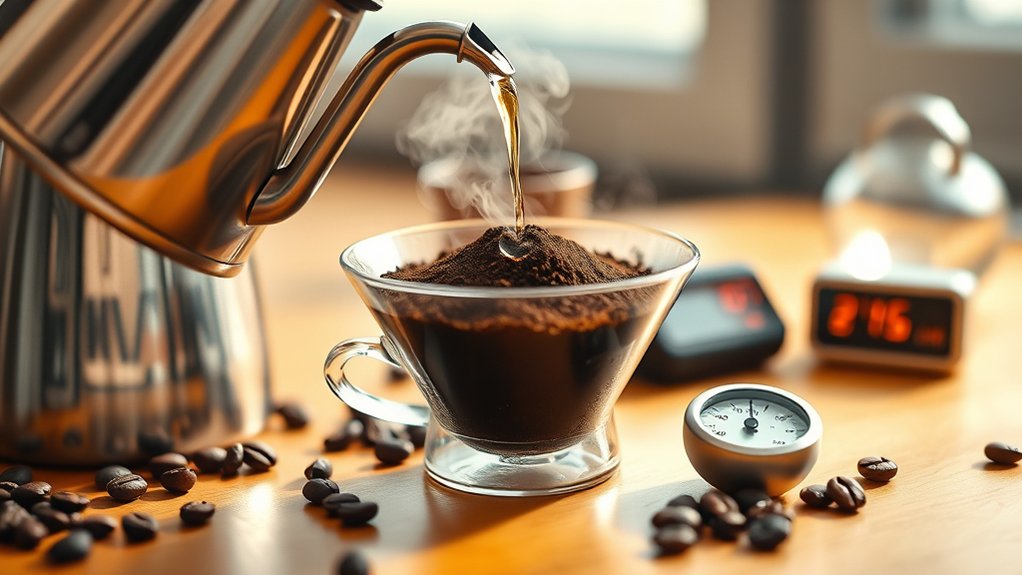
How hot should your water be to release the best flavors in your coffee? The ideal water temperature is essential for balanced coffee brewing. Too hot or too cold, and you risk ruining the profile. Here’s what you need to know:
- Use water between 195°F to 205°F for most methods like drip and French press to guarantee balanced extraction.
- For AeroPress, lower it to 175°F to 185°F to yield a clean, flavorful cup with low acidity.
- Avoid water above 205°F to prevent bitterness from over-extraction, and below 195°F to prevent weak, flat coffee.
Consistently maintaining the right water temperature maximizes your coffee’s flavor potential every time you brew.
How Coffee-To-Water Ratio Influences Brewing Time
You’ll find that adjusting the coffee-to-water ratio directly impacts extraction time and brew strength.
When you use more coffee, it slows down the water flow, which extends the brew time and makes the flavor more intense. On the other hand, using less coffee speeds up the extraction but can lead to under-extraction.
Getting this balance right is key.
Once you master it, you can tailor your brew’s profile exactly how you like it — with precision and passion.
Ratio Impact On Extraction
Anyone adjusting their coffee-to-water ratio quickly realizes how pivotal this balance is to both flavor and brew time. The ratio directly impacts extraction efficiency, affecting how compounds dissolve and develop in your cup.
A stronger coffee-to-water ratio, such as 1:15, demands a slightly longer brew time to fully extract robust flavors, while a milder 1:17 ratio requires less time to avoid over-extraction.
Keep these key points in mind:
- Higher coffee concentration extends brew time for balanced extraction.
- Lower coffee concentration shortens brew time, preventing bitterness.
- Consistency in ratio guarantees predictable extraction and flavor stability.
Mastering this interplay lets you tailor your brew precisely, optimizing both strength and timing for your perfect cup.
Strength Versus Brew Time
Although adjusting your coffee-to-water ratio might seem straightforward, it directly shapes both the strength of your brew and the ideal brewing time. A higher ratio yields stronger coffee, demanding shorter brew time to prevent bitterness.
Conversely, a lower ratio produces milder coffee, requiring longer extraction. Remember, grind size also plays a role, so you’ll need to balance all variables carefully.
| Coffee-to-Water Ratio | Brew Time |
|---|---|
| 1:15 | 2.5 – 3 minutes |
| 1:16 | 3 – 3.5 minutes |
| 1:17 | 3.5 – 4 minutes |
| Higher (>1:15) | Shorter brew time |
| Lower (<1:17) | Longer brew time |
Mastering this balance lets you craft coffee precisely how you like it.
Adjusting Ratio For Flavor
When you adjust the coffee-to-water ratio, you directly influence both flavor intensity and brewing time. This makes it a powerful tool to tailor your cup. The ideal ratio usually falls between 1:15 and 1:17, balancing extraction and flavor.
Increasing coffee concentration boosts strength but demands longer brew time to extract fully. Conversely, a lower ratio yields milder coffee with shorter brew time.
Focus on these key points:
- A 1:16 ratio suits drip coffee; a 1:12 ratio delivers espresso-like boldness.
- Higher coffee-to-water ratios extend brew time for complete flavor development.
- Experimenting lets you customize flavor profiles to your taste and desired strength.
How To Troubleshoot Common Brew Time Issues
If your coffee isn’t brewing just right, adjusting your steeping time and grind size can make all the difference. Overly bitter coffee often signals over-extraction. Reduce brewing time or switch to coarser ground coffee, especially with a French Press.
Weak brews benefit from more coffee or longer steeping, balancing the coffee-to-water ratio. Grounds in your cup? Coarser grind is essential for proper filtration. Slow drip? Check water temperature and clean your coffee maker to avoid scale buildup.
| Issue | Solution |
|---|---|
| Bitter taste | Shorten brewing time, coarser grounds |
| Weak coffee | Increase coffee amount, extend brewing time |
| Grounds in cup | Use coarser ground coffee |
Fine-tuning these factors guarantees best flavor extraction every time.
Tips To Speed Up Or Slow Down Your Brew
Mastering the pace of your brew can transform your coffee experience, whether you want to speed things up or slow them down.
Adjusting brewing time in coffee makers is key to perfect extraction and flavor balance. Here’s how to control it effectively:
For drip coffee makers, keep water temperature between 195-205°F and use a medium grind to hit the ideal 5-6 minute brew time without bitterness.
In a French press, shorten steeping to about 3 minutes for a cleaner, less intense cup.
With an AeroPress, use a fine grind and lower water temperature (175-185°F) to brew in just 1-3 minutes.
These precise tweaks help you tailor your coffee’s strength and clarity by managing brewing time expertly.
How To Choose Brew Time That Suits Your Taste
Adjusting brew time isn’t just about technique; it’s about tuning your coffee to match your personal taste.
To craft the perfect cup, you need to understand how brewing time influences flavor.
For drip coffee, aim for 5-6 minutes to balance extraction without bitterness. If you prefer a French press, steep for about 4 minutes but feel free to adjust for strength.
Pour-over lovers should target 3-4 minutes to highlight bright, nuanced flavors.
AeroPress offers flexibility. One to three minutes lets you choose between espresso-like intensity or a regular brew.
Espresso demands precision: 25-30 seconds extraction prevents bitterness.
Experiment with these brewing times to find what pleases your palate, ensuring every cup you make aligns perfectly with your taste.
Frequently Asked Questions
Can Brew Time Affect the Caffeine Content in Coffee?
Yes, brew time greatly affects caffeine extraction in your coffee. Different brewing methods, like French Press or drip, use 4-6 minutes to maximize caffeine without bitterness.
Espresso, though quicker, concentrates caffeine per ounce differently. If you steep too long, you risk extracting unwanted compounds that mask caffeine’s effects.
Does Altitude Impact Coffee Brewing Time?
Yes, altitude impacts coffee brewing time by creating a paradox: water boils faster yet extracts flavors slower.
You’ll need to adjust your brewing techniques because the lower boiling point at higher elevations means water’s temperature drops. This slows extraction despite quicker brewing cycles.
This altitude effect challenges you to tweak grind size and steeping duration meticulously, ensuring your coffee remains rich and balanced even when the environment isn’t cooperating.
How Does Water Hardness Influence Brew Time?
Water hardness directly affects your brew time because minerals in water alter extraction efficiency. Hard water slows extraction, so you’ll need a longer brewing time or higher brewing temperature to balance flavor.
Soft water extracts quickly but risks a weaker taste.
To optimize your coffee, focus on water quality and maintain your equipment regularly. This guarantees consistent brewing temperature and prevents scale buildup, preserving both taste and ideal brew time.
Is There an Ideal Brew Time for Cold Brew Coffee?
You want smooth, you want rich, and you want balanced. So your ideal brew time for cold brew coffee is typically 12 to 24 hours.
Master cold brew ratios by using 1:4 to 1:8 coffee to water, adjusting strength to your taste.
Perfect your steeping techniques with coarse grounds and cold water to avoid bitterness.
Stick to this window, and you’ll reveal a mellow, flavorful cup every time.
Can Coffee Bean Freshness Change Brewing Duration?
Yes, coffee bean freshness directly impacts brewing duration. As coffee bean aging progresses, moisture decreases, altering extraction rates.
You’ll notice fresher beans extract flavors more quickly and consistently, which enhances brewing consistency. Stale beans require longer brewing to compensate for chemical changes, risking over-extraction.
To nail your brew time, always adjust based on freshness, grind size, and exposure to oxygen.
Mastering this guarantees your coffee’s flavor shines every time you brew.
Conclusion
Mastering your coffee brew time is like conducting a symphony. Each element plays a crucial role in crafting the perfect cup.
By understanding how grind size, water temperature, and coffee-to-water ratio interact, you take control of your flavor masterpiece. Don’t hesitate to adjust and experiment. Your ideal brew time is a personal journey.
Embrace the process with precision and passion, and every sip will reward you with coffee brewed just right.